How to do Tadabbur of Quran,Spiritual and intellectual?
I was reading a wonderful book, “Bridges translation of the Ten Qirat of the Noble Quran” I drew a lesson on the manner of doing Tadabbur of Quran which I want to share here.
Tadabbur of the Qur’an: Spiritual and Intellectual Reflections
Tadabbur meaning: Tadabbur is the act of deeply reflecting upon the Qur’an,
Tadabbur holds profound importance for any believer. The Qur’an repeatedly calls upon its readers to ponder its verses, an invitation that leads to two essential types of reflection: spiritual Tadabbur and intellectual Tadabbur. Both are critical for engaging with the Qur’an on a personal and deeper level, helping the heart and mind benefit from the timeless guidance of Allah.
Spiritual Tadabbur: Engaging the Heart
Spiritual Tadabbur is mentioned in the Qur’an in the following verse:
“Will they not ponder the Qur’an, or are there locks upon their hearts?” (Qur’an 47:24)
This type of reflection touches the core of one’s heart, invoking feelings of submission, gratitude, and reverence towards Allah’s words. Spiritual Tadabbur is about letting the Qur’an guide the heart’s emotions, aligning the reader’s feelings with the teachings of Allah. It is more than just reading the text—it involves feeling the text, allowing the Qur’an to open one’s heart and shape one’s inner world.
Allah describes the behavior of the true believers, the servants of the All-Merciful, as those who engage emotionally with the revelations:
“And they are those who, when reminded of the signs of their Lord, do not fall before them deaf and blind.” (Qur’an 25:73)
Here, the believers are portrayed as actively responding to Allah’s signs with their hearts and souls. They are not passive but are deeply moved by the message.
Practicing Spiritual Tadabbur
Spiritual Tadabbur can be a powerful tool in a believer’s relationship with the Qur’an. The key is in connecting the verses to one’s own life. For instance:
- When the Qur’an mentions rewards or the blessings of Allah, ask Allah to grant them to you with sincerity.
- When it mentions punishment or anger, seek Allah’s forgiveness and protection.
- When the righteous are mentioned, pray to be counted among them.
- When the hypocrites or wrongdoers are described, ask Allah to protect you from their traits.
Thus, every verse can be turned into a du’aa (prayer), making the Qur’an not just a book to be read but an ongoing dialogue with Allah, where you actively seek His mercy, guidance, and protection.
Intellectual Tadabbur: Engaging the Mind
On the other hand, intellectual Tadabbur involves a more analytical approach, requiring the mind to reflect on the wisdom and structure of the Qur’an. This is illustrated in the verse:
“Do they not ponder the Qur’an? For had it been from any other than Allah, they would have found in it much discrepancy.” (Qur’an 4:82)
In intellectual Tadabbur, one critically examines the meanings, the connections between verses, and the underlying messages. It involves understanding the divine wisdom behind every word, every shift in tense, and every structure within the text. Intellectual Tadabbur requires one to approach the Qur’an humbly as a student eager to learn, knowing that there is wisdom in every aspect of the revelation.
Example of Intellectual Tadabbur
Consider this verse:
“Say, ‘O Allah, Master of the dominion, You grant dominion to whomever You will and You strip dominion from whoever You will; You honor whomever You will and You humiliate whomever You will; in Your hand is all goodness. You are indeed All-Powerful over everything.” (Qur’an 3:26)
At first glance, a reader might think the repetition of “whomever You will” four times is unnecessary. But upon deeper reflection, one understands that this structure separates dominion from honor. A person may have authority but not be honored, while another may lose authority yet still be honored. The repetition emphasizes that Allah’s will is supreme in all matters, independent of human perceptions of power and status.
Similarly, the Qur’an often uses shifts in tenses and pronouns, which invite deeper reflection. For example, in the verse:
“Is someone who relies on evident proof from his Lord like someone the evil of whose work was adorned for him? And they followed their own whims.” (Qur’an 47:14)
The shift from singular to plural in “they followed their own whims” might seem sudden. But upon reflection, one realizes that this is to convey that the person who was deceived by his own evil was not a victim but was part of a group of people who consciously chose to follow their whims. The shift in pronouns highlights personal accountability within a collective disobedience.
Connecting Verses and Surahs
Another important tool of intellectual Tadabbur is recognizing the connections between verses, between the beginning and the end of a surah, and even between different surahs. For instance, the last verse of Surah Al-Isra (17) ends with:
“And say, ‘All praise be to Allah, Who has not taken any offspring, nor has He ever had an associate in the dominion, nor has He ever had an ally out of humbleness. And glorify Him constantly.’” (Qur’an 17:111)
While the first verse of the next surah, Surah Al-Kahf (18), begins with:
“All praise be to Allah, Who sent down the Scripture upon His servant and has not made therein any crookedness.” (Qur’an 18:1)
Both verses begin with praising Allah, demonstrating how the surahs are interconnected, continuing a theme of divine praise and perfection.
Conclusion
Tadabbur of the Qur’an, both spiritual and intellectual, enriches a believer’s understanding and experience of the divine message. Spiritual Tadabbur engages the heart, transforming verses into heartfelt prayers. Intellectual Tadabbur challenges the mind, urging believers to reflect on the wisdom behind the structure and language of the Qur’an.
Both types of Tadabbur are essential for a holistic engagement with the Qur’an. By practicing these reflections, a believer can unlock the profound depth of the Qur’an, transforming it from a text to be read into a living guide for both the heart and the mind.
Book- How to do Tadabbur of Quran-Bridges translation of the Ten Qirat of the Noble Quran” – Available in Amazon
This book is written by Fadel Soliman studied the Qira’at of the Qur’an and was licensed to recite and teach the Warsh narration by Dr. Abbas Anwar Al-Masry with a chain of narration to prophet Muhammad (peace be upon him). He has a master’s degree in Sharia with a specialization in de-radicalization, comparative religion, and theology. He is a member of the Egyptian Supreme Council of Islamic Affairs and the International Union of Muslim Scholars, as well as an adviser for the European Muslim League.
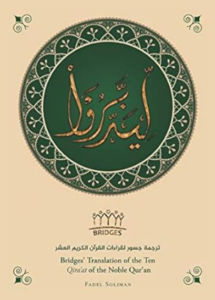
1. It is the first translation which includes the ten Qira’at (modes of recitation). The main text is written in accordance with the Qira’a of ʻAsem, narrated by Hafs. Variations from that are presented in footnotes denoted by ‘Q’. The translation presents around 30% of the variations of the Qira’at—those which affect the meaning.
2. It is the first translation that takes into consideration the Qur’anic phenomenon of grammatical shifts, whether in verb tenses, numbers, or pronouns. These are a great source of pondering for the reader.
3. To denote whether a pronoun like ‘you’ or an imperative verb like ‘say’ is plural, dual, or singular, the translators did not impose their understanding on the reader by adding text between brackets like (O Prophet) to denote singular form, or (O mankind) to denote plural form. Rather, this distinction was achieved by adding a superscript after pronouns and imperative verbs. For example: youpl is used for a plural pronoun, yousg for a singular pronoun, and youdl for a dual pronoun.
Written by

Ustadha Fahmina holds a Sanad in Alimiyyah (6-year Dars-e-Nizami) from two recognized Islamic institutes and a Master's degree in Arabic . She teaches Qur'an, Tafsir, Hadith, and Fiqh following the Hanafi school within Ahl al-Sunnah wal Jama'ah. She founded Islam Hashtag in 2015 to bring authentic Islamic learning to Muslim families online. She also holds a degree in Optometry and is the founder of Optometryskills.com.
Discover more from Islam Hashtag
Subscribe to get the latest posts sent to your email.