The Length of hair of Rasul Allah Muhammad Sallalahu alaihe wa sallam
The saheeh reports indicate that hair of prophet Muhammad Rasul Allah Muhammad Sallalahu alaihe wa sallam came to halfway down his ears; according to one report it reached his earlobes, and according to other reports it came between his earlobes and his shoulders, or it came down to his shoulders.
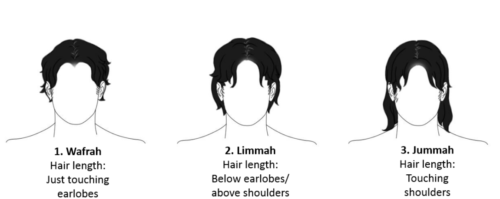
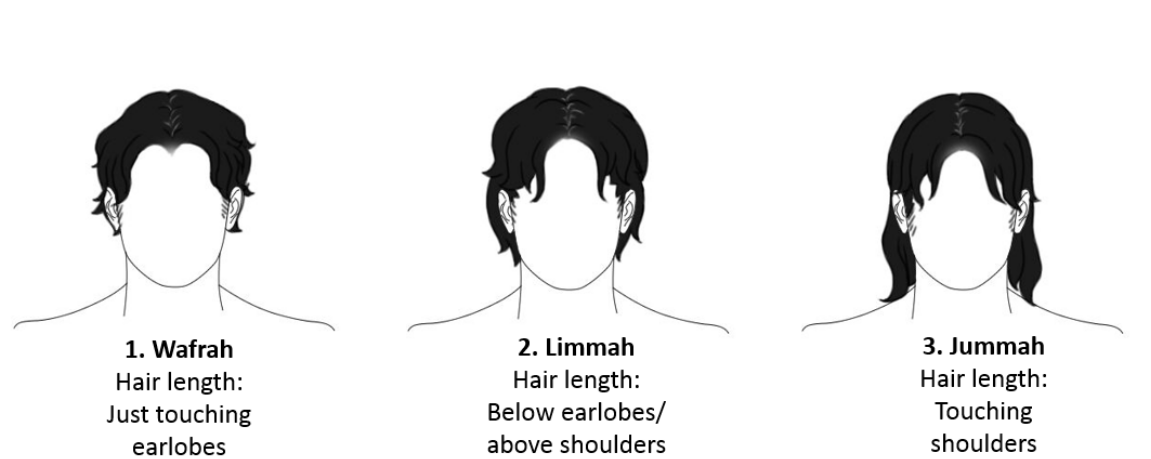
3 types of hair on basis of length
- Jumma-when hair touch shoulders
- Limma-below earlobe, above shoulder
- Wufra– just touch earlobe
كَانَ شَعَرُ رَسُولِ اللهِ صلى الله عليه وسلم إِلَى نِصْفِ أُذُنَيْهِ.
Anas ibn Malik said:”The hair of Allah’s Messenger (Allah bless him and give him peace) came down to the middle of his ears.”(Shamail Muhammadiya :24)
حَدَّثَنَا هَنَّادُ بْنُ السَّرِيِّ، قَالَ: أَخْبَرَنَا عَبْدُ الرَّحْمَنِ بْنُ أَبِي الزِّنَادِ، عَنْ هِشَامِ بْنِ عُرْوَةَ، عَنْ أَبِيهِ، عَنْ عَائِشَةَ، قَالَتْ: كُنْتُ أَغْتَسِلُ أَنَا وَرَسُولُ اللهِ صلى الله عليه وسلم مِنْ إِنَاءٍ وَاحِدٍ، وَكَانَ لَهُ شَعَرٌ فَوْقَ الْجُمَّةِ، وَدُونَ الْوَفْرَةِ.
A’isha ra said:”I used to perform the major ritual ablution, I and Allah’s Messenger (Allah bless him and give him peace) from a single basin, and he had hair above the shoulder level and below the earlobes.”(Shamail Muhammadiya :25)
حَدَّثَنَا مُحَمَّدُ بْنُ بَشَّارٍ، قَالَ: حَدَّثَنَا وَهْبُ بْنُ جَرِيرِ بْنِ حَازِمٍ، قَالَ: حَدَّثَنِي أَبِي، عَنْ قَتَادَةَ، قَالَ: قُلْتُ لأَنَسٍ: كَيْفَ كَانَ شَعَرُ رَسُولِ اللهِ صلى الله عليه وسلم؟ قَالَ: لَمْ يَكُنْ بِالْجَعْدِ، وَلا بِالسَّبْطِ، كَانَ يَبْلُغُ شَعَرُهُ شَحْمَةَ أُذُنَيْهِ.
Qatada said:“I said to Anas: ‘How was the hair of Allah’s Messenger (Allah bless him and give him peace)?’ He replied: ‘It was neither crisply curled nor lank. His hair used to reach the lobes of his ears’.”(Shamail Muhammadiya :27)
Reference : Sunnah.com
Also read : 40 hadith on Description of Prophet Muhammad sallalahu alaihe wa sal;lam
The Length of Prophet Muhammad’s (ﷺ) Hair: Understanding Jumma, Limma, and Wafra
When Muslims study the Shama’il — the physical description and character of Prophet Muhammad ﷺ — one of the recurring details in the hadith literature concerns something deceptively simple: how long was his hair? At first glance, the various narrations seem to disagree. Some say his hair reached his earlobes. Others say it reached his shoulders. Still others describe something in between. Understanding why these reports differ — and what the three Arabic terms jumma, limma, and wafra actually mean — gives us a much richer, and more accurate, picture of the Prophet’s ﷺ appearance than a single soundbite can.
Why the Hadith Reports Seem to Differ
The Prophet ﷺ lived for over sixty years, and his Companions described him at different points in his life, after different grooming routines, and in different seasons. His hair was naturally wavy rather than straight or tightly curled, and wavy hair changes appearance considerably depending on whether it has just been washed and combed, or left to dry and settle over several days.
Hadith commentators such as Ibn Hajar al-‘Asqalani, in his famous commentary on Sahih al-Bukhari (Fath al-Bari), addressed this apparent contradiction directly. His explanation, echoed by later scholars, is that immediately after the Prophet ﷺ oiled and combed his hair, it would hang down closer to his shoulders. As days passed and the hair dried out and curled again, it would draw back up toward his earlobes. Companions who saw him on different occasions were simply each reporting what they personally witnessed — and every report was true for that moment.
The Core Hadith Evidence
A cluster of authentic (sahih) narrations, collected in works such as Imam al-Tirmidhi’s Shama’il al-Muhammadiyyah and in the primary hadith collections of Bukhari and Muslim, describe the length of the Prophet’s ﷺ hair from several angles:
- Anas ibn Malik (RA) reported that the Prophet’s ﷺ hair reached halfway down his ears.
- A’isha (RA), describing bathing from the same vessel as the Prophet ﷺ, said his hair was longer than what is called jumma but shorter than wafra — that is, of a medium length, neither notably short nor notably long.
- Qatada, narrating from Anas (RA), asked him directly how the Prophet’s ﷺ hair was. Anas replied that it was neither tightly curled nor straight and lank, and that it reached the lobes of his ears.
- Al-Bara ibn ‘Azib (RA), one of the most frequently cited narrators on the Prophet’s ﷺ physical description, said the Prophet ﷺ was of moderate height with broad shoulders, and that his hair reached his earlobes — adding that he never saw anyone more handsome, especially when the Prophet ﷺ wore a red cloak. This narration is recorded in Sahih al-Bukhari.
- Anas ibn Malik (RA), in another well-known narration, is recorded as saying the Prophet’s ﷺ hair used to hang down to his shoulders — a report found in Sahih al-Bukhari.
- Umm Hani (RA) narrated that on the day of the conquest of Makkah, the Prophet ﷺ had his hair styled in four braided locks.
| Narrator | Report | Source & Number |
|---|---|---|
| Anas ibn Malik (RA) | Hair reached halfway down his ears | Shama’il al-Muhammadiyyah (Tirmidhi), Hadith 24 |
| A’isha (RA) | Hair was above jumma, below wafra (medium length) | Shama’il al-Muhammadiyyah (Tirmidhi), Hadith 25 |
| Qatada, narrating from Anas (RA) | Neither curly nor straight; reached earlobes | Shama’il al-Muhammadiyyah (Tirmidhi), Hadith 27 |
| Al-Bara ibn ‘Azib (RA) | Moderate height, broad shoulders, hair reaching earlobes, red cloak | Sahih al-Bukhari 3401 and 3551; Sahih Muslim 2337a |
| Al-Bara ibn ‘Azib (RA) | Same report (parallel chain) | Sunan Abu Dawud 4072; Sunan an-Nasa’i 5232; Musnad Ahmad 18473 |
| Anas ibn Malik (RA) | Hair used to hang down to his shoulders | Sahih al-Bukhari 5904 |
| braided locks at the Conquest of Makkah | Shama’il al-Muhammadiyyah (Tirmidhi), roughly the section on hairstyles (commonly cited around p.44 in print editions; exact numbering varies by edition/translation) |
Taken together, these narrations are not contradictory reports competing for accuracy — they are complementary snapshots of the same hair at different stages between haircuts and grooming sessions.
The Three Classifications: Jumma, Limma, and Wafra
Arabic possessed precise vocabulary for men’s hair length, and classical scholars used three specific terms to categorize where the Prophet’s ﷺ hair fell on this spectrum. It’s worth noting that different commentators order and define these terms slightly differently, but the most widely cited framework is as follows:
| Term | Arabic | Length Description |
|---|---|---|
| Wafra (وَفْرَة) | Shortest of the three | Hair that reaches only to the earlobe |
| Limma (لِمَّة) | Middle length | Hair that falls below the earlobe but does not reach the shoulders |
| Jumma (جُمَّة) | Longest of the three | Hair that reaches down to the shoulders |
Some commentaries reverse the middle two labels (calling the shoulder-length hair “jumma” and the intermediate hair “wafra” or vice versa), which is precisely why you will find slightly different orderings across different Islamic websites and translated hadith commentaries. What all scholars agree on, however, is the underlying picture: the Prophet’s ﷺ hair, across the full body of authentic narrations, ranged somewhere between earlobe-length and shoulder-length, and never went beyond the shoulders or into the extremely short “buzzed” styles common in some other cultures.
Reconciling the Reports on Hair of Prophet Muhammad ﷺ: One Description, Multiple Moments
Rather than trying to determine which single hadith is “the correct one” and which are mistaken, the classical scholarly approach — following Ibn Hajar and other muhaddithun — is to accept all of these authentic narrations as accurate descriptions of real moments:
- Freshly groomed — after oiling, combing, and sometimes braiding, the hair would fall to shoulder length (jumma).
- A middle stage — as a few days passed, the hair would settle to a length below the earlobe but above the shoulder (limma), which A’isha (RA) described as the Prophet’s ﷺ typical, most commonly observed state.
- Before the next grooming — as the wavy hair dried and curled further, it would draw up to just touch the earlobe (wafra).
This is why A’isha’s (RA) narration is often treated as the most representative “default” description — she had the most consistent, everyday access to observe him ﷺ — while Anas’s (RA) and al-Bara’s (RA) reports capture him at other points in this natural cycle.
What This Teaches Us
Beyond satisfying historical curiosity, this small detail from the Shama’il carries a few broader lessons:
- The Prophet ﷺ groomed himself and took care of his appearance. Oiling, combing, and even braiding the hair were part of his regular practice, showing that personal grooming and cleanliness are part of the Sunnah, not opposed to piety.
- Moderate hair length was his norm. He did not keep his hair extremely short nor let it grow excessively long past the shoulders, modeling a middle path (a recurring theme across many aspects of his character and practice).
- Precision in hadith transmission. The Companions were careful enough in their descriptions that later scholars could reconcile seemingly different reports into a single, coherent, non-contradictory picture — a testament to the rigor of the hadith sciences.
A Note on Sources
The hadiths referenced above are drawn primarily from Shama’il al-Muhammadiyyah of Imam al-Tirmidhi, and from Sahih al-Bukhari and Sahih Muslim, with explanatory notes drawing on classical commentaries such as Ibn Hajar al-‘Asqalani’s Fath al-Bari. As with any hadith-based topic, readers are encouraged to consult qualified scholars of hadith and seerah for deeper study, since translations and secondary summaries — including this article — are no substitute for engaging with the original Arabic texts and their chains of narration (isnad).
Wallahu a’lam (and Allah knows best).
Written by

Ustadha Fahmina holds a Sanad in Alimiyyah (6-year Dars-e-Nizami) from two recognized Islamic institutes and a Master's degree in Arabic from Indira Gandhi National University. She teaches Qur'an, Tafsir, Hadith, and Fiqh following the Hanafi school within Ahl al-Sunnah wal Jama'ah. She founded Islam Hashtag in 2015 to bring authentic Islamic learning to Muslim families online. She also holds a degree in Optometry and is the founder of Optometryskills.com.
Discover more from Islam Hashtag
Subscribe to get the latest posts sent to your email.