Last updated:
Last two ayats of Surah Baqarah hadith
Surah Baqarah last 2 Ayah
Abu Umama said he heard Allah’s Messenger (ﷺ) say:
Recite the Qur’an, for on the Day of Resurrection it will come as an intercessor for those who recite It. Recite the two bright ones, al-Baqara and Surah Al ‘Imran, for on the Day of Resurrection they will come as two clouds or two shades, or two flocks of birds in ranks, pleading for those who recite them. Recite Surah al-Baqara, for to take recourse to it is a blessing and to give it up is a cause of grief, and the magicians cannot confront it. (Mu’awiya said: It has been conveyed to me that here Batala means magicians.)
Sahih Muslim
Transliteration of Surah Baqarah last 2 Ayah
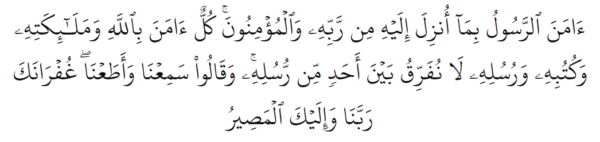
Aamanar-Rasoolu bimaaa unzila ilaihi mir-Rabbihee walmu’minoon; kullun aamana billaahi wa Malaaa’ikathihee wa Kutubhihee wa Rusulihee laa nufarriqu baina ahadim-mir-Rusulih wa qaaloo sami’naa wa ata’naa ghufraanaka Rabbanaa wa ilaikal-maseer
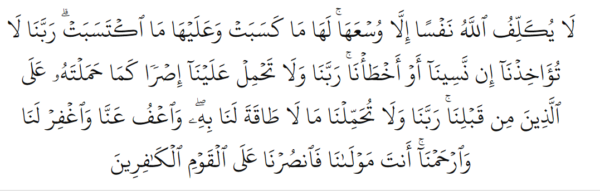
Laa yukalliful-laahu nafsan illaa wus’ahaa; lahaa maa kasabat wa ‘alaihaa maktasabat; Rabbanaa laa tu’aakhiznaaa in naseenaaa aw akhtaanaa; Rabbanaa wa laa tahmil-‘alainaaa isran kamaa hamaltahoo ‘alal-lazeena min qablinaa; Rabbanaa wa laa tuhammilnaa maa laa taaqata lanaa bih; wa’fu ‘annaa waghfir lanaa warhamnaa; Anta mawlaanaa fansurnaa ‘alal qawmil kaafireen (section 40)
Sahih International translation of Surah Baqarah last 2 Ayah:
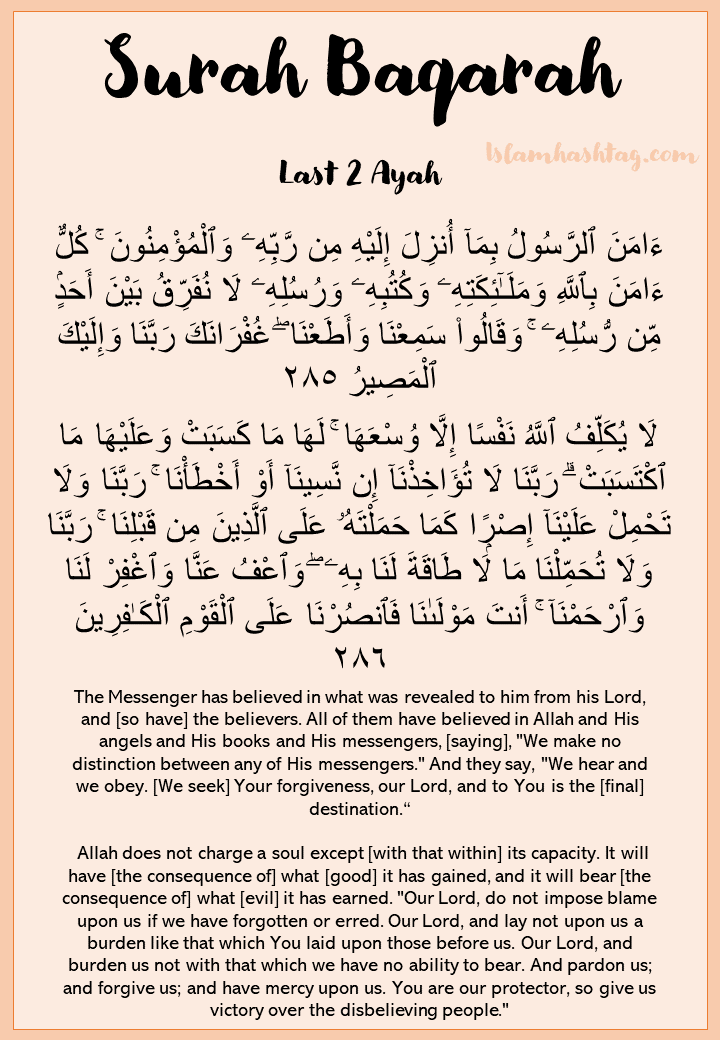
The Messenger has believed in what was revealed to him from his Lord, and [so have] the believers. All of them have believed in Allah and His angels and His books and His messengers, [saying], “We make no distinction between any of His messengers.” And they say, “We hear and we obey. [We seek] Your forgiveness, our Lord, and to You is the [final] destination.”
Allah does not charge a soul except [with that within] its capacity. It will have [the consequence of] what [good] it has gained, and it will bear [the consequence of] what [evil] it has earned. “Our Lord, do not impose blame upon us if we have forgotten or erred. Our Lord, and lay not upon us a burden like that which You laid upon those before us. Our Lord, and burden us not with that which we have no ability to bear. And pardon us; and forgive us; and have mercy upon us. You are our protector, so give us victory over the disbelieving people.”
Virtue of Surah Baqarah last 2 Ayah
Surah Al-baqarah has enormous value and great rewards for us in this life and the next. According to Hadith, the last verses of Surah Al-Baqarah are one of the gifts bestowed upon our Prophet (S.A.W.) during the Night Journey (Shab-e-Meraaj):
“When Allah’s Messenger (S.A.W.) was taken on the Night Journey. He stated: “It was gold moths. And three things were given to me: the five daily prayers, the last verses of Surah Al-Baqarah, and whoever of my Ummah die without associating anything with Allah will be forgiven for Al-Muqhimat.”
(Sunan An-Nisai: 452)
Feel Free to download the Surah Baqarah last 2 Ayah poster.
The Qur’anic Foundation: Surah al-Baqarah 2:285–286
The two verses in question are the closing verses of the longest surah of the Qur’an:
٢:٢٨٥ آمَنَ الرَّسُولُ بِمَا أُنزِلَ إِلَيْهِ مِن رَّبِّهِ وَالْمُؤْمِنُونَ ۚ كُلٌّ آمَنَ بِاللَّهِ وَمَلَائِكَتِهِ وَكُتُبِهِ وَرُسُلِهِ لَا نُفَرِّقُ بَيْنَ أَحَدٍ مِّن رُّسُلِهِ ۚ وَقَالُوا سَمِعْنَا وَأَطَعْنَا ۖ غُفْرَانَكَ رَبَّنَا وَإِلَيْكَ الْمَصِيرُ
٢:٢٨٦ لَا يُكَلِّفُ اللَّهُ نَفْسًا إِلَّا وُسْعَهَا ۚ لَهَا مَا كَسَبَتْ وَعَلَيْهَا مَا اكْتَسَبَتْ ۗ رَبَّنَا لَا تُؤَاخِذْنَا إِن نَّسِينَا أَوْ أَخْطَأْنَا ۚ رَبَّنَا وَلَا تَحْمِلْ عَلَيْنَا إِصْرًا كَمَا حَمَلْتَهُ عَلَى الَّذِينَ مِن قَبْلِنَا ۚ رَبَّنَا وَلَا تُحَمِّلْنَا مَا لَا طَاقَةَ لَنَا بِهِ ۖ وَاعْفُ عَنَّا وَاغْفِرْ لَنَا وَارْحَمْنَا ۚ أَنتَ مَوْلَانَا فَانصُرْنَا عَلَى الْقَوْمِ الْكَافِرِينَ
In meaning, the first verse is a declaration of īmān (belief in Allah ﷻ, His angels, books, and messengers) closing with the believers’ pledge of hearing and obeying. The second affirms the principle of taklīf bi-qadr al-wus’ (that Allah ﷻ does not burden a soul beyond its capacity) and then turns into a sustained supplication. This structure matters for what follows: these are verses that are at once creed and du’ā’, which is relevant both to the hadith’s explanation and to certain fiqh questions discussed below.
The supplications of 2:286 also carry their own prophetic confirmation. In Sahih Muslim 125 (from Abu Hurayrah, may Allah be pleased with him) and Sahih Muslim 126 (from Ibn ‘Abbas, may Allah be pleased with him), when the Companions were distressed by the verse before it (2:284) and the later words of this supplication were revealed, Allah ﷻ answered each petition with “qad fa’altu” (“I have done so”). The commentators understand this as the reason these verses came to be regarded as a du’ā’ already answered.
The Core Hadith: “Kafatahu” in the Two Sahihs
The central narration is from Abu Mas’ud ‘Uqbah ibn ‘Amr al-Badri al-Ansari (may Allah be pleased with him), who reported that the prophet ﷺ said:
مَنْ قَرَأَ بِالْآيَتَيْنِ مِنْ آخِرِ سُورَةِ الْبَقَرَةِ فِي لَيْلَةٍ كَفَتَاهُ
“Whoever recites the last two verses of Surat al-Baqarah at night, they will suffice him.”
Where it is recorded:
- Sahih al-Bukhari 5009 (Kitab Fada’il al-Qur’an, chapter on the excellence of Surat al-Baqarah), and also Sahih al-Bukhari 5008, 4008, and 5051 in other chapters
- Sahih Muslim 807 (numbering varies slightly by edition; some print it as 808)
- Sunan Abi Dawud 1397
- Jami’ al-Tirmidhi 2881, where Imam al-Tirmidhi calls it hasan sahih
- Sunan Ibn Majah 1368
- Sunan al-Nasa’i al-Kubra
In the Bukhari and Muslim narrations the transmission passes through ‘Abd al-Rahman ibn Yazid al-Nakha’i, who met Abu Mas’ud while the latter was performing tawāf of the Ka’bah and asked him about it; this encounter is itself recorded in the narration. The chain is therefore of the highest tier: it is muttafaq ‘alayh (agreed upon by the two Shaykhs), and there is no scholarly discussion of its authenticity.
A note on the name “Surah al-Baqarah”
Imam al-Bukhari’s chapter heading in the Book of the Virtues of the Qur’an uses the name “Surat al-Baqarah.” Ibn Hajar al-‘Asqalani, in Fath al-Bari (commentary on the chapter, around volume 9), records that some early scholars disliked saying “Surat al-Baqarah” or “Surat Al ‘Imran” and preferred “the surah in which the cow is mentioned.” Ibrahim al-Nakha’i responded by citing Ibn Mas’ud’s own phrase “Surat al-Baqarah” (Sahih al-Bukhari 1750), and the majority position, as Ibn Hajar relays, is that there is no objection to the usage.
Which Verses Exactly? Two or Three?
A frequent point of confusion is whether the khawātīm (closing verses) of al-Baqarah are two or three. The answer depends on the narration:
- The Abu Mas’ud narration specifies two verses. Ibn Hajar, in Fath al-Bari on Bukhari 5009, explains that the closing section begins from “Āmana al-rasūl” (2:285) to the end of the surah.
- Other narrations, such as Sahih Muslim 806 (from Ibn ‘Abbas), use the general phrase “the concluding verses of Surat al-Baqarah” without a number.
- Mulla ‘Ali al-Qari (the Hanafi hadith scholar, d. 1014 AH), in his commentary on Mishkat al-Masabih, states that the apparent meaning is from “Āmana al-rasūl” to the end, while also acknowledging that the wording could encompass the last three verses (beginning at 2:284, “Lillāhi mā fi al-samāwāti”).
The safest practice is therefore to recite 2:285–286, which is what the explicit text names; reciting 2:284 additionally is permissible and many do so, but it should not be presented as the textual requirement.
What Does “Kafatahu” Mean? The Commentators’ Differing Explanations
The hadith states a result but not its precise nature. Imam al-Nawawi, in al-Minhaj Sharh Sahih Muslim (on the hadith of Abu Mas’ud), records that scholars gave several explanations of the word kafatāhu:
- It suffices him in place of the night prayer (qiyām al-layl). That is, the reward of voluntary night worship is attained, in the sense of being sufficient for him in enlivening the night. This is the explanation most closely associated with the placement of the narration in the context of nocturnal worship, and it is the one adopted in several Urdu and Arabic commentaries on Bukhari.
- It protects him from the harm of Shaytan for that night.
- It protects him from harms and dangers generally, a wider category than (2).
- All of the above are included, which Nawawi mentions as a further view.
Ibn Hajar in Fath al-Bari likewise gathers these views, and a later reading, noted in some commentaries, is that the two verses suffice the reciter for the Qur’anic recitation he might otherwise have intended that night. The lack of a single dominant interpretation is itself instructive. The better scholarly practice is to present the plurality honestly rather than to assert one meaning, and the unrestricted wording of the hadith does not require us to choose.
Two points of rigor are worth adding:
- “Sufficient” does not cancel obligations. There is no scholarly view that reciting these verses substitutes for any fard or wājib act, including witr in the Hanafi school. At most it is understood as sufficient in place of voluntarynight worship, or as protection.
- “At night” is not tied to a single moment. The hadith says fī laylah, which scholars understand broadly, though reciting before sleep is the most commonly practised reading and is supported by the next narration.
Supporting Narrations and Their Strength
Because readers often see several virtues attributed to these verses at once, it is useful to separate them by source and strength:
| Narration | Source | Strength |
|---|---|---|
| “Suffice him” for whoever recites them at night | Bukhari 5009; Muslim 807; Abu Dawud 1397; Tirmidhi 2881; Ibn Majah 1368 | Sahih (muttafaq ‘alayh) |
| Jibril ﷺ announced two lights given to the Prophet ﷺ, the Fatihah and the closing verses of al-Baqarah; “you will not recite a letter of them except that you will be given it” | Sahih Muslim 806 (Ibn ‘Abbas) | Sahih |
| The verses were among the three gifts of the Mi’raj | Sahih Muslim 173 (Ibn Mas’ud) | Sahih |
| Allah ﷻ revealed two verses closing al-Baqarah; if recited in a house for three nights, Shaytan will not approach it | Jami’ al-Tirmidhi 2882 (al-Nu’man ibn Bashir); Nasa’i al-Kubra | Tirmidhi: hasan gharib; several later scholars accept it as sahih on the strength of its chain |
The third narration carries a further detail, in some of its wordings, that Allah ﷻ wrote a book two thousand years before creating the heavens and the earth. This detail is part of the report as transmitted, and students should attribute it to the source and its grading, not to the Qur’anic text itself.
The Hanafi Position: Where the School Is Unified and Where It Differs
The Hanafi school treats these narrations as establishing a mustaḥabb (recommended) practice and has no formal juristic dispute about their authenticity. Several distinct fiqh questions, however, bear on how they are practised, and on two of them the school’s own jurists differ.
1. Weak narrations and the principle of fadā’il
The Hanafi (and broader Sunni) approach is that a hadith of limited weakness may be acted upon in matters of fadā’il al-a’māl (virtuous deeds), subject to conditions that Ibn Hajar al-‘Asqalani is widely cited as stating: that the weakness not be severe, that the act fall under an established general principle, and that one not believe it to be an established Sunnah on that basis alone. This is the framework behind the Hanafi muftis’ treatment of the Hashr narration below. Other scholars, including Shaykh al-Albani, rejected acting on weak reports even in fadā’il. The disagreement is real, long-standing, and respectful, and it explains much of the divergence between fatwa sites on this topic.
2. Reciting while in a state of major ritual impurity
This question arises because these verses are both Qur’an and du’ā’. The mainstream Hanafi position is that a person in janābah or ḥayd/nifās may not recite Qur’an as tilāwah. Ibn ‘Abidin in Radd al-Muhtar (Kitab al-Taharah) records, however, that verses whose wording is itself supplication or praise may be said with the intention of du’ā’ or dhikr and not of recitation. Hanafi jurists differ in how widely they apply this rule and in the threshold of what counts as a permissible portion, and contemporary muftis are often more cautious than the earlier texts. A reader in this situation should consult a qualified Hanafi mufti for their circumstance rather than rely on a general statement.
3. Silence during the Friday khutbah (relevant to Surah al-Kahf)
The Hanafi school requires silence and attentive listening during the Friday khutbah. On when the restriction on speech and voluntary prayer begins, the founders differ: Abu Hanifah held that it begins when the imam emerges to deliver the khutbah, whereas Abu Yusuf and Muhammad held that it begins with the khutbah itself. This is discussed in al-Hidayahand its commentaries, in Bada’i’ al-Sana’i’, and in Radd al-Muhtar (Kitab al-Salah, chapter on Jumu’ah). The practical result, for the Hanafi, is that recitation of Surah al-Kahf should be completed before the imam comes out, or after the prayer.
Related Narrations Readers Ask About
Search data shows these two topics are often asked about together with the Baqarah verses, so they are treated here, each graded separately.
Surah Hashr Last 3 Ayat Hadith: A Weaker Narration
The three closing verses of Surah al-Hashr (59:22–24, beginning “Huwa Allāhu alladhī lā ilāha illā huwa ‘ālim al-ghayb”) are the subject of a hadith from Ma’qil ibn Yasar (may Allah be pleased with him), recorded in Jami’ al-Tirmidhi 2922 and Sunan al-Darimi, and in Musnad Ahmad. In summary: whoever says in the morning three times “A’ūdhu billāhi al-Samī’ al-‘Alīm min al-shayṭān al-rajīm” and then recites the last three verses of al-Hashr, Allah ﷻ will appoint seventy thousand angels to send blessings upon him until evening, and if he dies that day he dies a martyr; the same applies to the evening.
Grading, stated plainly:
- Imam al-Tirmidhi himself calls it gharīb.
- The weakness lies in the narrator Khalid ibn Tahman, whom Ibn Hajar describes in Taqrib al-Tahdhib as ṣadūq(truthful) but one who suffered ikhtilāṭ (confusion in memory) late in life and was accused of leaning toward Shi’ism.
- Imam al-Nawawi classed it as weak in al-Adhkar, and al-Albani graded it da’if. Zubair ‘Ali Za’i likewise judged the chain weak.
- Hanafi muftis of the Deobandi tradition, including Darul Ifta Deoband Waqf and the HadithAnswers team, have indicated that the weakness is light enough that it may be acted upon under the fadā’il principle, while the Albani school and IslamQA hold that it should not be.
The responsible formulation for a teacher is therefore this: the narration is weak; it must not be presented as a sahihpromise; some scholars permit acting on it in fadā’il, others do not. The verses themselves, which are an enumeration of Allah’s names and attributes, are of course part of the Qur’an and recitation is meritorious in its own right, independently of this narration. Many people confuse the Hashr verses with the Baqarah verses; the Baqarah narrations are sahih, the Hashr narration is not.
Hadith on Surah Kahf: Two Separate Virtues
Two distinct virtues attach to Surah al-Kahf, and they are often merged.
1. Protection from the Dajjal. Abu al-Darda’ (may Allah be pleased with him) reported that the Prophet ﷺ said: “Whoever memorises the first ten verses of Surat al-Kahf will be protected from the Dajjal” (Sahih Muslim 809, also Abu Dawud 4323, Nasa’i al-Kubra 10721, Musnad Ahmad). In another narration within Sahih Muslim 809 (through Shu’bah from Qatadah), the wording is “the last ten verses.” Scholars have therefore recommended learning both portions. Note the verb: the hadith speaks of memorising (ḥafiẓa), not simply reading.
2. The light between two Fridays. Abu Sa’id al-Khudri (may Allah be pleased with him) reported that the Prophet ﷺ said that whoever recites Surat al-Kahf on Friday will have light shine for him between the two Fridays. This is recorded in al-Hakim’s al-Mustadrak (2/368) and al-Bayhaqi, and Imam al-Hakim graded it sahih. Al-Albani graded it sahih in Sahih al-Jami’ (6470). Some critics point out that the report is also transmitted as a statement of Abu Sa’id himself (mawqūf), and the discussion turns on whether such a statement carries the ruling of a marfū’ (attributed to the Prophet ﷺ) report, since the matter is not one of personal reasoning. Hanafi sources such as the SeekersGuidance answers cite it as supporting a recommended practice.
Importantly, the Dajjal narration is general and is not restricted to Fridays (as the HadithAnswers fatwa on this point records).
Contemporary FAQ
Do the last two verses of Surah Baqarah replace Tahajjud or Witr?
No. At most, according to one explanation of kafatahu, they are sufficient in place of voluntary night worship. They do not replace the obligatory prayers and, for the Hanafi, they certainly do not replace witr, which is wājib.
Is it enough to read the translation instead?
The hadith specifies qirā’ah, the recitation of the Qur’anic words. A translation does not carry the same ruling, though reading the meaning alongside recitation deepens the act and is strongly encouraged, because both verses are about belief and supplication.
Should I recite them once or three times?
The sahih narrations specify neither a number nor a time beyond “at night.” The wording “three nights” in Tirmidhi 2882 refers to the house, not to repetition. Adding a fixed number as if it were prescribed would be an addition to the text; reciting once is the textually grounded practice.
Is it bid’ah to recite Surah Kahf specifically on Fridays?
Not when the practice is based on a narration that scholars have graded sahih or hasan, as described above. The reader should know that the grading is itself discussed among scholars, and a person who follows a stricter grading does not thereby accuse the others of innovation. This is a question of ijtihād in hadith criticism, not of creed.
Why do some fatwa sites accept the Hashr narration and others reject it?
Because of the fadā’il disagreement described above, not because there is a dispute about the chain: nearly all agree it is weak. They differ on whether weak narrations may be acted upon at all for virtues. Readers following the Hanafi school will find the Deobandi muftis permissive under conditions; those following the Salafi methodology will find the stricter position.
Can women in their monthly cycle recite these verses?
This falls under the Hanafi discussion in section 2 above, and the answer depends on whether the intention is tilāwah or du’ā’/dhikr and on which Hanafi mufti one follows. The safe course is to ask a qualified scholar.
Must I recite the Arabic from memory?
No. The narration does not condition the reward on memorisation (unlike the Dajjal narration, which uses the verb for memorising). Reading from a muṣḥaf is fully valid.
Closing Reflection
The two verses with which Surah al-Baqarah ends are, in their structure, a model of what a believer’s night should contain: an affirmation of belief, a statement of obedience, an acknowledgment of divine mercy in not burdening the soul beyond its capacity, and a petition for forgiveness. The hadith corpus around them is strong, and its strength should be reported at its true measure, with the Hashr narration and the finer points of the Kahf narrations kept distinct. Accuracy about the sources is itself a form of respect for the Qur’an and the Sunnah.
Allāhumma ij’al al-Qur’āna rabī’a qulūbinā wa nūra ṣudūrinā. (O Allah ﷻ, make the Qur’an the spring of our hearts and the light of our chests.)
Fahmina Jawed (Aafiya) Alimah, MA Arabic
Have a fiqh question about these narrations? Leave it in the comments and I will respond with sources.
References Cited
Qur’an: Surah al-Baqarah 2:284–286; Surah al-Hashr 59:22–24; Surah al-Kahf 18.
Hadith collections: Sahih al-Bukhari 1750, 4008, 5008, 5009, 5051; Sahih Muslim 125, 126, 173, 806, 807 (808 in some editions), 809; Sunan Abi Dawud 1397, 4323; Jami’ al-Tirmidhi 2881, 2882, 2922; Sunan Ibn Majah 1368; Sunan al-Darimi (Hashr narration); Sunan al-Nasa’i al-Kubra (Kahf and Baqarah narrations); Musnad Ahmad; al-Mustadrak of al-Hakim (2/368); Sunan al-Bayhaqi.
Commentary and fiqh: Ibn Hajar al-‘Asqalani, Fath al-Bari; Ibn Hajar, Taqrib al-Tahdhib; al-Nawawi, al-Minhaj Sharh Sahih Muslim and al-Adhkar; Mulla ‘Ali al-Qari, Mirqat al-Mafatih; al-Marghinani, al-Hidayah; al-Kasani, Bada’i’ al-Sana’i’; Ibn ‘Abidin, Radd al-Muhtar; al-Albani, Sahih al-Jami’ and Da’if works.
Contemporary fatwa and hadith resources consulted: HadithAnswers (Hanafi); SeekersGuidance (Hanafi); Darulifta Deoband Waqf via IslamQA.org (Hanafi); IslamQA.info; Mufti of the Federal Territory (Malaysia), Irsyad al-Hadith series no. 419.
📌 You might also like:
Also read: identify the surah of quran activity
Also read: surah al hujurat ayah 13
Discover more from Islam Hashtag
Subscribe to get the latest posts sent to your email.