
Ibn Shihab al-Zuhri (58–124 AH): The Imam Who Helped Safeguard the Sunnah
In every age Allah raises servants who carry the light of the Sunnah. Among the earliest and greatest was Imam Ibn Shihab al-Zuhri—may Allah have mercy on him—whose tireless pursuit of knowledge and careful preservation of hadith became a turning point for the Ummah.

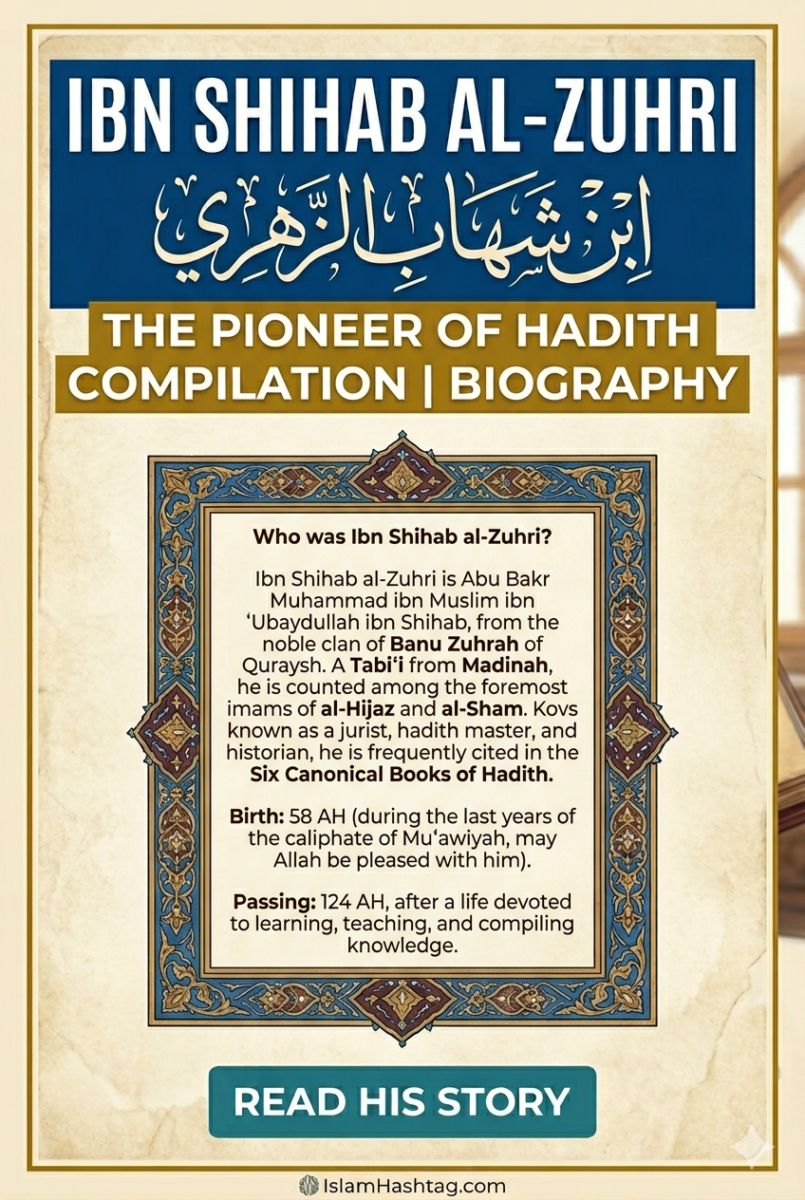
Who was Ibn Shihab al-Zuhri?
Ibn Shihab al-Zuhri is Abu Bakr Muhammad ibn Muslim ibn ʿUbaydullah ibn Shihab, from the noble clan of Banu Zuhrah of Quraysh. A Tabiʿi from Madinah, he is counted among the foremost imams of al-Hijaz and al-Sham. Known as a jurist, hadith master, and historian, he is frequently cited in the Six Canonical Books of Hadith.
- Birth: 58 AH (during the last years of the caliphate of Muʿawiyah, may Allah be pleased with him).
- Passing: 124 AH, after a life devoted to learning, teaching, and compiling knowledge.
Early Life & Quest for Knowledge
Al-Zuhri grew up with little wealth but immense aspiration. He attached himself to circles of knowledge in Madinah and traveled widely. He learned from Companions who lived into his era—such as Anas ibn Malik and Sahl ibn Saʿd—and from the leading senior Tabiʿin like ʿUrwah ibn al-Zubayr and Saʿid ibn al-Musayyib. He became known for walking with tablets and scrolls, writing everything of benefit that he heard.
Pioneering Role in Hadith Compilation
While the Sahabah and early Tabiʿin did write hadith in personal notebooks, al-Zuhri is widely credited with systematizing and expanding written hadith transmission—especially under the encouragement of ʿUmar ibn ʿAbd al-ʿAziz (r. 99–101 AH). This state-backed effort helped preserve large bodies of Sunnah that might otherwise have been lost. His meticulous attention to isnad (chains), careful selection, and breadth of teachers and students made his corpus foundational for later scholars.
Balance note: Earlier written collections (e.g., the ṣaḥīfah of Hammām ibn Munabbih) existed, but al-Zuhri’s work marks a milestone for organized, far-reaching compilation and teaching.
Service in the Umayyad Era
In al-Sham, his knowledge impressed ʿAbd al-Malik ibn Marwān, who granted him a stipend to support his scholarly work. He remained close to the Umayyad court—during the eras of al-Walid, ʿUmar ibn ʿAbd al-ʿAziz, Yazīd II, and Hishām ibn ʿAbd al-Malik—and was entrusted with responsibilities including teaching the princes and, at times, judicial duties.
Teachers and Students
- From the Companions: Anas ibn Malik, Sahl ibn Saʿd, and others.
- From the senior Tabiʿin: ʿUrwah ibn al-Zubayr, Saʿid ibn al-Musayyib, ʿAtaʾ ibn Abi Rabah, Qatadah, and more.
- Among his notable students/peers: Yahya ibn Saʿid al-Ansari, Salih ibn Kaysan, Mansur ibn al-Muʿtamir, and many who transmitted from him into the canonical collections.
PraisHis Birth and Upbringing
Imam al-Zuhri was born in the city of the Messenger of Allah ﷺ (Madinah). His exact year of birth is not definitively known, but scholars differed regarding it. Dr. Harith Sulayman al-Dhari considered the most likely year to be 51 AH, during the caliphate of Mu‘awiyah رضي الله عنه.
He grew up in Madinah, which at the time was a center of knowledge attracting students from all directions. Al-Zuhri was among the distinguished Tabi‘un (successors). He began seeking knowledge early, starting with memorizing the Qur’an, which he completed in 80 nights. He then studied genealogy, the Sunnah, and Islamic rulings of halal and haram. Whenever he finished learning from his teachers, he would revise and recall what he had learned to preserve it and prevent forgetfulness.
Praise from Scholars
Many great scholars praised him:
Ahmad ibn Hanbal said: “Al-Zuhri is the best in hadith and has the finest chains of narration.”
Sa‘id ibn al-Musayyib said: “One like you does not truly die.”
Umar ibn Abd al-Aziz said: “Go to Ibn Shihab, for no one remains more knowledgeable of the past Sunnah than him.”
Malik ibn Anas said: “Ibn Shihab remained without equal among people.”
Al-Shafi‘i said: “Had it not been for al-Zuhri, the Sunnah in Madinah would have been lost.”
His Role in Spreading the Sunnah
Imam al-Zuhri made tremendous efforts in spreading the Sunnah:
- Teaching it to students
- Reviewing it with peers
- Writing and documenting it
- Dictating it to students
- Teaching Bedouins and guiding them
- Warning against hoarding books of knowledge
- Encouraging memorization and learning
He would also spend generously on students, feeding them and supporting those who could not afford to study. He even traveled to teach people in remote areas.
His Advice on Seeking Knowledge
Al-Zuhri emphasized:
- Gradual learning (one hadith at a time)
- Students should go to scholars—not the other way around
- Avoiding overly long study sessions
- Using helpful means for memory (like eating raisins and honey)
He said:
“Holding fast to the Sunnah is salvation.”
His Death
Imam al-Zuhri passed away in 124 AH, at the age of over seventy, on a Tuesday night in Ramadan. He died in a village called Adami near the borders of Palestine and Hijaz. He requested to be buried by the roadside so that passersby might pray for him.
When the scholar Al-Awza‘i passed by his grave, he said:
“O grave, how much knowledge and wisdom you contain…”
May Allah have mercy on him and reward him greatly for his service to Islam and the Sunnah.
Character, Method, and Legacy
Al-Zuhri’s evidence-driven method, disciplined writing, and rigor in isnad created a template for later hadith scholarship. His narrations appear abundantly in Sahih al-Bukhari, Sahih Muslim, Sunan Abi Dawud, Jamiʿ al-Tirmidhi, Sunan al-Nasa’i, and Sunan Ibn Majah. He passed away in 124 AH, and it is related that he wished to be buried by the roadside so travelers would pray for him—a final mark of humility from a giant of knowledge.
Frequently Asked Questions
Was Ibn Shihab al-Zuhri the first to write hadith?
Writing existed earlier in personal scrolls, but al-Zuhri is renowned for broad, organized compilation—especially under ʿUmar ibn ʿAbd al-ʿAziz—which significantly advanced preservation.
What disciplines did he master?
Primarily hadith and fiqh, with contributions to sīrah/history. His chains and narrations are among the backbones of later scholarship.
Where did he live and teach?
He was from Madinah and spent significant time in al-Sham, teaching widely across the region.
Written by

Ustadha Fahmina holds a Sanad in Alimiyyah (6-year Dars-e-Nizami) from two recognized Islamic institutes and a Master's degree in Arabic from Indira Gandhi National University. She teaches Qur'an, Tafsir, Hadith, and Fiqh following the Hanafi school within Ahl al-Sunnah wal Jama'ah. She founded Islam Hashtag in 2015 to bring authentic Islamic learning to Muslim families online. She also holds a degree in Optometry and is the founder of Optometryskills.com.
Discover more from Islam Hashtag
Subscribe to get the latest posts sent to your email.