

I’tikaf Types and I’tikaf Rules
We generally relate Itikaf to spiritual retreat to a Mosque in the last 10 days of Ramadan . Do you know that itikaf can also be for any time and for whatever Period ? yes , It can even be for minutes,provided that we have pronounced the intention .This other type of Itikaf is a Nafil Ittikaf. It is a blessing which we should all try to utilise especially in these blessed months of Rajab ,Shaban and Ramadan .
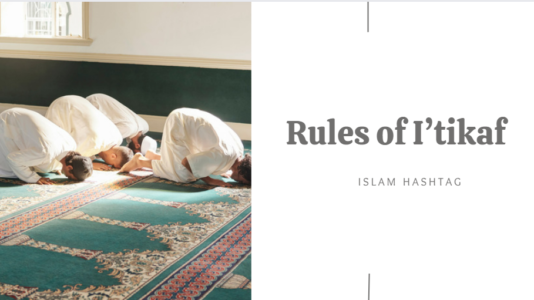
For those who are new to Islam,
itikaf meaning?
The I’tikāf is a type of spiritual retreat which allows the person to experience isolation from the hustle and bustle of everyday life and socialising with other people in order to gain a closeness with Allāh .
itikaf in islam: I’tikaf types
There are three types of I’tikaf: 1. Wajib, 2. Sunnah, 3. Nafl

1. Sunnah I’tikaf: This I’tikaf was observed by Rasulullah (PBUH) in every year of his stay at Madinah Munawwarah.
- This I’tikaf means to seclude oneself inside the masjid for the last ten days of Ramadan. This I’tikaf is Sunnatul-mu’akkadah ‘alal-kifayah: that is, if a few persons from the locality observe it, the rest will be exempted.
- Rasulullâh Sallallâhu ‘alayhi wasallam always observed, I’tikâf and the Muslims have on the whole adhered to it. It has become a regular feature of the month of Ramadhân and a confirmed practice with the devout and the faithful. Hazrat Ayesha Radiallâhu anha relates that “Rasulullâh. Sallallâhu ‘alayhi wasallam regularly observed I’tikâf during the last ten days of Ramadhân till the end of his life. After him, his wives maintained the tradition.” (Bukhari)It is related by Hazrat Abû Huraira Radiallâhu anhu that “Rasulullâh Sallallâhu ‘alayhi wasallam observed I’tikâf for ten days every year in the month of Ramadhân. In the year he passed away he observed it for twenty days.” (Bukhari)
- If no one observes it then all the Muslims of that area will be sinful in neglecting this sunnah. The niyyah for Sunnah I’tikaf is that a firm intention should be made for this purpose before the sun sets on the 20th of Ramadan, in the masjid that is chosen for the I’tikaf. It terminates at sunset if the crescent is sighted on the 29th or on the 30th of Ramadan.
- There is no prescribed salah to be performed for this purpose. It is noteworthy that generally no Nafl salah should be performed after ‘Asr salah until Maghrib.
2. Wajib I’tikaf: This refers to that I’tikâf
(a) which becomes wâjib because of making nadhr, that is, taking a vow, or
(b) which becomes wâjib as Qada’ for rendering void a Sunnah I’tikâf.
- For instance, when a person makes a vow of thanks-giving to Allah that if Allah fulfills a certain wish of his, he will perform so many … days of I’tikaf. In this case, the moment his wish is fulfilled, I’tikaf becomes compulsory. Or, a person may merely make an unconditional vow whereby he makes I’tikaf compulsory upon himself for a certain number of days. This becomes a duty on him from that moment onwards.
- A wajib I’tikaf cannot be for less than one day and one night and has to be performed while fasting, irrespective of whether the fast is specifically for this purpose or not. If the niyyah is for several days then the same number of nights will also have to be spent in I’tikaf. The I’tikaf will thus begin before sunset and terminate at sunset after the avowed number of days has been completed. The night proceeds the day in Islamic reckoning. The intention for this type of I’tikaf must be pronounced, mere mental niyyah is not sufficient.
3. Nafl l’tikaf: There is no special time or specific number of days for Nafl l’tikaf.
- A person may form the niyyah for any number of days at any time of the year, even for his whole life. While Imam Abu Hanifah (R) states that it cannot be for less than a full day, Imam Muhammad (R) states that there is no limit as to the minimum period of time. It could even be for just a few seconds. The fatwa is on this latter view.
- There is no fast associated with this type of I’tikaf. .It is desirable for anyone entering a masjid to make the niyyah for I’tikaf as long as he will remain in the masjid. So, while he is in ‘ibadah (worship), he also gains the reward of I’tikaf.
- It is advisable for everyone who comes to join the congregational prayers to form an intention of I’tikaf upon entering the masjid. This will mean that as long as he remains busy with salah, dhikr,’ listening to religious lectures, etc. He also receives the reward for I’tikaf.
Conditions that must be fulfilled for Itikaf
- It is necessary for I’tikâf that a person be a Muslim and sane. Hence, the I’tikâf of an insane person or a kafir will not be valid. However, just as a minor child may perform Salâh or keep fast, similary such minor may performI’tikâf. (Badai).
- A woman may also performI’tikâfin her home by setting aside a specified place for ibâdah and performing therein such I’tikâf. However, it is necessary for her to obtain her husband’s consent for such I’tikâf. Moreover, it is essential that she is not in a state of menstruation and nifâs.
- it is a condition ofI’tikâf Masnun and I’tikâf wâjib that a person be in a state of fasting. Hence, if a person is not in a state of fasting, he cannot perform these categories of I’tikâf. However, fasting is not a condition in the case of Nafl I’tikâf.
- For male persons, ‘Itikat can only be performed in the masjid. The most blessed and preferred I’tikâf is that performed at al‑Masjid al Harâm in Makkah. The next most preferred I’tikâf is that performed at al‑Masjid al‑Nabawîin al‑Madinah. Third in order of preferability is al‑Masjid al Aqsa (in Al‑Quds). Fourthly, any Jam’i Masjid. However, it is not necessary to perform I’tikâf at a Jam’i Masjid. On the contrary, I’tikâf may be performed at any masjid where prayers are said five times (each day) in jama’at. If a masjid is such that five time prayers (each day) are not said therein, then in such an event there is a difference of opinion amongst the ‘Ulamâ’. Some scholars are of the view that I’tikâf may be performed at such a masjid, although it is not preferable. (Shâmi)
- I’tikâf can be made in a masjid wherein only in Ramadhân 5 daily Salâh are performed (Fatâwa Rahîmîyah vol. 2. p. 30)

Factors That Render I’tikaf void
I’tikâf is rendered void by the following factors:
- Apart from the necessities mentioned above,I’tikâf is rendered void if the person performing I’tikâf leaves the hudud of the masjid for any other purpose although such leaving is for one moment (Hidâyah). It is clear that one will be said to have left the masjid when the feet (of the person performing I’tikâf) have been put outside in such a manner that according to custom one will be said to have left the masjid. Hence, if only the head is outside the masjid, then I’tikâf shall not thereby be rendered void. (Al‑Bahr‑ur‑Raiq).
- Similarly, if a person performingI’tikâf leaves for a valid Shar’î necessity, but after completing such a necessity, he waits or stays outside (the masjid) even for one moment, then theI’tikâf is thereby rendered void. (Shâmi)
- If one leaves themasjid without a valid Shar’î reason or need, whether intentionally, in forgetfulness or by mistake, then in such situations the I’tikâf is rendered void. However, one will not sin for rendering the I’tikâfvoid if the leaving is due to mistake or forgetfulness. (ibid.)
- TheI’tikâf will also be rendered void if a person under mistaken belief enters a part of the area of the masjidthinking that it falls within the hudud of the masjid, whereas in fact it is excluded there from. Hence, one must properly ascertain the hudud of the masjid before commencing I’tikâf.
- Since fasting is a condition forI’tikâf, if the fast breaks then I’tikâf is rendered void accordingly, irrespective whether such fast was broken for a valid reason or not, or intentionally or by mistake. In each of these cases,I’tikâf is rendered void. The meaning of breaking fast by mistake is that a person whilst remembering that he is fasting does some involuntary act which is opposed to the requirement of fasting; for example, the person continued eating until the rise of dawn, or made iftar before the setting of the sun under the mistaken belief taht the time for Iftar had passed; or whilst gargling water entered the gullet by mistake althought the person remembered that he was fasting. In all these situations, the fast is broken and I’tikâf is correspondingly rendered void.However, if a person forgot that he was fasting and in such state of forgetfulness ate, and drank something, then both his fast and I’tikâf are not rendered void. (Shâmi)
- I’tikâfis also rendered void by sexual intercourse whether done intentionally or by mistake, and whether done during the day or night, inside the masjid or outside, and whether emission results or not. In all these situations, I’tikâf is rendered void.
- Kissing and cuddling is not permissible during the course ofI’tikâf if this causes emission, then I’tikâf is rendered void. However, if no emision results then notwithstanding its illegality, the ’ltikaf is not rendered void. (Hidâyah)
Itikaf of Women / itikaf for females
Narrated Aisha RA : (the wife of the Prophet) The Prophet (ﷺ) used to practice I`tikaf in the last ten days of Ramadan till he died and then his wives used to practice I`tikaf after him.
The fadilah ofI’tikâf is not confined to men; women also can take advantage of it. However, women should not perform I’tikâf in the masjid. Their I’tikâf is only possible in the house. The procedure is as follows:
- Women should sit for I’tikâf in that place in the house which has been set aside for Salâh and ‘Ibadah. If no such place has been previously set aside, then a place must be so set aside prior to the commencement ofI’tikâf, and I’tikâf must accordingly be performed therein. (Shâmi)
- If no specific place has been built or set aside in the house forSalâh, and it is not possible for some reason to so build or set aside a place therein, then in such event a woman may at her discretion demarcate any place within the house and perform I’tikâf there. (Âlamghiri)
- It is necessary for a married woman to obtain the consent of her husband for the purpose of performing I’tikâf. It is not permissible for a woman to perform I’tikâf without the permission of her husband. (Shâmi) However, husbands should not without reason deprive their wives of performing I’tikâf by refusing consent. On the contrary, they should grant consent.
- If a woman has commencedI’tikâf with the permission of her husband and thereafter he endeavours to prohibit or prevent her from completing same, then he cannot do so. If he succeeds in preventing her, then the woman is not obliged to complete I’tikâf. (Alamghiri)
- It is necessary for a woman to be free from menstruation andNifâs in order to perform I’tikâf ‑ that is, she cannot perform I’tikâf in a stage of menstruation and Nifâs.
- Consequently, a woman should, prior to the commencement ofMasnun I’tikâf, determine whether the date of her menstruation will coincide with the period of I’tikâf. If the menstruation is expected to occur towards the end of the last ten days of Ramadhân, then she must not perform Masnun I’tikâf. However, she may performNafl I’tikâf for the period until the arrival of her menstruation.
- If a woman has commencedI’tikâf, and thereafter menstruation commences during the duration of I’tikâf, then it is wâjib upon her to immediately abandon I’tikâf, as soon as her menstruation commences. In such a situation it is wâjib upon her to make qada I’tikâf of only the day in which she abandoned the I’tikâf (as a result of the intervention of menstruation). The procedure of such qadah is as follows: After the woman becomes pure of such menstruation, she keeps fast on any day and performs I’tikâf. If the days remain in Ramadhân, then she may make qadha in Ramadhân in which case the fast of Ramadhân will be sufficient. However, if Ramadhân has terminated at the time of her becoming pure from such menstruation, then she must thereafter specifically keep fast qadha I’tikâf for one day. (Commentary toBehesti Zewar)
- The place within the home demarcated by a woman for the purpose ofI’tikâf will for the duration thereof fall within the hukm of the masjid. It is not permissible for her to move from such place without a Shar’înecessity. She cannot leave such place and enter any other portion or area of the home. If she does so, herI’tikâf will break.
- The rules applicable to men relating to moving from the place ofI’tikâf are also applicable to women. For those needs and necessities in relation to which it is permissible for men to leave the masjid, it is similarly permissible for women to leave the place of I’tikâf for such needs and necessities. (not Janazah). For those works in relation to which it is permissible for men to leave the masjid, it is similarly permissible for women to leave the place of I’tikâf for such works. Accordingly, women should, prior to commencing I’tikâf, thoroughly acquaint themselves with the rules relating to I’tikâf Masnun which have been discussed earlier under the heading “I’tikâf Masnun”.
- During the I’tikâf, women may, whilst sitting in their place of I’tikâf indulge in sewing and knitting. They can advise and guide others in regard to matters affecting the home. However, they cannot leave the place demarcated for I’tikâf. Moreover, it is preferable if they concentrate during the I’tikâf on Dhikr, Tasbihat,Tilawat al‑Qur’an and ‘Ibadat. They should not spend too much time on other matters.
Types and Detail Rules of I’tikaf (Detailed) from book Ahkam’e I’tikaf by Mufti Taqi Usmani
Masnun Itikaf
The I’tikâf which is performed in the last ten days of Ramadhân Mubarak is known as Masnun I’tikâf. The time for this I’tikâf commences upon completion of the twentieth day (of Ramadhân), that is, with effect from the setting of the sun, and remains until the sighting of the Shawwal moon (Eid moon). In view of the fact this I’tikâf commences from the twenty‑first night (of Ramadhân) ‑ and the night commencing from the setting of the sun ‑ it is therefore necessary for the person wishing to performI’tikâf to enter the hudud of the masjid on the twentieth day on such time before Maghrib so that the setting of the sun takes place whilst he is in the masjid.
The I’tikâf of the last ten days of Ramadhân is Sunnah Mu’akkadah Kifayah. This means that if one person, who lives in a particular area in which a masjid is situated, performs I’tikâf, then in such an event the Sunnah is fulfilled on behalf of all the members of that area. However, if nobody in the entire area performs I’tikâf, then all the members of the area will be liable for the sin of failing to fulfil a Sunnah.
RESPONSIBILITY OF MEMBERS OF AN AREA AND MAIN FEATURE OF I’TIKAF
- It is clear from the foregoing that it is the responsibility of every member of the area or township to ascertain in the beginning whether any person is to sit for theI’tkâf in their masjid or not.
- However, it is not permissible to cause some person to sit by giving him payment or money because it is not permissible in the case of ‘Ibadah to give or take money or wages. (Shâmi)
If no member of a particular area is able to sit forI’tikâf due to circumstances of necessity, then in that event arrangements must be made to cause some person from another area to sit. (Fatâwa Darul Ulûm Deoband)
The outstanding pillar of I’tikâf is that a person remains for the duration of I’tikâf within the hudûd of the masjid. Save and except for the necessities of nature (see details later), he must not leave the hudud of the masjid even for one moment. For, if he leaves the hudûd of the masjid for one moment without a valid Shar’î reason (the details of which are dealt with later), the I’tikâf is rendered void.
LEAVING THE MASNUN ON THE GROUNDS OF SHAR’Î NECESSITY
By the term Shar’î necessity, we mean those necessities on the basis of which the Sharî‘ah has permitted the person performing I’tikâf to leave the masjid. TheI’tikâf is not rendered void if the person leaves by virtue of such necessities.
These necessities are as follows :
- The need to urinate or defecate, that is, to attend to the call of nature.
- The need forGhusl of janabah when it is not possible to make Ghusl in the masjid.
- The need to makewudhu when it is not possible to make wudhu while in the masjid.
- The need to bring food and drink when another person is not available to do so.
- The need of theMu’adhin to go out for the purpose of calling Adhân.
- If JumuahSalâh is not performed in the masjid wherein I’tikâf is performed, the need to go to another masjidto perform Jumu’ah.
- The need to move to anothermasjid in the event of leaking, etc. of the the masjid.
Apart from these needs, it is not permisible for the person performing I’tikâf to leave the masjid for any other purpose. Now, we shall, insha-Allâh, explain details of each of these needs.
CALL OF NATURE
(a) The person performingI’tikâf can leave the rnasjid to attend the call of nature, that is, to urinate of defaecate. In so far as urinating is concerned, he must go to the place nearest the masjid where it is possible to urinate. In regard to defaecation, if a toilet has been built attached to the masjid, and if it is possible to defaecate therein, then he must go there. It is not permissible to go to another place. However, if a person cannot defaecate due to his nature or because of extreme difficulty at any place besides his home, then it is permissible forlim to go to his house for this purpose, even if a toilet is available near the triasjid. (Shâmi)
If a person does not have this difficulty, then he should utilise the toilet of the masjid. If such a person leaves the masjid toilet and goes to his house, then his I’tikâf is rendered void according to some ‘‘Ulamâ. (Shâmi)
(b) If the masjid does not have any toilet, or if it is not possible to attend the call of nature therein, or in the case of extreme difficulty, then in such events it is permissible to go home to attend the call of nature, notwithstanding the distance of such home. (Shâmi)
(c) If the home of a friend or a relative is present near the masjid, it is not necessary to go to his friend’s or relative’s home to attend the call of nature. Despite this, one is permitted to go to one’s home even if it is situated at a distance in comparison to the home of such a friend or a relative. (Shâmi)
(d) If a person owns two houses then he should go to the nearer one to attend the call of nature. If he goes to the further home then his I’tikâf is rendered void according to some ‘ulama. (Alamgiri)
(e) If the toilet is occupied, then it is permissible to wait until it is vacant. But it is not permissible to remain even for one moment once the need is fulfilled. If one remains then, I’tikâf is rendered void. (Barjandi)
(f) It is permissible to make Salâm to someone or to reply to a Salâm or to talk briefly in the house or on the way to the toilet and on return, provided that one does not stop for such brief talk. (Mirqat)
(g) It is not necessary to walk briskly on the way to the toilet or on return. It is permissible also to walk slowly. (Âlamghiri)
(h) On the way to the toilet to attend to the call of nature, one must not stop at the instance of another. One must while walking indicate to such other person that one is in a state of I’tikâf. One can not stop for this purpose. If one stopped for some time at the instance of another, then his I’tikâf is rendered void. This applies to the extent that if a debtor has on the road stopped the person performing I’tikâf then according to Imâm Abû Hanifah Rahmatullâh ‘alayhi the I’tikaf is rendered void. The I’tikâf is not rendered void by virtue of his necessity according to Imâm Abû Yusuf and Imâm Muhammad Rahmatullâh ‘alayhi. Imâm SarakasiRahmatullâh ‘alayhi has on the basis of ease and facility manifested a preference for the view point of the latter two. (Mabsut) However, precaution demands that one must not stop on the road under any circumstances.
(i) It is permissible to smoke a cigarette upon leaving to visit the toilet provided that one does not have to stop for this purpose.
(j) If any person who has gone to his house for the purpose of attending to the call of nature, then it is permissible for him to make wudu therein, after attending to the call of nature. (Majma‑ul‑Anhar)
(k) Istinjah is included in the term “attending to call of nature”. Hence, if a person suffers from the disease of urine drops, he can go outside for the purpose only of Istinjah for this reason, the jurists have set forth Istinjah as a separate ground of necessity entitling a person to leave apart from the ground of “attending to the call of nature.” (Shâmi)
(l) While in I’tikâf to be in state of wudhu is Mustahab [desirable] and not wâjib [compulsory]. To read books ofTafsîr and jurisprudence in the state of wudhu is also mustahab. (Fatâwa Mehmoodiya vol. 3 p. 117/2)
(m) While in I’tikâf one can inquire from vistors about those who are absent. (ibid.)
GHUSL
It is permissible for the person performing I’tikaf to leave the masjid for the purpose of Ghusl of Janabah in the event of emission of semen.
This is subject to the explanation that if such a person can make Ghusl whilst remaining in the masjid, for example, by sitting in some big tub and performing Ghusl in a manner that the water does not fall in the masjid then it is not permissible for him to go outside.
However, if this is not possible or there is extreme difficulty then he may go outside for Ghusl of Janabah. (Fath‑ul‑Qadir) If there is a Ghusl Khanah in the masjid, then he must perform Ghusl there. However, if there is noGhusl Khana in the masjid, or it is not possible to make Ghusl therein for some reason, or if there is extreme hardship, then one can perform Ghusl in one’s home.
Apart from Ghusl of Janabah, it is not permissible to leave the masjid for any other Ghusi. It is not permissible to leave the masjid for the purpose of Jurnu’ah Ghusl or a Ghusl to cool oneself. If one has left the masjid for this purpose then I’tikâf is rendered void. However, if one wishes to make Jumu’ah Ghusl or cool oneself, then he must adopt such a course that the water does not drip into the masjid. For example, he must sit in some tub and bathe himself, or make Ghusl at the corner of the masjid in such a way that the water drips outside the masjid.
EATING
If a person has another available to bring food and water for him to the masjid, then it is not permissible for such a person performing I’tikâf to leave the masjid for the purpose of fetching food. If, however, he does not have available any person to bring food and water, then it is permissible for him to leave the masjid to bring food (al‑Bahr‑ur‑Raiq). However, the food must be brought to the masjid and eaten therein. (Kifayat‑ul‑Mufti)
Such a person moreover must bear in mind that he must leave the masjid at a time when he is able to receive the food. But if he has to wait for some reason to receive the food, there is no objection.
ADHÂN
(a) If a mu’adhin is performing I’tikâf and he has to leave the masjid for the purpose of giving Adhân, then it is permissible for him to go outside. But he must not remain there after giving the Adhân.
(b) If a person is not a mu’adhin but he wishes to give Adhân for a particular time, then it is permissible for him to leave the masjid for the purpose of giving Adhân. (Mabsut)
(c) If the door of the minaret of the masjid is situated within the masjid, then it is absolutely permissible for the person performing I’tikâf to climb the minaret because it will constitute part of the masjid. However, if the door of the masjid is outside the masjid itself, then apart from the need to give Adhân, the person performing ’ltikaf is not permitted to climb such a minaret. (Shâmi)
(d) It is preferable that I’tikâf be made in such a masjid where Jumu’ah Salâh is performed so that it is not necessary to go outside for Jumu’ah. However, if no Jum’ah Salâh is said in a particular masjid and only five times Salâh is said therein, then it is permissible to perform I’tikâf in such a muffid. (Âlamghiri)
(e) In such a situation, it is permissible to go to another masjid to perform Jum’ah Salâh. However, one must leave for this purpose at such a time that, in his estimation, upon reaching the Jam’i Masjid, he will be able to perform the four rakâh sunnah and thereafter, witness immediately the commencement of the khutbah. (ibid.)
(f) If the person performing I’tikâf has gone to a certain masjid to perform Jurn’ah, then he may perform sunnah prayers after completing the fard in that masjid. However, he cannot remain (in the masjid) thereafter. (Ibid). If he remains for a period exceeding necessity then his I’tikâf is not rendered void because he has remained in a masjid. (Badai)
(g) If a person goes to a Jam’i Masjid to perform Jum’ah and thereafter remains there and completes the remaining period of I’tikâf, then his I’tikâf will remain valid. This act is, however, makrûh. (Âlamgiri)
One can make I’tikâf in one masjid and lead tarawîh in another provided when sitting for I’tikâf this intention was made. (Âlamqiri vol. 1, p. 199)
TRANSFER OF MASJID
It is necessary for every person performing I’tikâf to complete his I’tikâf in the masjid where he commenced it. However, if he is faced with such an extreme difficulty and hardship that it is not possible for him to complete theI’tikâf in such a masjid, for example, because such a masjid may collapse, or he is removed therefrom under compulsion, or there is a strong danger to life or property by staying there (in the masjid), then it is permissible to move to another masjid and complete the I’tikâf there. If one has left for this purpose, the ’ltikaf will not be rendered void, provided that upon leaving one does not wait or remain on the road but proceeds directly to the other masjid. (Âlamgiri)
JANAZAH SALÂH AND VISITING THE SICK
(a) Generally it is not permissible for the person performing I’tikâf to leave the masjid to participate in Janazah Salâh or to visit the sick. However, if one left to attend the call of nature, and incidentally, on the road enquired of some person’s health or participated in a Janazah Salâh, then theI’tikâf is not rendered void. (Badai)
Moreover, one can visit or enquire of the sick whilst one is walking on. Consequently, Hadrat ’Aishah (R.A.) has said that the Rasululla Sallallâhu ‘alayhi wasallam enquired of the sick whilst walking on, and he did not change his way for the purpose. (Abû Dawûd). In regard to Janazah Salâh it is a condition that one does not stop at all after the Salâh itself. (Mirqat).
(b) Apart from this, if a person makes a condition at the time of the intention of the I’tikâf itself to the effect that if he wishes during the course
of the I’tikâf to visit a certain sick person, or participate in Janazah Salâh, or attend a certain Islâmic or religious gathering, he will do so, then in such a situation it is permissible to leave the masjid for these purposes, and hisI’tikâf will not thereby be rendered void. However, in this manner, his I’tikâf will become a nafl one, and will not remain Masnun.
SITUATIONS IN WHICH IT IS PERMISSIBLE TO BREAK I’TIKÂF
It is permissible to break I’tikâf in the following situations:
- If such a disease emerges during the course of I’tikâf which is not possible to cure except by leaving the masjid, then it is permissible to break the I’tikâf.
- It is permissible to break I’tikâf and go outside (the masjid) in order to save a person who is drowning or burning or to prevent a fire. (Shâmi)
- It is permissible to break I’tikâf because of extreme disease which has afflicted one’s parents, wife or children.
- It is permissible to break I’tikâf if one is compelled to go outside (the masjid), for example, if a warrant of arrest is issued by the government.
- If ajanazah arrives and there is nobody else to perform the Janazah Salâh, then also it is permissible to break the I’tikâf. (Fath‑ul‑Qadir)
THE CONSEQUENCES OF BREAKING I’TIKÂF: RULES OF QADHA
If the I’tikâf Masnûn is rendered void for any of the reasons set forth above, then it is wâjib to make qadah only of that day in which the ’ltikaf’ was rendered void. It is not wâjib to make qadah of the full ten days. (Shâmi). The procedure of making qadha of this one day is as follows:
If there is time remaining in that Ramadhân, then one must perform I’tikâf with the niyâh of qadha in that Ramadhân commencing from the setting of the sun of one day until the setting of the sun of the following day. If there is not time in that particular Ramadhân or if it is not possible for any reason to perform I’tikâf therein, then apart from Ramadhân, one can keep fast on any day and perform I’tikâf for one day. On the other hand, if one makes qadah the following Ramadhân this also will be valid. However, there is no guarantee of life and accordingly one must make qadah as quickly as possible.
- If the I’tikaf Masnun is rendered void, it is not necessary to leave the masjid. But one can continue the I’tikâf for the remainder of the last ten days with niyyah of nafl. In this way, the sunnah al‑Mu’akkadah will not be fulfilled but thawab will be obtained for the nafl I’tikaf. On the other hand, if the I’tikâf was rendered void due to some involuntary mistake, then it is not inconceivable that Allâh Ta’âla may bestow in His infinite mercy the reward of the Masnun I’tikâf of the last ten days. Hence, it is preferable in the case of the breaking of the I’tikâf is broken and to commence a permissible to leave on the day that I’tikaf is broken and to commence anafl I’tikâf with nafl niyyah the following day.
THE ADAB OF I’TIKAF
In view of the fact that the purpose of I’tikâf it to withdraw oneself from worldly affairs and devote oneself entirely to the remembrance of Allâh, therefore, one must during the course of I’tikâf avoid unnecessary talk and work. Whatever time one finds, one must spend in performing qadha salâh, nawafil (Salâh), tilawah al‑Qur’ân, and other ‘ibâdah, dhikr and tasbihat. Moreover, the learning and teaching of ‘ilm of dîn, lectures and nasiliat and study of Islâmic books is not only permissible but also a cause of obtaining thawab.
PERMISSIBLE ACTS [MUBAHAT] IN I’TIKAF
The following acts are permissible in the state of I’tikâf
- Eating and drinking.
- Necessary transactions of purchase and sale relating to the necessities of life. However, it is not permissible to make the masjid a centre of trade as such. (Qazi Khan)
- Sleeping.
- Haircut provided the hair does not fall in the masjid.
- Talking and conversation, but it is necessary to avoid unnecessary talk. (Shâmi)
- To contract a Nikâh or other transactions. (al‑Bahr)
- To change clothes, apply scent and oil. (KulasatulFatâwa)
- To assist a sick person in the masjid, apply bandage or show him a medicine. (Fatâwa Darul Uloom)
- To give lessons on the Qur’an or ’ilm of Din. (Shâmi)
- To wash and sew clothes provided that when washing the person remains within the masjid and the water falls outside the masjid. This ruling also applies in the case of washing pots or utensils.
- To pass wind in the masjid at the time of necessity. (Shâmi)
Moreover, all those actions are permissible in I’tikâf which are not makrûh or render I’tikâf void, and which actions in themselves are halâl.
MAKRUHAT OF I’TIKÂF
The following matters are makrûh in the state of I’tikâf:
- To adopt complete silence because the adoption of complete silence in the Sharî’ah does not constitute I’tikâf. If one adopts silence with the intention that such silence is I’tikâf, then he will receive the sin of bid’ah. However, there is no objection if one does not regard silence as ibâdah and endeavours to remain silent in order to avoid sin. However, whenever a necessity arises, one must not avoid or abstain from talk. (Durre‑Mukhtâr)
- To indulge in unnecessary and vain talk; some conversation is permissible in accordance with necessity, but it is obligatory to avoid making themasjid a place of vanities and unnecessary talk. (Minhatul Kaliq)
- To bring goods of trade and throw them in themasjid.
- To enclose such area of the masjid for the purpose of I’tikâf that other persons performing I’tikâf or Salâh are caused difficulty or hardship.
- To charge a fee for writing, or sewing clothes, or teaching on the part of the person performing I’tikâf has been considered as makrûh by the jurists (Al‑Bahr). However, if a person cannot earn to provide for himself for the fasts of the days of I’tikâf without charging such fee, then it is permissible for him to do so on the analogy of sale. (And Allâh knows best).
- While performing the sunnah to indulge in a makrûh is not correct.
I’TIKÂF MANDHUR -Nadhr Itikaf
The second type of I’tikâf is I’tikâf Mandhur”, that is, that I’tikâf which a person has made obligatory upon himself by taking a vow [nadhr].
Having regard to the fact that this particular form of I’tikâf is rare in occurrence, only the necessary rules have been set out below. For details, one should refer to the books or jurisprudence or a Mufti.
Types of Nadhr I’tikaf and their Legal Effect
There are two categories of Nadhr:
(i) Nadlir Mu’ayyan, and
(ii) Nadhr Ghayr Mu’ayyan.
(i) Nadbr Muayyan: this means that the Niyyah of I’tikâf is made for specific day or days or month; for example, a person makes Nadhr that he will perform I’tikâf in the last ten days of Sha’ban. However, if for some reason he cannot keep fasts in these days, then he must make qadah in other days. (Shâmi)
(ii) Nadhr Ghayr Muayyan: this means that no specific month or day is fixed for the performance of I’tikâf; for example, a person makes Nadhr that he will perform I’tikâf for three days. Hence, it will be permissible for him to perform I’tikâf in all those days in which it is valid to keep fasts, and accordingly, his Nadhr will be fulfilled if he performs I’tikâf in such days.
Manner of Fulfilling Nadhr
1. Fasting is a condition for Mandhûr I’tikâf. Hence, the performance of I’tikâf in a state of fasting is obligatory at all times whether such I’tikâf is carded out in Ramadhân or not.
2. If a person has made Nadhr for the I’tikâf of one day, then the performance of a day’s I’tikâf will be wâjib upon him. Accordingly, he should enter the mosque before subh sâdiq and thereafter leave after the setting of the sun in the evening. However, at the time of making Nadhr for one day, intention was made in the heart to perform I’tikâf for twenty for hours ‐ that is, the night will also be spent in I’tikâf, then I’tikâf will be obligatory for twenty four hours In such a situation, the person in question should, as in the case of the I’tikâf of Ramadhân, enter the mosque before the setting of the sun, and thereafter, emerge therefrom after the next setting of the sun.
3. If a person made Nadhr for the I’tikâf of one night only, then such Nadhr will not be valid, and he will not be obliged t6 do anything. This is so because fasting is not possible at the time of night and (Mandhûr) I’tikâf is not possible without fasting. If at the time of Nadhr, there was an intention to include the day as part of the Nadhr, then also the Nadhr will not be valid, and no obligation will result.
4. If a person made Nadhr for the I’tikâf of two or more days, then the I’tikâf of both days and nights will be obligatory.
5. If a person made Nadhr for the I’tikâf of two or more nights, then also the I’tikâf of both days and nights will be obligatory.
6. If a person made Nadhr for the I’tikâf of two or more days, with the intention that he will perform I’tikâf only during the day and will leave the mosque in the evening, then such intention is legally valid. In such a situation, only the I’tikâf of the day will be wâjib. Consequently, such a person will enter the mosque daily before subh sâdiq and, thereafter, leave after the setting of the sun.
7. If the Nadhr was for the I’tikâf of two or more nights and the intention was confined to the performance of I’tikâf at the time of night, then no obligation results.
8. In those situations where the night was included with the day in the Nadhr I’tikâf, then the procedure will be to enter the mosque before the setting of the sun, that is, to commence the I’tikâf from the evening.
9. If a person has made Nadhr for the I’tikâf of more than one day, then he will be obliged to perform I’tikâf consecutively without interruption for the period in question. He cannot break the I’tikâf in the middle. For instance, a person made Nadhr that “I will perform I’tikâf for one month,” then it is wâjib, for him to continuously without break per form I’tikâf in a state of fasting for one month. If he misses one day, then he will be bound to begin the I’tikâf for one month again. However, if at the time of Nadhr, he stated clearly that “I will perform I’tikâf for thirty separate interrupted days,” then in such event I’tikâf may be performed with breaks or interruptions and need not be consecutive (These rules have been taken from Al‐Bahr al Râ‘iq)
NAFL I’TIKAF
- The third type of I’tikâfis Nafl I’tikâf. This form of I’tikâf is not subject to time, fasting, day, night ‑ on the contrary, the person will receive the reward of I’tikâf if he enters the masjid with the intention of I’tikâf at any time and for whatever period.
- In the last ten days of Ramadhân, if a person performs I’tikâf with the requisite intention for less than ten days, then such I’tikâf will be Nafl I’tikâf.
- If a person goes to themasjid for the purpose of Salâh and at the time of entering (the masjid) formulates an intention to the effect that he will remain in I’tikâf for whatever time he spends in he masjid, then such person will receive the reward of I’tikâf.
- Nafl I’tikâf remains in force for the period that the person is in the masjid. Upon leaving or emerging from the masjid, this I’tikâf ends.
- The person performing Nafl I’tikaf should complete I’tikâf for the period or days that he intended to undergo in I’tikâf.
- However, if he leaves the masjid for some reason prior to completion of the intended period, then he will receive reward for the period he remained in the masjid. For the remaining (that is, uncompleted) period, he is not obliged (that is, it is not wâjib upon him) to make qadah. (Shâmi).
- If a person, for example, made intention to perform I’tikâf for three days and thereafter upon entering the masjid, he commits an act which breaks his I’tikâf, then in such event his I’tikâf is completed, that is, he will receive the reward for the period he spent in the masjid prior to breaking of his I’tikâf, and furthermore, no qada’ is wâjib upon him (for the uncompleted period). In this event, he may leave the masjid if he wishes, or remain therein by making a new intention of I’tikâf. In such a situation, it is preferable that he completes the period for which he had made the intention of I’tikâf.
Reference :
- Saḥiḥ Muslim, 1167
- Saḥiḥ al-Bukhari, 309.
- Q. al-baqarah, v:187.
- Saḥiḥ Bukhari, 2029 & Saḥiḥ Muslim 297.
- Saḥiḥ-Bukhari, 242.
- Saḥiḥ-Bukhari, 2026
- Heavenly Ornaments
- Ahkam e It’ikaf by Mufti Taqi Usmani
Written by

Ustadha Fahmina holds a Sanad in Alimiyyah (6-year Dars-e-Nizami) from two recognized Islamic institutes and a Master's degree in Arabic . She teaches Qur'an, Tafsir, Hadith, and Fiqh following the Hanafi school within Ahl al-Sunnah wal Jama'ah. She founded Islam Hashtag in 2015 to bring authentic Islamic learning to Muslim families online. She also holds a degree in Optometry and is the founder of Optometryskills.com.
Discover more from Islam Hashtag
Subscribe to get the latest posts sent to your email.



brilliant article, amazing to read. Really helpful to clarify rulings on I’tikaf. Jzk Khayr.