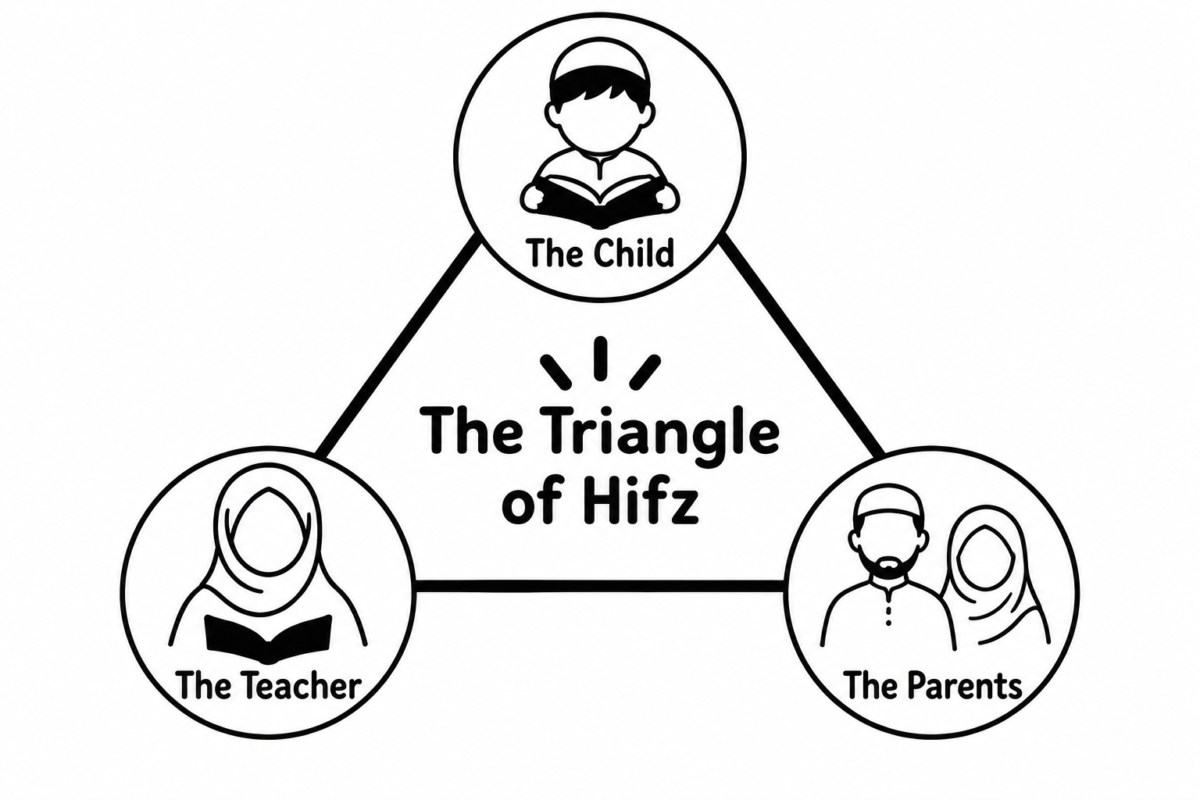

The Triangle of Hifz: The Child, the Teacher and the Parents
Are we truly doing enough to help our children become Huffaz of the Qur’an?
Many parents want their children to memorise the Qur’an. They enrol them in a local Maktab or Hifz class, make sure they attend regularly and assume that, because their children are going to the masjid every day, everything must be progressing as it should.
But there is an important question we need to ask ourselves: Are we actually doing enough to support our children’s Hifz, or have we simply handed the responsibility over to the teacher and assumed that everything else will fall into place?
This is something we all need to reflect upon.
Recently, a parent shared an experience with us which carried a very important lesson. He mentioned that his children were doing Hifz. He had enrolled them in a local Hifz class and assumed that, because they were attending regularly, making their way to the masjid every day and spending time with the teacher, everything was progressing well.
This parent was someone with a genuine love for Deen. He was a regular Musalli at the local masjid and wanted the best for his children. However, he was neither a Hafiz nor an Alim, nor did he have a background in the practical methods and demands of Hifz. Like many parents, he simply did not know what was expected of him or how much involvement was necessary.
His children would return home and read some Qur’an, but their home revision was nowhere near the level that was actually required. The parent did not realise this. He assumed that they were doing what was necessary and that the teacher would take care of the rest.
It was only when he began communicating with the teacher regularly, asking questions, seeking advice and taking a much more active interest in his children’s progress that things began to change. He started understanding where his children were falling behind, what needed to be corrected, how much time needed to be spent at home and what his own responsibility was.
In his own words, it felt as though he had started Hifz with his children!
The difference was remarkable. And this brings us to a lesson that every parent, teacher and family embarking upon the journey of Hifz needs to understand.
- Hifz is a partnership, not simply a class
One of the biggest misconceptions surrounding Hifz is that it is primarily the responsibility of the teacher. A child attends the masjid for a couple of hours, completes his lesson and returns home. The parent assumes that the teacher is taking care of everything.
But is a couple of hours at the masjid really sufficient to memorise and retain the Qur’an?
The actual learning, memorisation, repetition and revision require considerably more time than the hours spent in the classroom. A child cannot expect to make meaningful progress if the Qur’an is only given attention during the few hours spent at the masjid.
Hifz must become part of the daily routine at home. It must be reflected in the family’s priorities, timetable and environment.
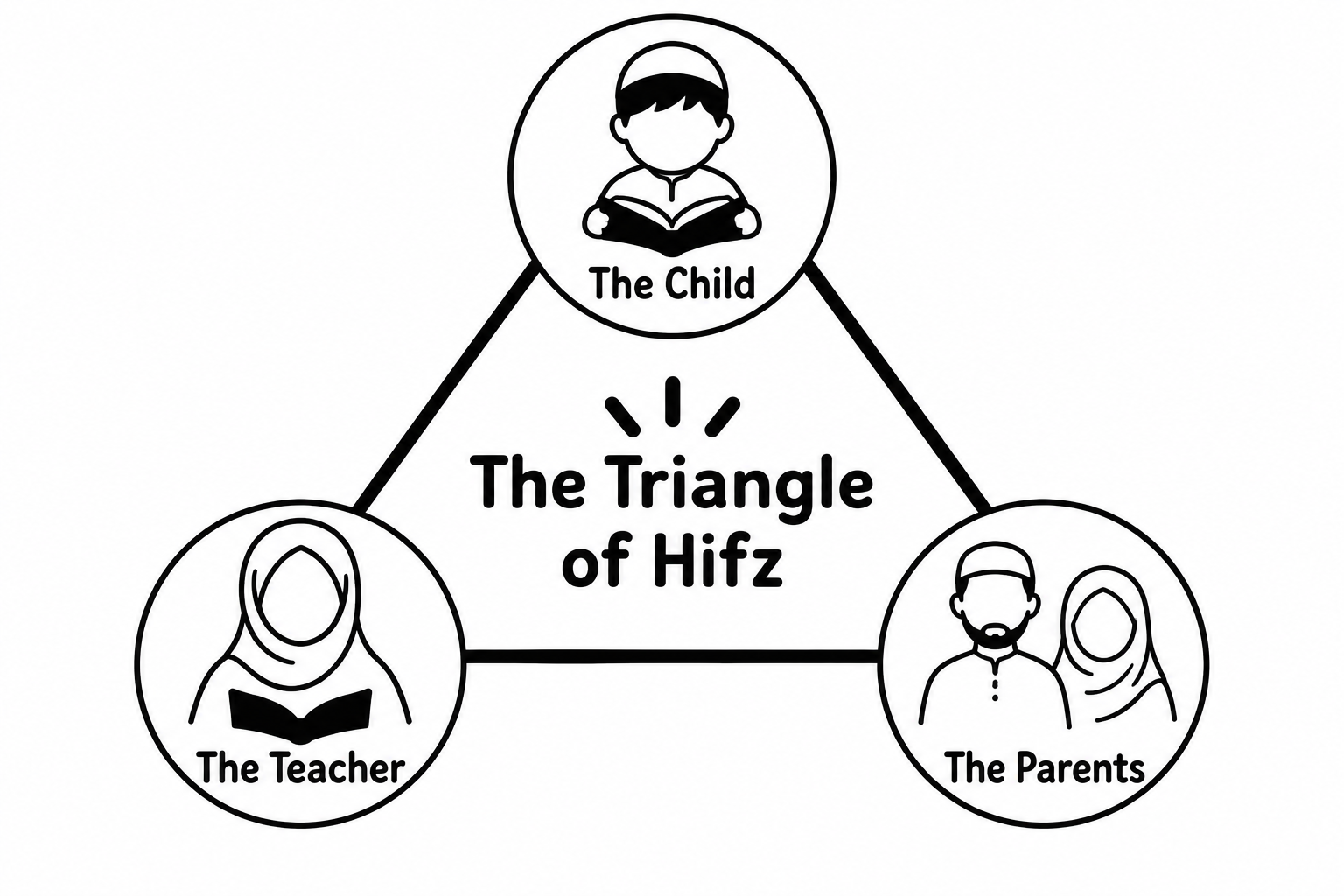
This is why we often speak about the Triangle of Hifz: the child, the teacher and the parents.
The child must show commitment, discipline, consistency and a willingness to work. The teacher provides guidance, correction, supervision, direction and accountability. The parents establish the environment, organise the routine, supervise home revision and provide encouragement.
All three are essential. If one side of this triangle is missing, the entire process is affected. A teacher can only do so much within the time available at the masjid. The parent cannot expect the teacher to compensate for a lack of revision at home, and the child cannot carry the responsibility entirely on his own.
Hifz is a collective effort.
- The teacher must remain connected to the parents
One of the most important things a Hifz programme can establish is a strong relationship between the teacher and the parents. Parents need to know exactly where their children stand.
Are they memorising properly? Is their previous lesson being retained? Is their revision sufficient? Are there particular mistakes that keep recurring? Are they struggling with fluency, pronunciation, Tajweed or consistency?
These are not things that should remain unknown to the parents. A parent should not have to wait until a problem becomes serious before discovering that their children have been struggling for months.
There needs to be regular communication. Teachers should guide parents on how much time should be allocated to new memorisation, how much revision of previous lessons is required, what mistakes the children are repeatedly making and how parents can listen to them at home.
Parents, in turn, should not hesitate to approach the teacher. Ask questions. Request advice. Find out what is expected of you.
Do not simply ask, “How much have my children memorised?” Ask, “How well have they retained what they have memorised?”
There is a considerable difference between completing a portion of the Qur’an and retaining it properly.
The objective is not simply to finish Hifz. The objective is to become a Hafiz whose memorisation is strong, reliable and maintained throughout life.
- The real work often takes place at home
Parents need to appreciate that the hours spent at home are just as important like the classroom.
Children may attend the masjid every day, but if they return home and do not revise properly, their progress will inevitably suffer. The Qur’an cannot be treated as something that only receives attention during the few hours spent with the teacher.
Morning and evening routines are particularly important. For many children, the morning is one of the most productive times for Qur’an memorisation and revision. Where possible, parents should establish a proper routine before school.
As a practical target, families should work towards allocating at least 1.5 to 2 hours in the morning for Hifz, where the children’s ages, school timetables and circumstances allow. This should be planned in consultation with the teacher and divided appropriately between memorisation and revision.
Simply waking up, reading for 20 or 30 minutes and ticking the box that the children have completed their morning Hifz is not necessarily going to produce the results we are hoping for.
Of course, every child is different, and the quantity and pace must be appropriate. But we must distinguish between merely completing a routine and genuinely putting in the effort required.
The Qur’an requires repetition. It requires consistency. It requires time. And most importantly, it requires a routine that is maintained day after day.
Parents must understand that Hifz cannot be treated as something children do only when there happens to be spare time. If we genuinely want our children to become Huffaz, we need to organise our time around the Qur’an rather than trying to fit the Qur’an around everything else.
- What kind of environment are we providing at home?
This is another area where parents need to reflect honestly.
Sometimes we hear parents complain that their children are distracted, do not concentrate, have no motivation or find memorisation difficult. But we need to ask ourselves: What kind of environment are we providing at home?
How much time are the children spending on screens, games, television and other distractions? Are we expecting children who spend hours on entertainment and constantly seek stimulation to suddenly sit down and concentrate on memorising the Qur’an?
Have we made the Qur’an a central part of our household, or is it simply another task that the children are expected to complete?
We cannot expect children to develop discipline if the environment around them encourages the opposite.
This does not mean that children should never have time to relax, play or enjoy themselves. They certainly should. However, there must be boundaries, structure and priorities. If screen time is affecting concentration, it needs to be limited. If unnecessary activities are taking away from revision, adjustments need to be made.
And perhaps most importantly, children should see their parents giving importance to the Qur’an themselves. They should see their parents reading, revising, making time for Salah and respecting the routines that have been established.
A child is far more likely to appreciate the importance of something when he sees that it is important to those around him.
We cannot expect our children to make sacrifices for the Qur’an if we are unwilling to make any ourselves.
- Parents must be willing to take advice
Something else that needs to be addressed is the importance of trusting those who have experience in teaching Hifz.
There are times when parents have their own ideas about how Hifz should be conducted. They may have heard about a particular method, spoken to someone else or developed an opinion about how much their children should memorise or how the revision should be organised.
Of course, parents should ask questions. They should understand the process and remain involved. But there is a difference between asking a teacher for guidance and constantly trying to dictate how the teaching should take place.
Consider this simple example. If someone visits a doctor because they need medical advice, they do not normally spend the appointment telling the doctor how the treatment should be carried out. They explain the problem, listen to the advice and follow the appropriate guidance.
Similarly, when parents enrol their children in a Hifz programme, they should make use of the experience and knowledge of the teacher.
If the teacher says that the children need to slow down, strengthen their previous memorisation or spend more time revising, the parents should take that seriously. If the teacher identifies a particular weakness, work together to address it. And if something is not clear, ask.
The purpose of seeking guidance is to benefit from the guidance being offered, not simply to seek confirmation of what we already want to do.
This requires humility from all parties. Teachers must remain approachable, and parents must remain willing to learn.
- Learn from families who have already completed the journey
Speak to families whose children have successfully completed Hifz. Ask them about their routines, the sacrifices they made, the challenges they faced and the systems that worked for them.
How did they organise their mornings? How much revision was expected at home? How did they deal with distractions? What role did the parents play? How did they ensure that the memorisation remained strong after completion?
These families have first-hand experience. There is a great deal we can learn from those who have already travelled the journey we are about to embark upon.
Sometimes, however, we become too attached to our own preferred methods. We want to do things differently, introduce our own systems or change established practices without fully understanding why those practices exist.
The memorisation of the Qur’an is not a new educational experiment. It is an act of worship that has been carried out by generations of Muslims since the time of the prophet ﷺ. Throughout the centuries, scholars, teachers and institutions have developed methods of memorisation, revision and preservation through experience.
Of course, teaching methods can be improved, and every child may require a slightly different approach. But this does not mean that we should disregard established principles or constantly try to reinvent the wheel.
There is wisdom in benefiting from the experience of those who have successfully taught and memorised the Qur’an. We should learn before attempting to change.
- Do not confuse completing Hifz with retaining the Qur’an
One of the greatest mistakes we can make is becoming overly focused on how quickly children are progressing.
How many pages have they completed? How many Juz have they memorised? When will they finish?
These questions are not unimportant, but they should never become the sole measure of success.
A child may memorise quickly but struggle to retain what he has learnt. Another child may progress more slowly but develop much stronger memorisation.
Our aim should not be to produce someone who has merely completed the memorisation of the Qur’an. Our aim should be to produce a Hafiz who can recite the Qur’an confidently, accurately and consistently.
This requires a strong foundation from the beginning. Parents must understand that allowing weaknesses to accumulate will only make matters more difficult later.
If a child is struggling with a particular portion, address it early. If their revision is weak, strengthen it before moving forward unnecessarily. If their routine is inconsistent, correct it before inconsistency becomes a habit.
A little extra effort at the beginning can save a great deal of difficulty later.
- The responsibility does not end when the children leave the masjid
There is sometimes an assumption that once children have been dropped off at the masjid, the responsibility has been fulfilled.
But what happens when they return home? Who listens to their lessons? Who checks whether they have completed their revision? Who ensures that they follow the timetable? Who notices when they are falling behind?
The teacher cannot be present in every home. Parents must take ownership of their role.
This does not mean that every parent needs to be a Hafiz or an Alim. The example we mentioned earlier demonstrates precisely this point.
That parent did not have a background in Hifz, but once he began communicating with the teacher, seeking advice and taking responsibility for the home routine, the situation changed.
You do not need to know everything about Hifz to be a supportive parent. But you do need to be willing to learn.
You need to know what your children are expected to do, ensure that they have the time and environment to do it, and maintain communication with the teacher.
Even if you cannot personally listen to every lesson, you can still supervise their routine, encourage them, monitor their progress and make sure that the necessary work is being completed.
Never underestimate the difference that an involved parent can make.
- Make Hifz a priority, not an additional activity
Perhaps the most important point of all is this: if we genuinely want our children to become Huffaz, we must make Hifz one of the central priorities of our household.
Sometimes we try to fit Hifz around everything else. We arrange multiple activities, commitments, outings and other pursuits, and then wonder why the children are struggling to find sufficient time for memorisation.
We want our children to progress, but we are not always willing to adjust the family’s routine to accommodate that progress.
Something has to give.
This does not mean that children should be deprived of their childhood or that every moment of their day must be spent studying. Balance is important. However, there must be a clear understanding that Hifz is a significant commitment.
The family needs to work together. The morning routine, the journey home from school, the evenings and even the weekends should be organised with the children’s Hifz in mind.
There should be consistency rather than constantly changing expectations. And there should be encouragement rather than making the entire journey feel like a burden.
The children need to feel that their family is supporting them, not simply monitoring them.
A final reminder to parents and teachers
We need to change the way we think about Hifz.
Enrolling our children in a Hifz class is only the beginning of the journey. It is not a guarantee that they will become strong Huffaz.
We cannot simply send our children to the masjid, assume that everything is being taken care of and then become disappointed when the expected results do not materialise.
We must ask ourselves what we are contributing. Are we communicating with the teacher? Are we following the guidance being given? Are we providing sufficient time for memorisation and revision at home? Are we limiting distractions? Are we creating an environment in which the Qur’an is genuinely valued? Are we making the necessary sacrifices as parents?
And are we remembering that our children are not the only ones who need to develop discipline throughout this journey? We do too.
The Triangle of Hifz is not simply a teaching concept. It is a reminder of a shared responsibility. The teacher provides the direction, the children put in the effort, and the parents establish the support system that allows the journey to continue beyond the classroom.
Let us not make the mistake of thinking that enrolling our children in Hifz is enough. We must become actively involved in their journey.
Our children are being entrusted with the memorisation of the greatest Book. This deserves our time, our attention, our sacrifices and our sincere efforts.
We all want to see our children become Huffaz, but we must also ask ourselves what we are doing to help make that possible.
May Allah Tala grant our children the ability to memorise His Book, grant them strength in retaining it, make them people of the Qur’an and allow it to become a source of guidance, light and success throughout their lives. May He reward every parent and teacher who sacrifices their time and effort in this noble endeavour. Ameen.
Reposted from Quba Academy
Discover more from Islam Hashtag
Subscribe to get the latest posts sent to your email.