The Family of ‘Abdul-Muttalib and the Year of the Elephant
Assalamu Alaikum wa Rahmatullahi wa Barakatuh,
In Seerah Part 3 we looked at the social, economic, and moral life of pre-Islamic Arabia. Today the story finally narrows in on one household. As promised, this is the part where we meet ‘Abdul-Muttalib directly, witness the rediscovery of Zamzam, and relive the Year of the Elephant, the very year the prophet ﷺ was born. By the end of today’s post, we will be standing right at the doorstep of his birth.
Seerah Series Part 4: The Family of ‘Abdul-Muttalib and the Year of the Elephant
(Seerah of Prophet Muhammad ﷺ | The Sealed Nectar Summary | Rabi-ul-Awwal Special)
Three Levels of Lineage
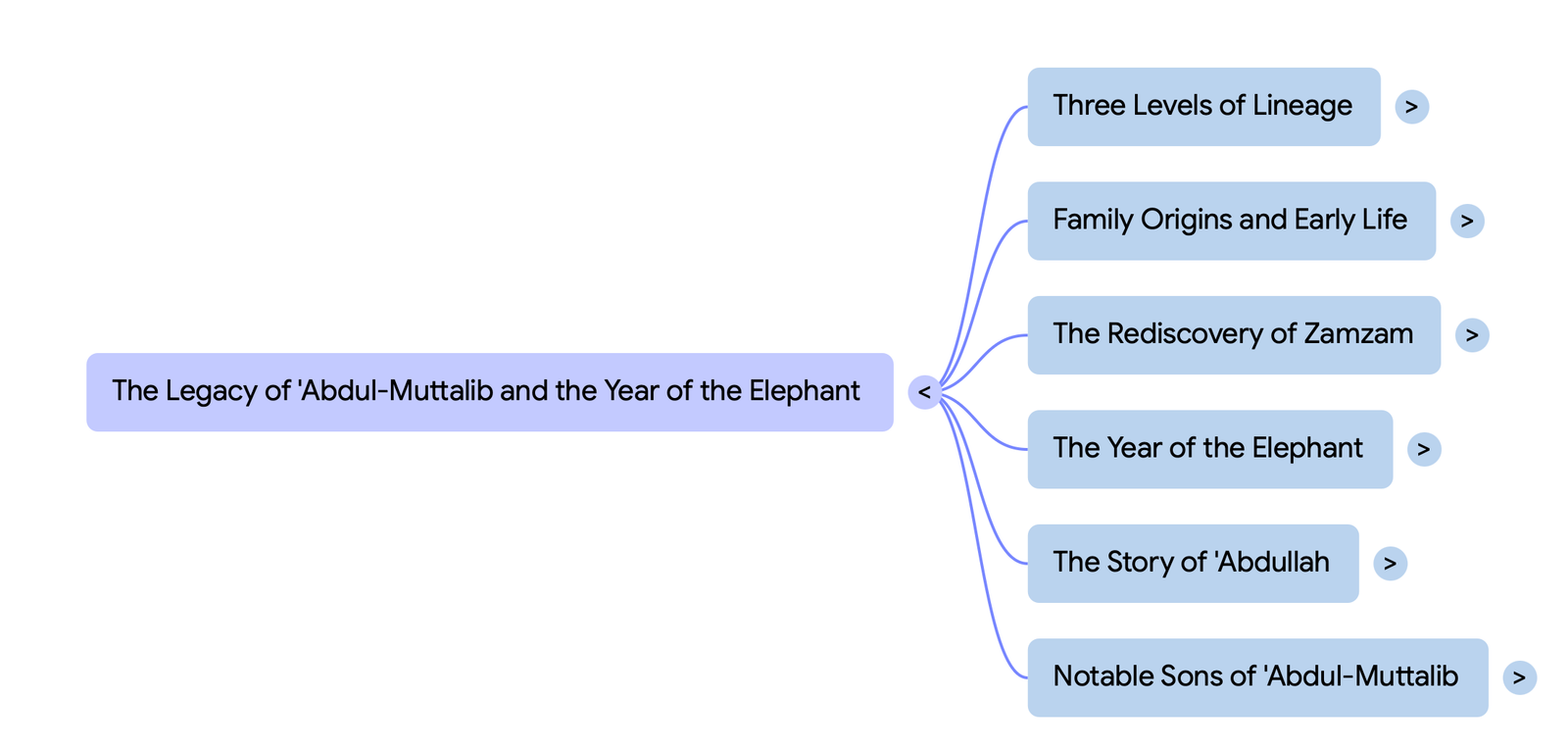
Biographers trace the Prophet’s ﷺ family tree on three levels. The first, from Muhammad ﷺ back to ‘Adnan, is agreed upon without dispute by every historian and genealogist. We already walked through this chain in Part 1: Muhammad ﷺ, son of ‘Abdullah, son of ‘Abdul-Muttalib, son of Hashim, son of ‘Abd Manaf, son of Qusai, all the way to ‘Adnan.
The second level, from ‘Adnan back to Ibrahim عليه السلام, is far less certain, with historians recording long and sometimes conflicting chains of names. The third level, tracing lineage beyond Ibrahim عليه السلام back to Adam عليه السلام, is even less reliable, and scholars generally advise caution here rather than treating it as settled fact. It is worth remembering what the Prophet ﷺ himself is reported to have said whenever his ancestry was traced past ‘Adnan: that genealogists beyond this point often speak without real knowledge. What matters for us, and what is agreed upon with certainty, is the first chain, and that chain leads directly to the household we are about to meet.
Hashim: The Man Who Fed the Pilgrims
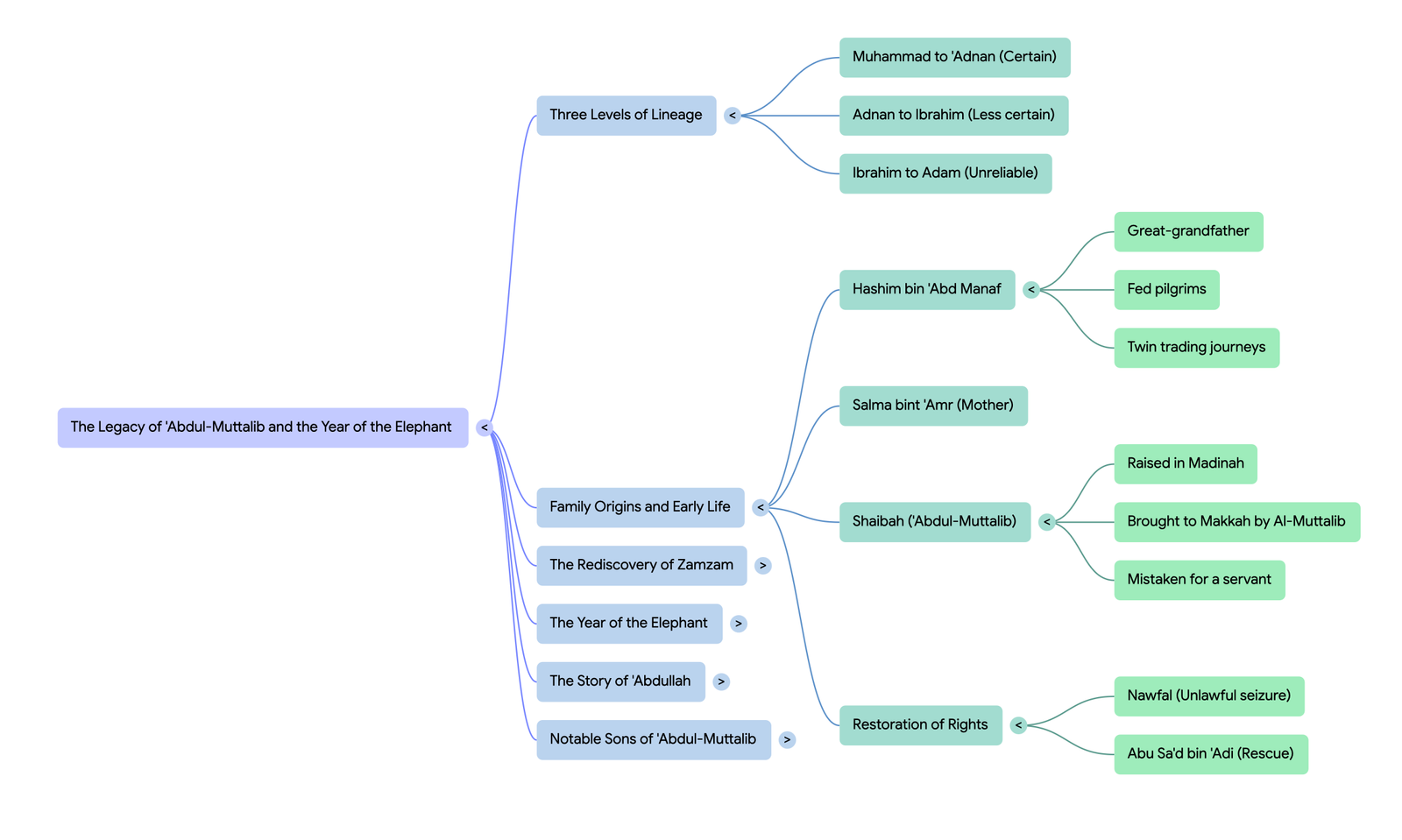
We introduced Hashim bin ‘Abd Manaf in Part 2, when the sons of ‘Abd Manaf and ‘Abdud-Dar divided responsibilities after Qusai’s death, with Hashim inheriting the honor of feeding and providing water to pilgrims. His actual first name was ‘Amr, but he earned the name Hashim, meaning one who crumbles bread, because of his habit of breaking bread into broth to feed the pilgrims himself. He was also the one who began Quraish’s famous twin trading journeys, one to Syria in summer, one to Yemen in winter, a trade rhythm the Qur’an later references in Surah Quraish.
On one of his journeys to Syria, Hashim passed through Madinah and married Salma bint ‘Amr of Bani ‘Adi bin An-Najjar. He left again for Syria while she was pregnant, and died in Gaza before he ever saw his child. Salma gave birth to a son with a streak of white hair, and named him Shaibah. No one in Makkah even knew the child had been born. That child would grow up to be known as ‘Abdul-Muttalib, the Prophet’s ﷺ own grandfather.
Who’s who
- Hashim bin ‘Abd Manaf — the Prophet’s ﷺ great-grandfather, honored with feeding pilgrims, and the man after whom the entire Hashimite family is named.
- Salma bint ‘Amr — Hashim’s wife from Madinah, who raised ‘Abdul-Muttalib alone in her father’s household for the first years of his life.
Bringing ‘Abdul-Muttalib Home
Years passed with young Shaibah growing up in Madinah, completely unknown to his family in Makkah. Eventually his uncle, Al-Muttalib bin ‘Abd Manaf, who had taken over Hashim’s responsibilities, heard of the boy and travelled to Madinah to find him. When he saw him, he was overcome with emotion, embraced him, and set him on his own camel. The boy, showing remarkable respect even as a child, refused to leave until his mother agreed.
Al-Muttalib eventually persuaded Salma by telling her that her son deserved to inherit his father’s position and live beside the Sacred House. When they arrived in Makkah, people assumed the boy riding behind Al-Muttalib was a servant, and began calling him ‘Abdul-Muttalib, the servant of Muttalib, a nickname that stuck for the rest of his life, even though his real name was Shaibah.
Who’s who
- Al-Muttalib bin ‘Abd Manaf — Hashim’s brother, known for honesty and generosity, who personally brought young ‘Abdul-Muttalib to Makkah and raised him.
A Threat, and a Rescue
When Al-Muttalib later died in Yemen, a relative named Nawfal seized ‘Abdul-Muttalib’s inherited responsibilities without any right to them. Quraish, when asked to intervene, chose to stay neutral. So ‘Abdul-Muttalib turned to his mother’s family, Bani An-Najjar in Madinah, for help.
His uncle, Abu Sa’d bin ‘Adi, rode into Makkah at the head of eighty horsemen. Before even greeting his nephew, he confronted Nawfal directly beside the Ka’bah, sword drawn, and warned him that unless he returned what belonged to ‘Abdul-Muttalib, he would pay with his life. Nawfal backed down immediately, in front of the assembled elders of Quraish. Not long after, the tribe of Khuza’ah, seeing this show of support, formed their own alliance with Banu Hashim as well, an alliance that would, decades later, become one of the direct causes behind the peaceful conquest of Makkah.
Who’s who
- Nawfal — a relative of ‘Abdul-Muttalib who unlawfully seized his inherited responsibilities after Al-Muttalib’s death.
- Abu Sa’d bin ‘Adi — ‘Abdul-Muttalib’s maternal uncle, who rode to Makkah with eighty men to restore his nephew’s rights.
The Rediscovery of Zamzam
‘Abdul-Muttalib went on to become one of the most respected men in Makkah, and his life was marked by two extraordinary events. The first was the rediscovery of zamzam.
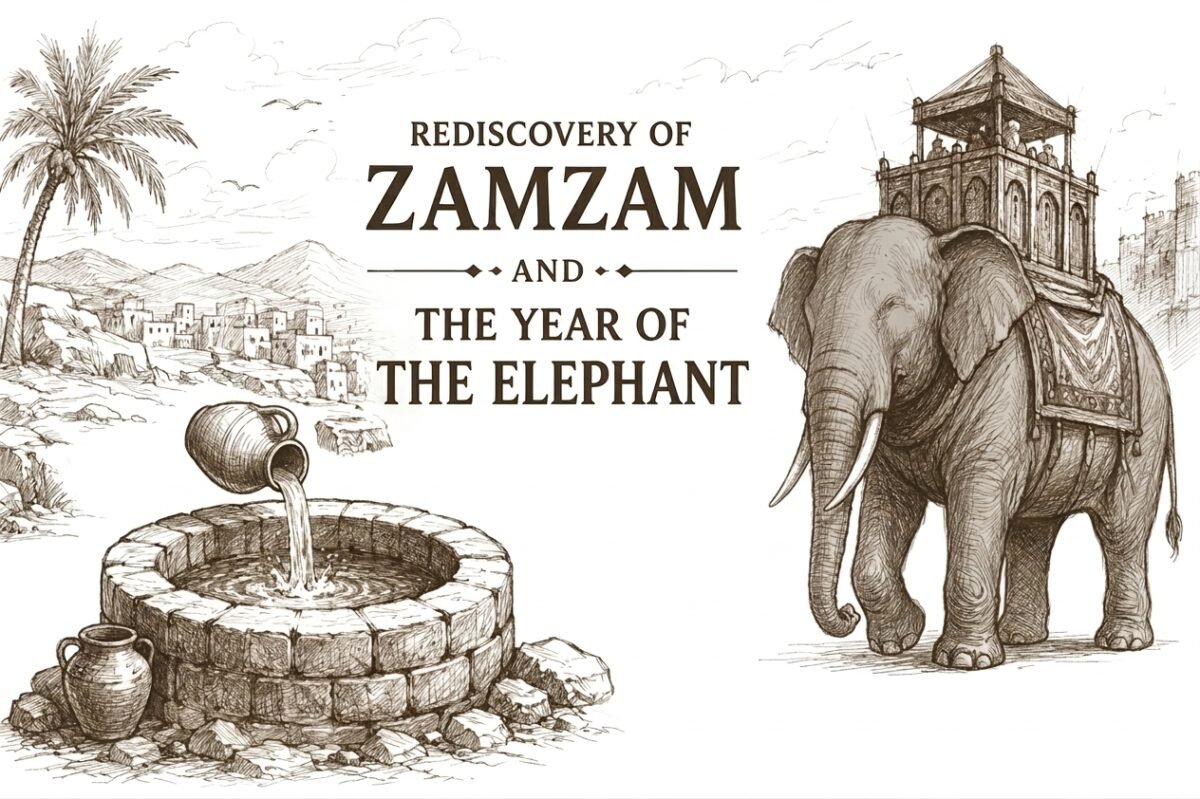
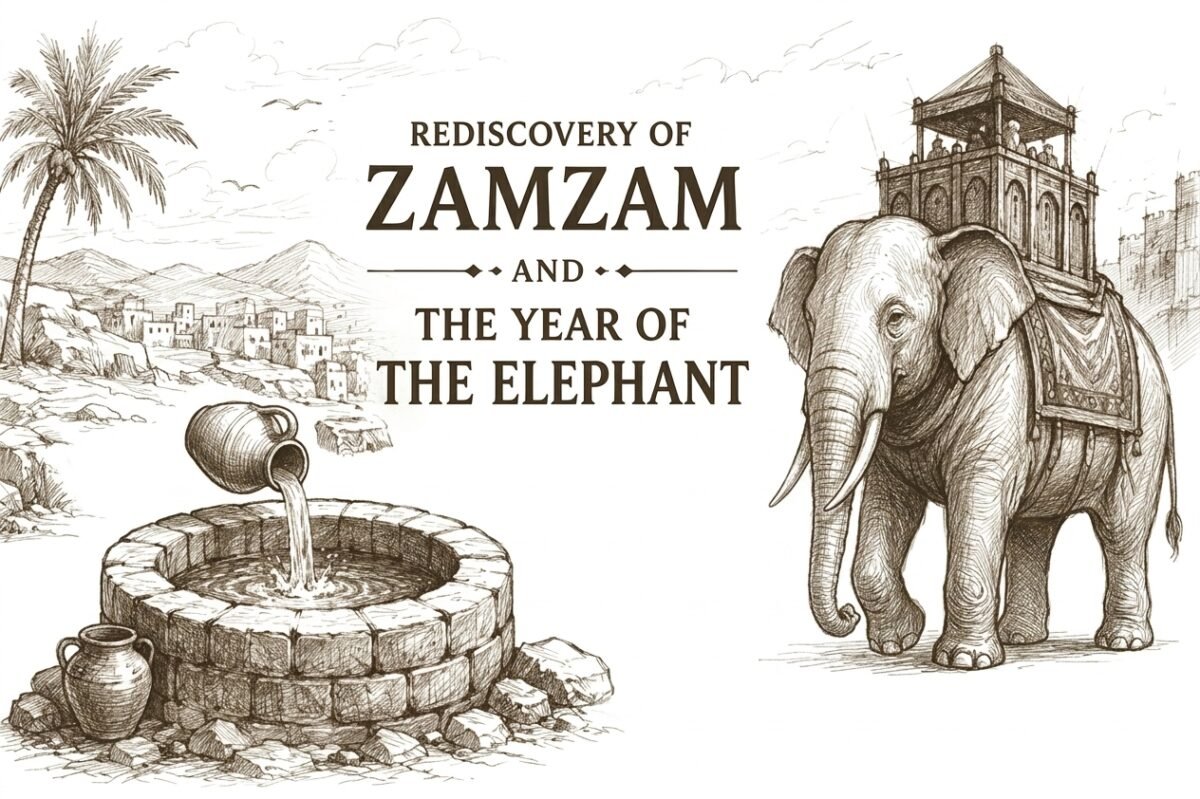
Recall from Part 2 that the well of Zamzam had been filled in and hidden by the tribe of Jurhum when they were driven out of Makkah, centuries earlier. ‘Abdul-Muttalib received a series of dreams instructing him to dig in a very specific spot. He followed the instruction, and there, buried beneath the earth, he found not only the lost spring itself but also swords, armor, and the two golden deer that Jurhum had buried there long before. The gold was used to overlay the door of the Ka’bah, and from that day, the tradition of providing Zamzam water to pilgrims, a tradition that continues to this very day, was firmly reestablished.
When the well began to flow, other clans of Quraish demanded a share in the enterprise. ‘Abdul-Muttalib refused, insisting that Allah had singled him out alone for this honor. The dispute was nearly taken to a diviner for arbitration, but before that could happen, a series of unmistakable signs confirmed ‘Abdul-Muttalib’s claim, and the matter was settled in his favor. It was around this time that ‘Abdul-Muttalib made a private vow: if Allah blessed him with ten sons who lived to see adulthood, he would sacrifice one of them at the Ka’bah. We will return to this vow shortly, because it is directly tied to the Prophet’s ﷺ own father.
The Year of the Elephant
The second defining event of ‘Abdul-Muttalib’s life is one of the most famous stories in all of Seerah, and one that directly precedes the Prophet’s ﷺ birth.
Abrahah, the Abyssinian viceroy ruling Yemen at the time, noticed how devotedly the Arabs made pilgrimage to the Ka’bah, and grew envious of Makkah’s religious prestige. He built an enormous church in San’a’ hoping to redirect the Arabs’ pilgrimage there instead. When a man from the tribe of Kinanah realized what Abrahah intended, he expressed his contempt for the plan by desecrating the church under cover of night. Enraged, Abrahah assembled a massive army, reportedly sixty thousand strong, accompanied by a fleet of elephants, and marched toward Makkah with the explicit goal of demolishing the Ka’bah itself.
Who’s who
- Abrahah — the Abyssinian ruler of Yemen who marched on Makkah with an army and elephants to destroy the Ka’bah, in the year the Prophet ﷺ was born.
As the army approached the valley of Muhassir, between Muzdalifah and Mina, something strange happened. The lead elephant knelt down and refused to move toward Makkah, no matter how hard the soldiers tried to force it forward. It would walk readily in any other direction, but the moment it was turned toward the Ka’bah, it simply refused. Then, from the sky, Allah sent flocks of birds carrying small stones of baked clay, striking Abrahah’s army with devastating force. The soldiers were struck down and scattered like chaff, Abrahah himself was struck with an illness that caused his fingers to fall away piece by piece, and he died in agony not long after returning to San’a’. The people of Makkah, who had fled to the surrounding hills to watch helplessly, returned to find their city, and their Sacred House, completely untouched.
This event, referenced directly in Surah Al-Fil in the Qur’an, took place in the month of Muharram, fifty to fifty-five days before the birth of the Prophet ﷺ, corresponding to roughly late February or early March of the year 571 C.E. Consider what this means: in the very same year, within weeks of one another, Allah defended His House from destruction and then sent into the world the man who would restore it to the purpose it was originally built for. It is difficult to read this as coincidence. It reads instead like a divine announcement, a sign to the whole known world, Roman, Persian, Abyssinian alike, that something of enormous significance was about to unfold in that small, dusty valley in Hijaz.
The Ten Sons of ‘Abdul-Muttalib
‘Abdul-Muttalib was blessed, according to most narrations, with ten sons: Al-Harith, Az-Zubair, Abu Talib, ‘Abdullah, Hamzah, Abu Lahab, Al-Ghidaq, Maqwam, Safar, and Al-‘Abbas, along with six daughters. Several of these names will matter enormously as this series continues. Abu Talib would become the Prophet’s ﷺ devoted protector during the difficult years of his mission. Hamzah would become one of the most beloved and fearless of the Companions رضي الله عنه. Al-‘Abbas رضي الله عنه would later embrace Islam and become a key figure in the early Muslim community. Abu Lahab, tragically, would become one of the Prophet’s ﷺ most bitter opponents, so much so that an entire chapter of the Qur’an, Surah Al-Masad, was revealed condemning his hostility. Keep these names in mind. We will meet each of them properly in the chapters ahead.
But it is the son named ‘Abdullah whose story we need to follow right now, because he is the Prophet’s ﷺ own father.
‘Abdullah: The Son Who Was Nearly Sacrificed
Remember ‘Abdul-Muttalib’s vow, that if he had ten sons reach adulthood, he would sacrifice one of them at the Ka’bah? When that day came, he gathered his sons, and true to their character, they accepted his vow without protest. Names were written on divination arrows and placed before the idol Hubal. When the arrows were drawn, the name that came out was ‘Abdullah, described as the most beloved, the most chaste, and the most intelligent of all his sons.
‘Abdul-Muttalib took him toward the Ka’bah, ready to fulfill his vow. Quraish, along with ‘Abdullah’s own uncles from Bani Makhzum and his brother Abu Talib, pleaded with him to reconsider. Under pressure, ‘Abdul-Muttalib agreed to consult a woman known for divination. Her advice was this: draw lots again, this time between ‘Abdullah and ten camels, and if the arrow still points to ‘Abdullah, add ten more camels each time, until the arrow finally points to the camels instead.
The lots were drawn again and again. Each time the arrow pointed back to ‘Abdullah. Ten camels became twenty, then thirty, all the way up to one hundred, at which point the arrow finally pointed to the camels. The hundred camels were slaughtered in ‘Abdullah’s place, and this event permanently changed the accepted value of blood money in Arabia from ten camels to one hundred, a standard that Islam later confirmed. The Prophet ﷺ himself would later refer to this story, saying that he was the descendant of the two who were meant to be sacrificed, meaning Isma’il عليه السلام, spared by a ram, and ‘Abdullah, spared by a hundred camels.
Who’s who
- ‘Abdullah bin ‘Abdul-Muttalib — the Prophet’s ﷺ father, the son nearly sacrificed at the Ka’bah, remembered for his intelligence, chastity, and the deep love his father held for him.
Who was Aminah
‘Abdul-Muttalib chose Aminah bint Wahb, from the noble family of Bani Zuhrah, to be ‘Abdullah’s wife. She came from a household of real distinction, her father being the chief of his clan. They married in Makkah, and soon after, ‘Abdullah set out on a journey, most accounts say to buy dates in Madinah, others say a trading journey to Syria that ended in Madinah on the way back. There, still a young man of twenty-five, he fell ill and passed away, before he ever saw the face of his son.
He left behind very little in the way of wealth, five camels, a small flock of goats, and a servant girl named Barakah, who would later be known as Umm Ayman, and who would go on to serve as the Prophet’s ﷺ own nursemaid, remaining devoted to him for the rest of her life. When news of ‘Abdullah’s death reached Aminah, who was by then carrying her child, she mourned him with words so moving that they were remembered and repeated by later generations.
Who’s who
- Aminah bint Wahb — the Prophet’s ﷺ mother, from the noble family of Bani Zuhrah, widowed while still pregnant with him.
- Barakah, known as Umm Ayman — ‘Abdullah’s servant, inherited among his modest belongings, who would go on to nurse and care for the Prophet ﷺ throughout his childhood.
Key Takeaways for Students
- The Prophet’s ﷺ lineage back to ‘Adnan is agreed upon by all historians, while anything traced further back should be treated with appropriate caution, as the Prophet ﷺ himself indicated.
- ‘Abdul-Muttalib’s own childhood, an unknown boy in Madinah mistaken for a servant, mirrors a pattern we will see again in this Seerah: greatness that begins in humility.
- The rediscovery of Zamzam was not a random archaeological find. It restored a sacred tradition that Jurhum had buried away, and it happened in the hands of the very family Allah had chosen.
- The Year of the Elephant and the birth of the Prophet ﷺ occurred within the very same year, a striking sign that did not go unnoticed by the wider world at the time.
- ‘Abdullah’s story, drawn by lot toward sacrifice and spared by a hundred camels, connects directly back to Isma’il عليه السلام, and the Prophet ﷺ himself pointed to this connection.
Let Us Discuss
- Which moment in today’s post moved you the most, the rescue of young ‘Abdul-Muttalib, the rediscovery of Zamzam, the Year of the Elephant, or the story of ‘Abdullah?
- Why do you think Allah arranged for the Prophet ﷺ to be born as an orphan, his father having passed away before his birth?
- Had you previously known the connection between the sacrifice of Isma’il عليه السلام and the story of ‘Abdullah?
Please share your reflections in the comments, and if this series is benefiting you, please share it with your friends and family so more people can benefit too, in sha’ Allah.
Coming up in Part 5: The moment we have been building toward, the birth of the Prophet Muhammad ﷺ himself, the signs that accompanied it, and the early months of his life in the care of his mother Aminah. Check back in a few days, in sha’ Allah.
May Allah send His peace and blessings upon our beloved Prophet Muhammad ﷺ, upon his pure family, and upon all his noble Companions رضي الله عنهم أجمعين. Ameen.
Try this Quiz on Seerah Part 4
How do historians view the Prophet's ﷺ lineage beyond 'Adnan back to Ibrahim عليه السلام?
The lineage back to 'Adnan is agreed upon without dispute, but tracing from 'Adnan to Ibrahim عليه السلام is far less certain with conflicting chains.
What was the actual first name of Hashim bin 'Abd Manaf?
His actual first name was 'Amr, but he earned the name Hashim ('one who crumbles bread') because of his habit of breaking bread into broth to feed pilgrims.
Why was young Shaibah given the nickname ''Abdul-Muttalib' upon arriving in Makkah?
When Al-Muttalib brought young Shaibah to Makkah, people assumed the boy riding behind him was his servant ('abd) and began calling him 'Abdul-Muttalib.
Who rode to Makkah with eighty horsemen to restore 'Abdul-Muttalib's rights from Nawfal?
'Abdul-Muttalib's maternal uncle, Abu Sa'd bin 'Adi from Madinah, confronted Nawfal with eighty horsemen to demand the return of his inherited rights.
What items were buried and rediscovered alongside the spring of Zamzam?
Buried beneath the earth at the Zamzam site, 'Abdul-Muttalib found the lost spring along with swords, armor, and two golden deer buried by Jurhum.
How long before the birth of the Prophet ﷺ did the Year of the Elephant occur?
The event of the Elephant took place in Muharram, roughly fifty to fifty-five days before the birth of the Prophet ﷺ in 571 C.E.
Which uncle of the Prophet ﷺ was condemned for his hostility in Surah Al-Masad?
Abu Lahab tragically became one of the Prophet's ﷺ most bitter opponents, leading to the revelation of Surah Al-Masad condemning him.
How many camels were ultimately sacrificed to redeem 'Abdullah from his father's vow?
Lots were drawn repeatedly, increasing by ten camels each time until reaching one hundred camels, at which point the arrow finally pointed to the camels.
Who were the 'two intended for sacrifice' that the Prophet ﷺ referred to in his ancestry?
The Prophet ﷺ declared himself the descendant of the two who were meant to be sacrificed: Isma'il عليه السلام (spared by a ram) and 'Abdullah (spared by 100 camels).
Which servant was left behind by 'Abdullah and went on to nurse the Prophet ﷺ?
'Abdullah left behind a servant girl named Barakah (known as Umm Ayman), who became the Prophet's ﷺ devoted nursemaid.
Share your Results:
A small request: kindly share the original link , this helps us continue our dawah work and reach more people. Jazakumullahu Khairan.
Check : Madrsatuna : 1-1 Islamic classes for Girls
Written by

Ustadha Fahmina holds a Sanad in Alimiyyah (6-year Dars-e-Nizami) from two recognized Islamic institutes and a Master's degree in Arabic . She teaches Qur'an, Tafsir, Hadith, and Fiqh following the Hanafi school within Ahl al-Sunnah wal Jama'ah. She founded Islam Hashtag in 2015 to bring authentic Islamic learning to Muslim families online. She also holds a degree in Optometry and is the founder of Optometryskills.com.
Discover more from Islam Hashtag
Subscribe to get the latest posts sent to your email.