Seerah Series Part 3: Pre-Islamic Arabia: Social, Economic & Moral Life before Islam
Assalamu Alaikum wa Rahmatullahi wa Barakatuh,
In Part 2 we looked at who held power in pre-Islamic Arabia and how idol worship entered the Ka’bah through ‘Amr bin Luhai. Today we step back from politics and religion and look at something closer to everyday life: how people actually lived, how they treated one another, how they earned a living, and what kind of character they carried. This background matters enormously, because when the prophet ﷺ arrived with his message, he was not simply correcting the belief of people, he was reforming an entire society, its treatment of women, its economy, its family bonds, and its sense of right and wrong. You cannot appreciate the size of that reform without first seeing clearly what came before it.
Seerah Series Part 3: Social, Economic and Moral Life Before Islam
(Seerah of Prophet Muhammad ﷺ | The Sealed Nectar Summary | Rabi-ul-Awwal Special)
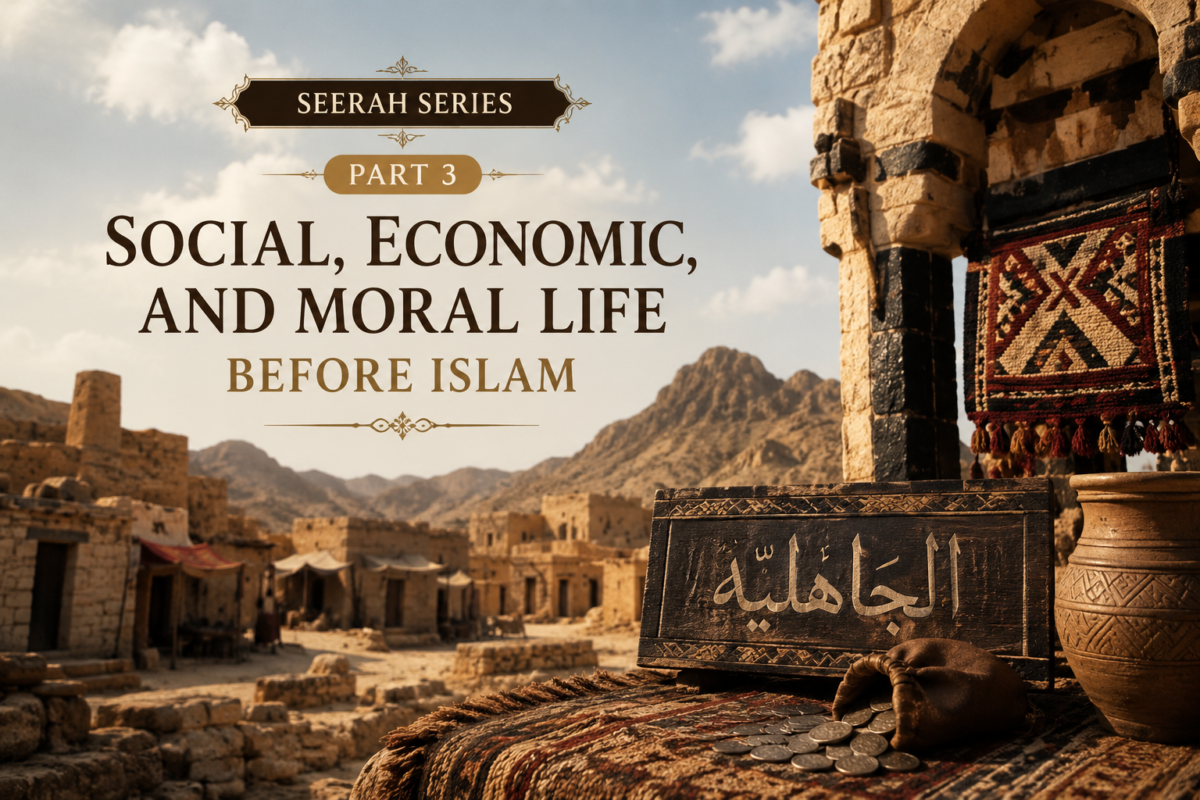
A Society of Sharp Contrasts -Jahilliyah era
Pre-Islamic Arabian society was not one single picture. It was a patchwork of very different realities existing side by side. Among the noble families, women could hold real influence, their opinion often carried weight, and their honor was something men were prepared to fight and die for. At the very same time, the overall family structure remained strictly patriarchal, and a woman’s marriage was decided entirely by her male guardian, with no say of her own in many cases.
Outside these noble circles, conditions could be far darker. ‘Aishah رضي الله عنها, the Prophet’s ﷺ wife, described that several different types of marital and non-marital arrangements existed in that society, ranging from something resembling a proper marriage with a guardian’s consent and an agreed dowry, to arrangements that reduced women to little more than a means of producing children for men who had no lasting responsibility toward them, to situations where a woman was left with no protection or dignity at all, and a child’s paternity would afterward be guessed at or assigned by a fortune-teller. When Islam arrived, the Prophet ﷺ abolished every one of these practices, retaining only marriage as we understand it in Islam today: a clear contract, a willing bride, a guardian, and a dowry.
This is worth sitting with. One of the very first things Islam did, before addressing politics or economics, was restore the dignity of the marriage contract itself, and with it, the dignity of women.
Marriage, Divorce, and the Limits That Did Not Exist
Pre-Islamic Arabs placed no limit on the number of wives a man could take. Men could even marry two sisters simultaneously, or marry the widow or divorcee of their own father, practices the Qur’an later addressed directly, laying out clearly who was and was not permissible to marry and closing these particular doors for good. Divorce, meanwhile, rested almost entirely in the hands of the husband, with the wife having little to no say in the matter.
Adultery, sadly, was widespread across most levels of society, held back only by the personal self-respect of a minority of men and women. Islam’s response was firm and unambiguous: the Prophet ﷺ established that a child belongs to the family into which he or she was born, and that lineage disputes rooted in pre-Islamic practices carried no weight whatsoever once Islam arrived. The past was closed, and a clear, dignified standard was set going forward.
The Tragedy of Female Infanticide:status of women in pre-Islamic Arabia
Perhaps the most heartbreaking practice of the era was the burying alive of infant daughters, driven by an irrational fear of poverty or a distorted sense of shame. The Qur’an confronts this practice with unusual emotional force, describing how a father’s face would darken with grief upon hearing he had been given a daughter, and how he would hide from his own community rather than face them, torn between the “choice” of keeping her in what he wrongly saw as disgrace, or burying her alive. On the Day of Judgment, the Qur’an says, that buried infant girl will be asked for what crime she was killed. It is important to note, as the Sealed Nectar itself clarifies, that this practice was not the universal norm, tribes also needed sons in large numbers for warfare and survival, but it happened often enough, and was tolerated widely enough, that Allah addressed it directly and repeatedly in the Qur’an.
Tribal Loyalty: A Double-Edged Sword
Arab society ran on tribal loyalty, or ‘asabiyyah, and it was one of the strongest emotional forces in a person’s life. Their well-known saying, support your brother whether he is the oppressor or the oppressed, was taken completely literally, with no room for the correction Islam would later add: that supporting an oppressor means stopping him from his oppression, not joining him in it.
This same fierce loyalty, combined with a hunger for status and leadership, fueled long and bloody conflicts between tribes who often shared the very same ancestry, the wars between Aws and Khazraj, between ‘Abs and Dhubyan, between Bakr and Taghlib, are well documented examples. What kept society from complete collapse was a mix of superstition-driven restraint, the value placed on alliances and loyalty, and a remarkable custom: the sacred months of Muharram, Rajab, Dhul-Qa’dah, and Dhul-Hijjah, during which all hostilities were suspended by mutual agreement, allowing trade, travel, and the great seasonal gatherings to take place in relative peace.
The Economic Reality
Economically, Arabia was fragile. Trade was the backbone of survival, but trade required safe roads and temporary peace between tribes, both of which were rare outside the sacred months. It was during these months that the great markets of the era, ‘Ukaz, Dhul-Majaz, and Majannah, would come alive, serving as both commercial fairs and cultural gatherings where poetry was recited and reputations were made.
Arabia had almost no industry of its own. Skilled trades like weaving and tanning were largely brought in by people from Yemen, Heerah, and Syria. Farming and livestock rearing existed in pockets, and Arab women were broadly skilled in spinning yarn, though even that modest trade was constantly disrupted by tribal warfare. Poverty, hunger, and inadequate clothing were, for most people, simply the normal condition of life.
The Virtues That Remained
Here is something important, and something I think we sometimes forget when we focus only on the darkness of the pre-Islamic period: this was not a society without any good in it. Alongside real evils, the Arabs held onto a set of virtues that Islam would later refine, elevate, and put to proper use rather than discard.
Hospitality was perhaps their most celebrated trait. Entire chapters of pre-Islamic poetry are devoted to it. There are accounts of a host slaughtering the one animal his entire family depended on for survival simply because a guest had arrived hungry.
Keeping a covenant was treated as sacred. A promise made was treated as a debt that had to be honored, even at the cost of one’s own family or wealth.
A powerful sense of honor and refusal to tolerate injustice ran deep, alongside firm resolve and determination in pursuing whatever they valued, and a capacity for patience and forbearance that balanced their otherwise fiery, impulsive nature.
Simplicity of desert life, largely untouched by the deception and pretense of city life, fostered genuine honesty and straightforwardness in dealing with others.
It is worth reflecting on why Allah chose this particular people, in this particular place, to carry the final message. Their raw virtues, hospitality, courage, loyalty to one’s word, when properly directed and cleansed of their excesses, became some of the very qualities that allowed the earliest Muslims to sacrifice everything for the sake of this deen. Islam did not need to build good character in the Arabs from nothing. It needed to correct their direction, and channel a character that was already strong toward something worthy of it.
Key Takeaways for Students
- Pre-Islamic Arabian society was a mixture of real dignity for some women and genuine degradation for others, depending entirely on status, a contrast Islam ended by establishing one clear, dignified standard of marriage for everyone.
- The Prophet ﷺ abolished every pre-Islamic form of marital and non-marital union except the marriage contract we recognize in Islam today.
- Female infanticide, though not universal, was widespread enough that the Qur’an addressed it directly and repeatedly, and it stands as one of the clearest examples of the moral darkness Islam came to remove.
- Tribal loyalty (‘asabiyyah) could be both a source of strength and a source of endless, senseless bloodshed, depending on whether it was guided by justice or blind allegiance.
- Despite real evils, the Arabs held onto genuine virtues, hospitality, covenant-keeping, honor, and determination, which Islam did not discard but refined and redirected toward a higher purpose.
Let Us Discuss
- Which of the virtues mentioned today, hospitality, covenant-keeping, honor, forbearance, do you think is most needed in our communities again today?
- How does understanding the depth of pre-Islamic darkness change the way you see the reforms the Prophet ﷺ brought regarding women and family life?
- Were you aware that some of these very practices are directly addressed, verse by verse, in the Qur’an?
Please share your reflections in the comments, and if you are benefiting from this series, please pass it on to your friends and family so they can benefit too, in sha’ Allah.
May Allah send His peace and blessings upon our beloved Prophet Muhammad ﷺ, upon his pure family, and upon all his noble Companions رضي الله عنهم أجمعين. Ameen.
Try this Quiz on seerah
What was the condition of women in pre-Islamic Arabian society?
Pre-Islamic Arabian society was a patchwork: women in noble families held influence and honor, while outside those circles they faced strict patriarchal control and degrading marital practices.
How did Islam reform the various pre-Islamic marital practices described by 'Aishah رضي الله عنها?
Islam abolished all informal and degrading unions, retaining only one clear, dignified marriage contract involving consent, a guardian, and a dowry.
What limits existed on marriage and divorce for men in pre-Islamic Arabia before Islam?
There were no limits on the number of wives a man could take, and men could marry two sisters at once or their father's widow, with divorce resting entirely in the husband's hands.
What drove the heartbreaking pre-Islamic practice of female infanticide?
Female infanticide was driven primarily by an irrational fear of poverty or a distorted, exaggerated sense of shame.
How did Islam correct the pre-Islamic understanding of 'Support your brother whether he is the oppressor or the oppressed'?
Islam clarified that supporting an oppressing brother means stopping him from committing oppression, rather than blindly assisting him in wrongdoing.
Which four months were observed as sacred, suspending all hostilities for trade and travel?
The four sacred months in which war and hostility were strictly forbidden by mutual custom were Muharram, Rajab, Dhul-Qa'dah, and Dhul-Hijjah.
What served as the primary backbone of economic survival in pre-Islamic Arabia?
Trade was the main backbone of survival, dependent on temporary peace during sacred months and safe roads across the peninsula.
Where did skilled trades like weaving and tanning largely originate before arriving in Arabia?
Arabia had little industry of its own; skilled crafts such as weaving and tanning were brought in by people from Yemen, Heerah, and Syria.
Which virtue was considered so sacred that a host might slaughter his only animal for a guest?
Hospitality was among the most celebrated virtues of the pre-Islamic Arabs, often praised in poetry for supreme self-sacrifice for guests.
How did Islam interact with the positive pre-Islamic Arab virtues like honor and covenant-keeping?
Islam did not destroy or discard their noble natural traits; it cleansed, refined, and redirected them toward a higher, divine purpose.
Share your Results:
Written by

Ustadha Fahmina holds a Sanad in Alimiyyah (6-year Dars-e-Nizami) from two recognized Islamic institutes and a Master's degree in Arabic . She teaches Qur'an, Tafsir, Hadith, and Fiqh following the Hanafi school within Ahl al-Sunnah wal Jama'ah. She founded Islam Hashtag in 2015 to bring authentic Islamic learning to Muslim families online. She also holds a degree in Optometry and is the founder of Optometryskills.com.
Discover more from Islam Hashtag
Subscribe to get the latest posts sent to your email.