 By Fahmina
Al-Majalis bil-Amana Hadith
Alhumdillah I have the honor to teach the hadith of Rasul allah Sallalahu alaihe wa sallaam. I have made this interactive activity where the students of hadith can learn short hadith.
Here is a short hadith from the book Zad at Talibeen.
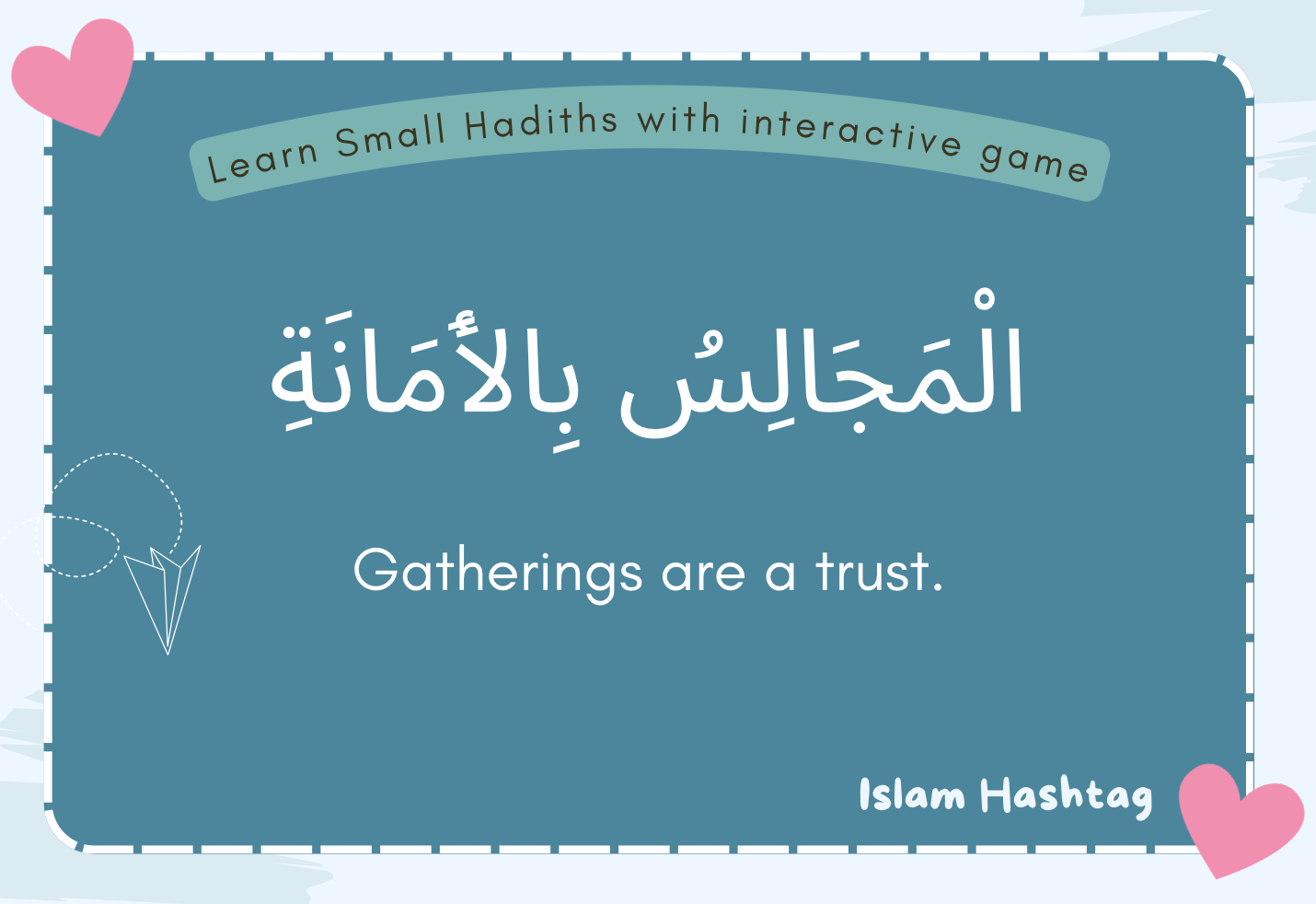
Al-Majalis bil-Amana Hadith
الْمَجَالِسُ بِالأَمَانَةِ
It can be translated as Gatherings are to be kept in confidence or Gatherings are a trust
Masha Allah! You got it right!
المجالس بالأمانة
مجالس (majaalis) is the broken plural for مجلس (majlis) which comes from the root جلس (jalasa), meaning “to sit”. Basically, a majlis is any sort of a sitting with two or more people.
An أمَانَة (amaanah) is a trust, and it comes from the root امن (amuna) which means “to be faithful, reliable, trustworthy, to be safe, to feel safe”. Other words from this root include آمين (aameen, related to the English word amen), and مؤمن (mu’min) which means a believer.
The Hadith “Al-Majlis bil-Amanat” conveys the ethical principle that participants in a meeting are bound by a sacred duty to keep the discussions and anything shared within the meeting confidential. It is a call for trustworthiness and discretion in social and religious settings.
It is extracted from this hadith :
Narrated Jabir ibn Abdullah:
The prophet (ﷺ) said: Meetings are confidential except three: those for the purpose of shedding blood unlawfully, or committing fornication, or acquiring property unjustly.
حَدَّثَنَا أَحْمَدُ بْنُ صَالِحٍ، قَالَ قَرَأْتُ عَلَى عَبْدِ اللَّهِ بْنِ نَافِعٍ قَالَ أَخْبَرَنِي ابْنُ أَبِي ذِئْبٍ، عَنِ ابْنِ أَخِي، جَابِرِ بْنِ عَبْدِ اللَّهِ عَنْ جَابِرِ بْنِ عَبْدِ اللَّهِ، قَالَ قَالَ رَسُولُ اللَّهِ صلى الله عليه وسلم “ الْمَجَالِسُ بِالأَمَانَةِ إِلاَّ ثَلاَثَةَ مَجَالِسَ سَفْكُ دَمٍ حَرَامٍ أَوْ فَرْجٌ حَرَامٌ أَوِ اقْتِطَاعُ مَالٍ بِغَيْرِ حَقٍّ ” .
This is one of the hadiths that indicate the perfection of the religion, as it relates to noble character, which many people have become heedless of. A man may confide a secret to his companion, then the other publicly discloses it without the permission of the one who entrusted him with the secret. This is from bad character—and we seek refuge in Allah.
I say: Its meaning is supported by a ḥasan hadith narrated by al-Tirmidhī under the chapter “What Has Been Reported That Gatherings Are a Trust”.
Aḥmad ibn Muḥammad narrated to us; ‘Abdullāh ibn al-Mubārak narrated to us, from Ibn Abī Dhi’b, who said: ‘Abd al-Raḥmān ibn ‘Aṭā’ informed me, from ‘Abd al-Malik ibn Jābir ibn ‘Atīk, from Jābir ibn ‘Abdullāh, from the Prophet ﷺ, who said:
“If a man speaks a statement, then looks around, it is a trust.”
Abū ‘Īsā (al-Tirmidhī) said:
“This is a ḥasan hadith, and we only know it through the narration of Ibn Abī Dhi’b.”
Al-‘Aẓīm Ābādī said in ‘Awn al-Ma‘būd:
“(Gatherings are held in trust): Ibn Raslān said that the letter bā’ is connected to an omitted word, the estimation being: ‘Gatherings are good’ or ‘The goodness and honor of gatherings lies in the trustworthiness of those present,’ due to what occurs in gatherings in words and actions. The meaning, then, is that the one present in a gathering should be trustworthy regarding what he hears or sees.”
Al-Mubārakfūrī said:
His statement, ‘If a man speaks’—meaning to someone—‘a statement’, meaning something he wants to conceal; ‘then looks around’, meaning to the right and left as a precaution; ‘it is a trust’, meaning that statement, and you, as the recipient of it. It is said this is because ḥadīth can mean narration, or the word that was spoken. ‘A trust’ means it carries the ruling of a trust and must be concealed.
Ibn Raslān said:
Because his looking around informs the one he is speaking to that he fears someone else might hear his words and that he has singled him out with his secret. Thus, the act of looking around takes the place of saying, “Keep this secret,” meaning: take it from me and conceal it; it is a trust with you.
Try the Dhikr Tasbih to increase your tasbih
Follow our Page on Hadith in Facebook