Updated March 2026 — expanded with copy-paste Arabic text, all variations, FAQ, Urdu meaning, and Indonesian translation.
If you have ever wanted to know exactly what Allahumma Barik means, when to say it, how to write it in Arabic, and what the difference is between Allahumma Barik and MashaAllah — this is the complete guide. Every Arabic text below is formatted for copy-paste so you can use it immediately in messages, captions, and cards.
Allahumma Barik in Arabic Text — Copy and Paste
Here is Allahumma Barik written in Arabic in every format you need. Tap and hold on mobile to copy, or click and use Ctrl+C on desktop.
اللَّهُمَّ بَارِكْ
With full harakat — for learning and formal writing


اللهم بارك
Without harakat — for WhatsApp and everyday typing
Bless someone, or something
Pick who or what you are blessing. The wording changes to match.
| Variation | Arabic Text | Meaning | Use For |
|---|---|---|---|
| Allahumma Barik Lahu | اللَّهُمَّ بَارِكْ لَهُ | O Allah, bless him | One male |
| Allahumma Barik Laha | اللَّهُمَّ بَارِكْ لَهَا | O Allah, bless her | One female |
| Allahumma Barik Lahum | اللَّهُمَّ بَارِكْ لَهُمْ | O Allah, bless them | A group (mixed or male) |
| Allahumma Barik Lahunna | اللَّهُمَّ بَارِكْ لَهُنَّ | O Allah, bless them | Group of females only |
| Allahumma Barik Lana | اللَّهُمَّ بَارِكْ لَنَا | O Allah, bless us | For yourself + others |
| Allahumma Barik Fihi | اللَّهُمَّ بَارِكْ فِيهِ | O Allah, bless it | An object (masculine) |
| Allahumma Barik Fiha | اللَّهُمَّ بَارِكْ فِيهَا | O Allah, bless it | An object (feminine) |
| Allahumma Barik Lana Fihi | اللَّهُمَّ بَارِكْ لَنَا فِيهِ | O Allah, bless this for us | Food — before eating |
| Allahumma Barik Lahum wa Barik Alaihim | اللَّهُمَّ بَارِكْ لَهُمْ وَبَارِكْ عَلَيْهِمْ | O Allah, bless them and bestow blessings upon them | Wedding dua — Ibn Majah 1906 |
What Does Allahumma Barik Mean?
Allahumma Barik (اللَّهُمَّ بَارِكْ) means “O Allah, bless.” It is a direct supplication — a dua — asking Allah to place His barakah (divine blessing and increase) upon a person, object, or situation.
The phrase is made up of two Arabic words:
- Allahumma (اللَّهُمَّ) — “O Allah.” This is the direct address form used exclusively in dua. It cannot be used in ordinary speech — whenever you say Allahumma, you are speaking directly to Allah.
- Barik (بَارِكْ) — “Bless.” This is the imperative (command) form of the verb baraka, derived from the root word barakah, meaning blessing, increase, and divine abundance.
Together, Allahumma Barik is not a casual phrase or a cultural habit — it is an act of worship. Every time you say it, you are turning your admiration of something into a dua and placing that person or thing under Allah’s protection.
Allahumma Barik Meaning and usage
What Does ‘Allahumma Barik’ Mean?
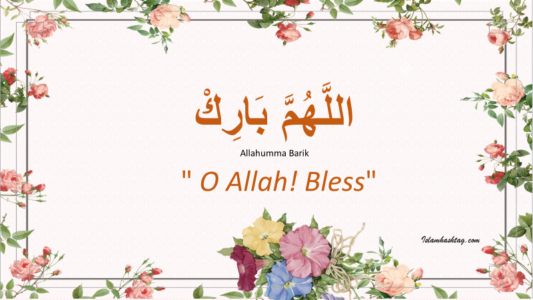
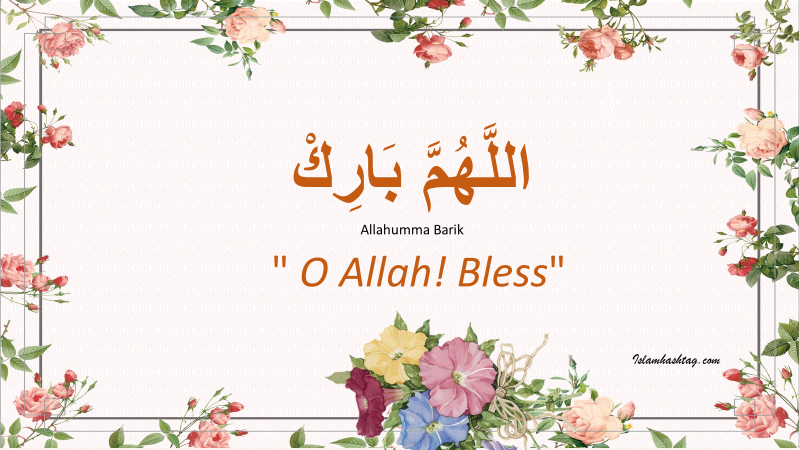
اللَّهُمَّ بَارِكْ
Allahumma Barik means “O Allah! Bless.”
When to Say Allahumma Barik
“Allahumma Barik” is used to seek blessings and productivity. This phrase is often used both formally and non-formally as a prayer of blessing. It is an invocation of Allah’s blessings and grace.
Usage in Sunnah
It is sunnah to say “Allahumma Barik” on the following occasions:
1. When you see something admirable in a person
The prophet ﷺ said: “If one of you sees something with his brother that he admires, let him pray for blessing (barakah) for him.” — Narrated by Imam Malik in al-Muwatta (2/939), Ibn Majah (3509)
This includes admiring someone’s appearance, their children, their home, their car, their intelligence, or any blessing you notice in them.
2. When a baby is born
Say Allahumma Barik Lahu for a boy, or Allahumma Barik Laha for a girl. This is the Sunnah greeting for a newborn — asking Allah to bless the child from the very first moments of their life.
3. At weddings and engagements
The authenticated wedding dua includes Allahumma Barik:
اللَّهُمَّ بَارِكْ لَهُمْ وَبَارِكْ عَلَيْهِمْ
Allahumma barik lahum wa barik alaihim
"O Allah, bless them and bestow blessings upon them."
Sunan Ibn Majah 1906
4. Before eating food
اللَّهُمَّ بَارِكْ لَنَا فِيمَا رَزَقْتَنَا وَقِنَا عَذَابَ النَّارِ بِسْمِ اللَّهِ
Allahumma barik lana fima razaqtana wa qina adhaban-naar. bismillah.
"O Allah! Bless the food You provided us and save us from the punishment of the hellfire. In the Name of Allah."
Sunan Ibn Majah 3322
5. When you fear the evil eye
Even if your admiration is sincere and well-intentioned, saying Allahumma Barik before expressing it protects the person you are looking at from harm. This is especially important when admiring children, beauty, or wealth.
6. For your own new possessions
Scholars recommend saying Allahumma Barik Fihi (O Allah, bless this) when you receive something new — a car, a home, a phone — as a form of gratitude and a reminder that the blessing belongs to Allah.
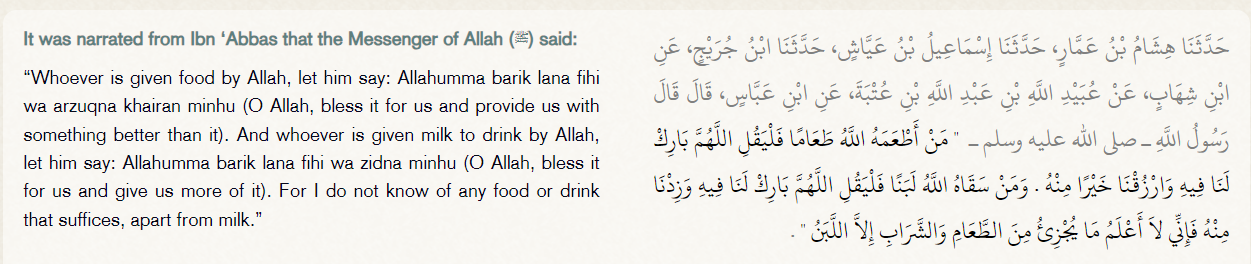
Allahumma Barik Lana
اللّهُمَّ بَارِكْ لَنَا فِيمَا رَزَقْتَنَا، وَقِنَا عَذَابَ النَّارِ ، بِسْمِ اللَّهِ
Transliteration: Allahumma barik lana fima razaqtana wa-qina adhaban-naar. Bismillah
Meaning: “O Allah! Bless (the food) You provided us and save us from the punishment of the hell fire. In the Name of Allah.” Sunan Ibn Majah 3322
Allahumma Barik Lahum
Meaning: O Allah, bless them. (“Lahum” is for plural.)

Allahumma Barik Lahum wa Barik Alaihim
اللَّهُمَّ بَارِكْ لَهُمْ وَبَارِكْ عَلَيْهِمْ
Meaning: O Allah, bless them and bestow blessings upon them. Sunan Ibn Majah 1906
Allahumma barik lahum wa barikalaihim
اللَّهُمَّ بَارِكْ لَهُمْ وَبَارِكْ عَلَيْهِمْ
- It was narrated from Aqil bin Abu Talib: that he married a woman from Banu Jusham, and they said: “May you live in harmony and have many sons.” He said:
“Do not say that, rather say what the Messenger of Allah said: ‘Allahumma barik lahum wa barikalaihim (O Allah, bless them and bestow blessings upon them). Sunan Ibn Majah 1906
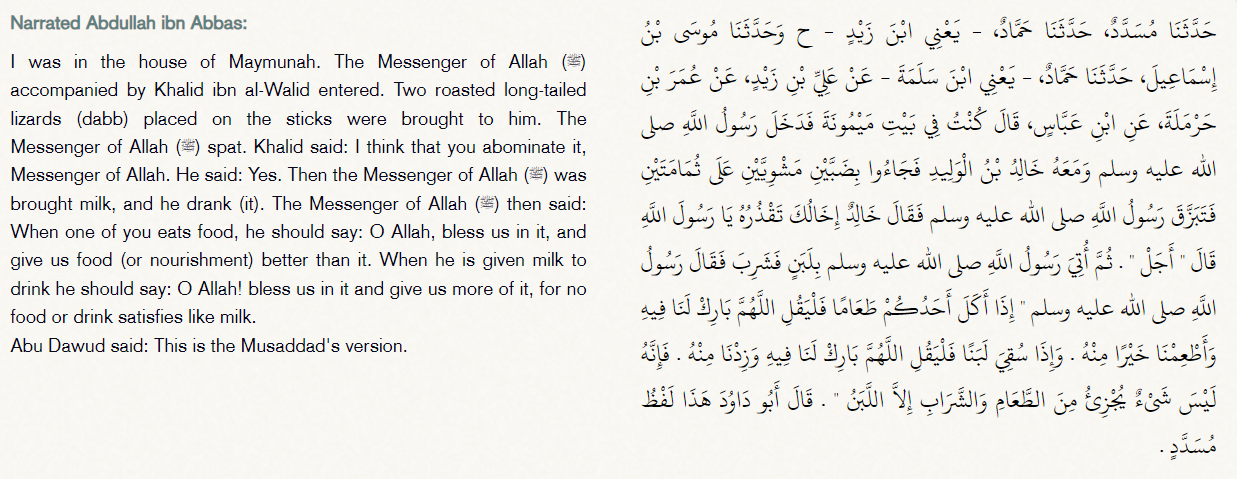
- Narrated Abdullah ibn Abbas: I was in the house of Maymunah. The Messenger of Allah (ﷺ) accompanied by Khalid ibn al-Walid entered.Two roasted long-tailed lizards (dabb) placed on the sticks were brought to him. The Messenger of Allah (ﷺ) spat.Khalid said: I think that you abominate it, Messenger of Allah. He said: Yes. Then the Messenger of Allah (ﷺ) was brought milk, and he drank (it).
The Messenger of Allah (ﷺ) then said: When one of you eats food, he should say: O Allah, bless us in it, and give us food (or nourishment) better than it. When he is given milk to drink he should say: O Allah! bless us in it and give us more of it, for no food or drink satisfies like milk. Sunan Abi Dawud 3730
Allahumma Barik Lana Fihi — for food specifically
اللَّهُمَّ بَارِكْ لَنَا فِيهِ وَزِدْنَا مِنْهُAllahumma barik lana fihi wa zidna minhu
“O Allah, bless us in it and give us more of it.” — For milk specifically, per Sunan Abi Dawud 3730.
If you are unsure which form to use, saying Allahumma Barik (without a pronoun) is always acceptable for any person or situation. The intention is what matters most.
Usage in the Sunnah — Hadith Evidence
The hadith of Sahl ibn Hunayf — why this dua is obligatory in some cases
It was narrated that Abu Umamah bin Sahl bin Hunayf said: “Amir bin Rabi’ah passed by Sahl bin Hunayf when he was bathing, and said: ‘I have never seen such beautiful skin.’ Straightaway, Sahl fell to the ground. He was brought to the Prophet ﷺ and it was said: ‘Sahl has had a fit.’ The Prophet ﷺ said: ‘Whom do you accuse?’ They said: ‘Amir bin Rabi’ah.’ The Prophet ﷺ then said: ‘Why would anyone of you kill his brother? If he sees something that he likes, let him pray for blessing (barakah) for him.’“— Sunan Ibn Majah 3509
This hadith establishes two important things. First, the evil eye is real — Sahl collapsed from Amir’s admiring glance, with no malicious intent at all. Second, the prescribed protection is Allahumma Barik — not silence, not averting the eyes, but actively making dua for blessing. The Prophet ﷺ called the failure to say it a form of harming your brother.
The hadith of the wedding greeting
It was narrated from Aqil bin Abi Talib that he married a woman from Banu Jusham, and they said: “May you live in harmony and have many sons.” He said: “Do not say that. Rather say what the Messenger of Allah ﷺ said: ‘Allahumma barik lahum wa barik alaihim — O Allah, bless them and bestow blessings upon them.'”— Sunan Ibn Majah 1906
The hadith of food and milk
The Messenger of Allah ﷺ said: “When one of you eats food, let him say: ‘O Allah, bless us in it, and give us nourishment better than it.’ When he is given milk to drink, let him say: ‘O Allah, bless us in it and give us more of it’ — for no food or drink satisfies like milk.”— Sunan Abi Dawud 3730
Allahumma Barik as Protection from the Evil Eye
The evil eye (al-‘ayn) is confirmed as real in both the Quran and the Sunnah. Allah says: “And from the evil of the envier when he envies” (Surah Al-Falaq 113:5). The Prophet ﷺ said: “The evil eye is real” (Sahih Muslim 2188).
Ibn al-Qayyim (may Allah have mercy on him) wrote: “If the one who is looking fears that he could cause harm by his evil eye to the object he is looking at, then he may ward off its evil by saying Allahumma Barik ‘Alayhi — as the Prophet ﷺ said to Amir ibn Rabi’ah when he looked at Sahl ibn Hunayf: ‘Did you not pray for barakah for him?'” — Zad al-Ma’ad, 4/156
This means saying Allahumma Barik before expressing admiration is not just recommended — scholars consider it obligatory when you fear your gaze could cause harm, because a Muslim is required to prevent harm to their brothers and sisters.
This is why you will hear Muslims say Allahumma Barik at weddings, at the birth of a child, when seeing a beautiful home, or even when looking at a photograph of someone they love. It is not a cultural habit — it is a Sunnah-backed shield.
How to Reply to Allahumma Barik
When someone says Allahumma Barik to you, there are three authentic ways to respond:
Reply 1 — Ameen
آمِينAmeen
“O Allah, accept this dua.” — The most common reply, accepting the blessing being made for you.
Reply 2 — Wa Feeka Barakallah (recommended)
وَفِيكَ بَارَكَ اللَّهُWa feeka barakallah
“And may Allah bless you too.” — Returns the blessing back to the person who made dua for you. This is the most beautiful reply.
Reply 3 — JazakAllahu Khayran
جَزَاكَ اللَّهُ خَيْرًاJazakAllahu Khayran
“May Allah reward you with goodness.” — Expresses gratitude for the dua made on your behalf.
There is no single fixed reply mandated in hadith — any of these three responses, said sincerely, is correct and praiseworthy.
Difference Between Allahumma Barik and MashaAllah
This is one of the most commonly confused distinctions in Islamic vocabulary. Here is the clear difference:
| Feature | Allahumma Barik | MashaAllah |
|---|---|---|
| Type | A dua — active supplication | An acknowledgement — statement of faith |
| What it does | Asks Allah to bless something | Acknowledges that the blessing comes from Allah |
| Source | Hadith — Ibn Majah 3509 | Quran — Surah Al-Kahf 18:39 |
| Direction | A request to Allah (dua) | A recognition of Allah’s will (dhikr) |
| Best used | When admiring someone, to protect them | When witnessing a blessing, to attribute it to Allah |
| Can they be combined? | Yes — scholars say saying both together is fully permissible and recommended | |
In simple terms: MashaAllah acknowledges a blessing; Allahumma Barik prays for more of it. Both are Sunnah. When you see something beautiful, saying both together covers all bases — acknowledgement and protection in a single breath.
Frequently Asked Questions about Allahumma Barik
What does Allahumma Barik mean in English?
How do you reply to Allahumma Barik?
What is the difference between Allahumma Barik and MashaAllah?
Does Allahumma Barik protect against the evil eye?
What is Allahumma Barik Lahu and Allahumma Barik Laha?
When should you say Allahumma Barik?
Is it obligatory to say Allahumma Barik?
Can you say Allahumma Barik for your own blessings?
🇵🇰 اردو — URDU SECTION
اللَّهُمَّ بَارِكْ کا اردو میں مطلب
اللَّهُمَّ بَارِكْ کا اردو میں مطلب ہے: “اے اللہ! برکت عطا فرما۔”
یہ ایک مختصر لیکن انتہائی طاقتور دعا ہے جو اس وقت کہی جاتی ہے جب ہم کسی شخص، چیز یا حالت میں کچھ خوبصورت یا قابلِ تعریف دیکھیں۔ اس دعا کا مقصد یہ ہے کہ اللہ تعالیٰ اس نعمت میں اضافہ فرمائے اور نظرِ بد سے محفوظ رکھے۔
Allah Huma Barik — اردو ترجمہ کا مکمل جدول
| عربی | اردو مطلب | کس کے لیے |
|---|---|---|
| اللَّهُمَّ بَارِكْ | اے اللہ! برکت دے | عام استعمال |
| اللَّهُمَّ بَارِكْ لَهُ | اے اللہ! اسے (مرد کو) برکت دے | ایک مرد کے لیے |
| اللَّهُمَّ بَارِكْ لَهَا | اے اللہ! اسے (عورت کو) برکت دے | ایک عورت کے لیے |
| اللَّهُمَّ بَارِكْ لَهُمْ | اے اللہ! ان سب کو برکت دے | جماعت کے لیے |
| اللَّهُمَّ بَارِكْ لَنَا فِيهِ | اے اللہ! ہمارے لیے اس میں برکت دے | کھانے سے پہلے |
Allah Huma Barik کب کہتے ہیں؟
نبی کریم ﷺ نے فرمایا: “جب تم میں سے کوئی اپنے بھائی میں کوئی قابلِ تعریف چیز دیکھے تو اس کے لیے برکت کی دعا کرے۔” (سنن ابن ماجہ: 3509)
اس لیے Allah Huma Barik کہنا سنت ہے — خاص طور پر جب آپ کسی کے بچے کی تعریف کریں، کسی کی خوبصورتی دیکھیں، یا کسی کی کامیابی پر خوشی محسوس کریں۔
Allahumma Barik Lahu Meaning in Urdu
اللَّهُمَّ بَارِكْ لَهُ — اے اللہ، اس مرد کو برکت عطا فرما۔ Lahu (لَهُ) مذکر کے لیے استعمال ہوتا ہے۔
Allahumma Barik Lana Fihi Meaning in Urdu
اللَّهُمَّ بَارِكْ لَنَا فِيهِ — اے اللہ، ہمارے لیے اس میں برکت عطا فرما۔ یہ کھانے سے پہلے یا کسی نئی چیز پر پڑھی جاتی ہے۔ (سنن ابن ماجہ: 3322)
Allahumma Barik Fihi Meaning in Urdu
اللَّهُمَّ بَارِكْ فِيهِ — اے اللہ، اس چیز میں برکت دے۔ یہ کسی چیز (مذکر) کے لیے استعمال ہوتا ہے۔
🇮🇩 🇲🇾 BAHASA INDONESIA / MELAYU — INDONESIAN & MALAY SECTION
Tulisan Arab Allahumma Barik — Lengkap dengan Artinya
Allahumma Barik dalam tulisan Arab:
اللَّهُمَّ بَارِكْSalin teks di atas untuk digunakan di WhatsApp, caption, dan kartu ucapan.
Allahumma Barik Alaih Artinya
Allahumma Barik ‘Alaih (اللَّهُمَّ بَارِكْ عَلَيْهِ) artinya: “Ya Allah, berkahilah dia.” Kata ‘alaih(عَلَيْهِ) berarti “atasnya” — digunakan untuk laki-laki. Ini adalah doa memohon keberkahan Allah untuk seseorang yang kita kagumi.
Tulisan Arab Allahumma Barik — Tabel Lengkap
| Tulisan Arab | Transliterasi | Artinya | Digunakan untuk |
|---|---|---|---|
| اللَّهُمَّ بَارِكْ | Allahumma Barik | Ya Allah, berkahilah | Umum |
| اللَّهُمَّ بَارِكْ عَلَيْهِ | Allahumma Barik ‘Alaih | Ya Allah, berkahilah dia | Laki-laki |
| اللَّهُمَّ بَارِكْ عَلَيْهَا | Allahumma Barik ‘Alaiha | Ya Allah, berkahilah dia | Perempuan |
| اللَّهُمَّ بَارِكْ لَهُ | Allahumma Barik Lahu | Ya Allah, berilah berkah untuknya | Laki-laki |
| اللَّهُمَّ بَارِكْ لَهَا | Allahumma Barik Laha | Ya Allah, berilah berkah untuknya | Perempuan |
| اللَّهُمَّ بَارِكْ لَهُمْ | Allahumma Barik Lahum | Ya Allah, berilah berkah untuk mereka | Kelompok |
| اللَّهُمَّ بَارِكْ فِيهِ | Allahumma Barik Fihi | Ya Allah, berkahilah ini | Benda (maskulin) |
| اللَّهُمَّ بَارِكْ لَنَا فِيهِ | Allahumma Barik Lana Fihi | Ya Allah, berkahilah ini untuk kami | Makanan — sebelum makan |
Allahumma Barik dalam Tulisan Jawi
Tulisan Jawi menggunakan huruf Arab yang sama. Tidak ada perbedaan antara tulisan Arab standar dan tulisan Jawi untuk frasa ini:
اللهم باركTulisan Jawi Allahumma Barik — sama dengan tulisan Arab
Alhamdulillah Allahumma Barik Artinya
Gabungan Alhamdulillah dan Allahumma Barik sering diucapkan bersama saat melihat sesuatu yang indah. Artinya: “Segala puji bagi Allah — ya Allah, berkahilah.”Alhamdulillah adalah ungkapan syukur; Allahumma Barik adalah doa memohon keberkahan. Keduanya saling melengkapi dan dapat diucapkan bersamaan.
Kapan Mengucapkan Allahumma Barik?
Nabi ﷺ bersabda: “Jika salah seorang di antara kalian melihat sesuatu yang ia kagumi pada saudaranya, hendaklah ia mendoakan keberkahan untuknya.” (Sunan Ibnu Majah 3509). Ucapkan Allahumma Barik saat mengagumi sesuatu pada orang lain, saat kelahiran bayi, saat pernikahan, sebelum makan, dan saat khawatir akan ‘ain (mata jahat).
Have you used “Allahumma Barik” in your daily life? How has it brought blessings and protection to you or your loved ones? Share your experiences and stories in the comments below to inspire others! Don’t forget to follow us on Facebook for more tips and duas.
Written by
Ustadha Fahmina holds a Sanad in Alimiyyah (6-year Dars-e-Nizami) from two recognized Islamic institutes and a Master's degree in Arabic . She teaches Qur'an, Tafsir, Hadith, and Fiqh following the Hanafi school within Ahl al-Sunnah wal Jama'ah. She founded Islam Hashtag in 2015 to bring authentic Islamic learning to Muslim families online. She also holds a degree in Optometry and is the founder of Optometryskills.com.
Discover more from Islam Hashtag
Subscribe to get the latest posts sent to your email.