
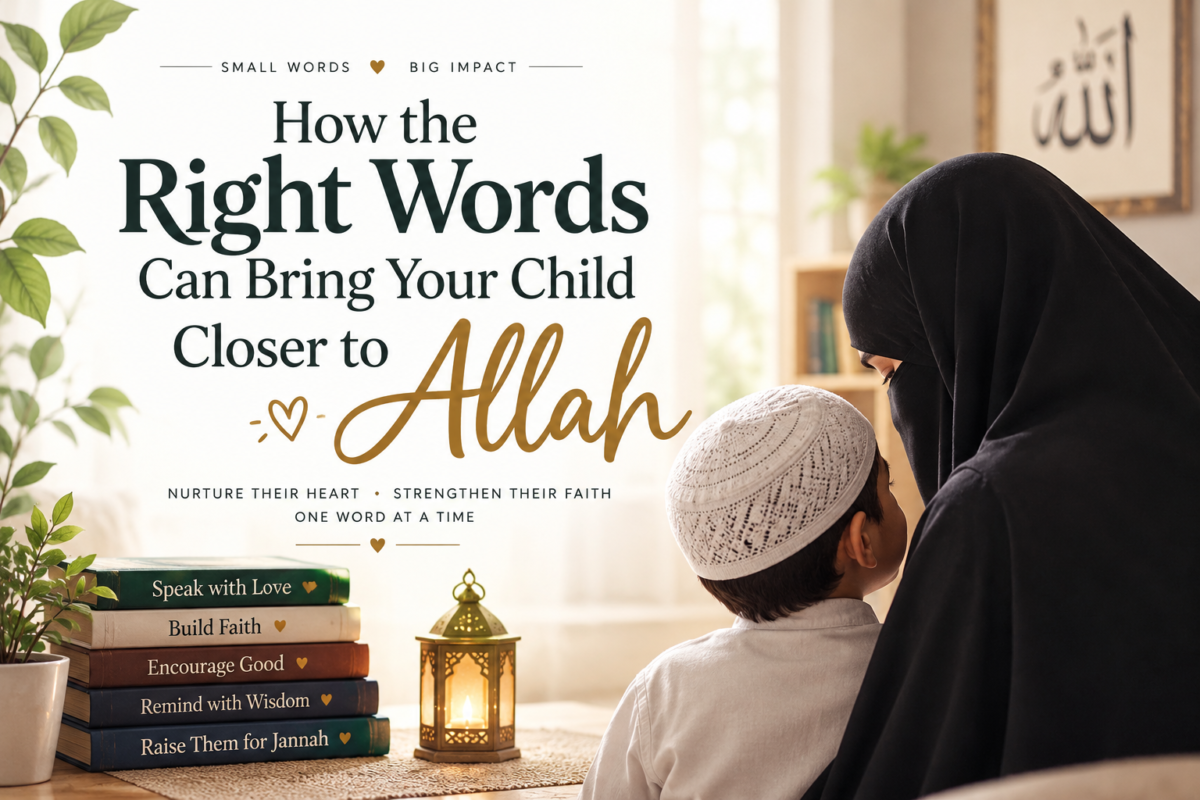
How the Right Words Can Bring Your Child Closer to Allah
The way you praise your child today can shape their sincerity, confidence, and relationship with Allah for years to come.
Are you a parent?
Grab a pen and paper, because what I’m about to share could change your child’s life in the most positive way:
Imagine two children.
Every time the first child does something well, he hears:
“You’re the smartest boy in your class.”
“You’re the best.”
“You make us so proud.”
The second child hears something slightly different:
“MashaAllah, Allah has blessed you with a sharp mind.”
“I’m proud of the effort you put in.”
“May Allah increase you in knowledge and keep you humble.”
Both children are being praised.
But they are learning two completely different lessons.
The first child slowly begins to believe that his value comes from being admired.
He starts chasing applause, grades, trophies, and compliments.
The second child learns that every blessing comes from Allah and every achievement is an opportunity to thank Him.
He learns that what matters most is not what people think of him, but what Allah knows about him.
As Muslim parents, we should be careful about the type of praise we give.
Instead of saying:
“You’re so smart.”
Try saying:
“MashaAllah, Allah has blessed you with intelligence. Keep using it to please Him.”
Instead of:
“You’re so beautiful.”
Say:
“MashaAllah, Allah created you beautifully. Remember that your taqwa is even more beautiful.”
Instead of:
“I’m proud because you came first.”
Say:
“I’m proud that you worked hard and Allah blessed your hard work with good results.”
The goal isn’t to stop praising our children.
The goal is to praise them in a way that strengthens their relationship with Allah instead of making them dependent on people’s approval.
The same applies to acts of worship.
Imagine little Yusuf prays Fajr one morning.
Everyone claps.
“Good job, Yusuf!”
The next day he prays again because he wants everyone to smile at him.
Eventually, if nobody notices, he may lose motivation.
Now imagine you kneel beside him and say:
“Yusuf, Allah saw you wake up for Fajr. And He loves that you are doing it for His sake. We ask Allah to make you among those He loves.”
Now Yusuf is learning that worship is for Allah, not for an audience.
Or imagine Amina memorises a surah.
Instead of saying:
“You’re the best girl in your class.”
Her mother says:
“MashaAllah, Amina. Every letter you recite brings reward. Keep memorising for Allah.”
Now Amina associates the Qur’an with Allah’s pleasure rather than people’s compliments.
Even when correcting children, be careful with labels.
Instead of saying:
“You’re lazy.”
Say:
“I know you can work harder. Let’s ask Allah to help you become more disciplined.”
Instead of:
“You’re naughty.”
Say:
“That choice wasn’t pleasing to Allah. You’re capable of making a better one.”
Correct the behaviour without attacking the child’s identity.
One of the greatest gifts we can give our children is teaching them that their worth is not tied to grades, beauty, popularity, wealth, or even praise from their parents.
Their worth comes from being servants of Allah.
These are the qualities that will benefit them long after certificates, medals, and trophies have faded away.
Raise children who ask:
“Is Allah pleased with me?”
Not children who constantly wonder:
“Are people proud of me?”
Because one question leads to sincerity, while the other can quietly lead to a lifetime of seeking validation from creation instead of the Creator.
And there will be moments when you won’t be with that child. He or she will always remember that whatever they do, even if you aren’t there, Allah is watching them.
(Credit :Aisha Abdullahi)
Also Read- 10 Parenting advice by real parents
Check : 50% Discount on Tafsir classes for chldren
Follow us in Facebook
Written by
Writes about Parenting, Islamic Homeschooling, Child Development, Gentle Parenting, and Raising Confident, God-Conscious Children.
Discover more from Islam Hashtag
Subscribe to get the latest posts sent to your email.