
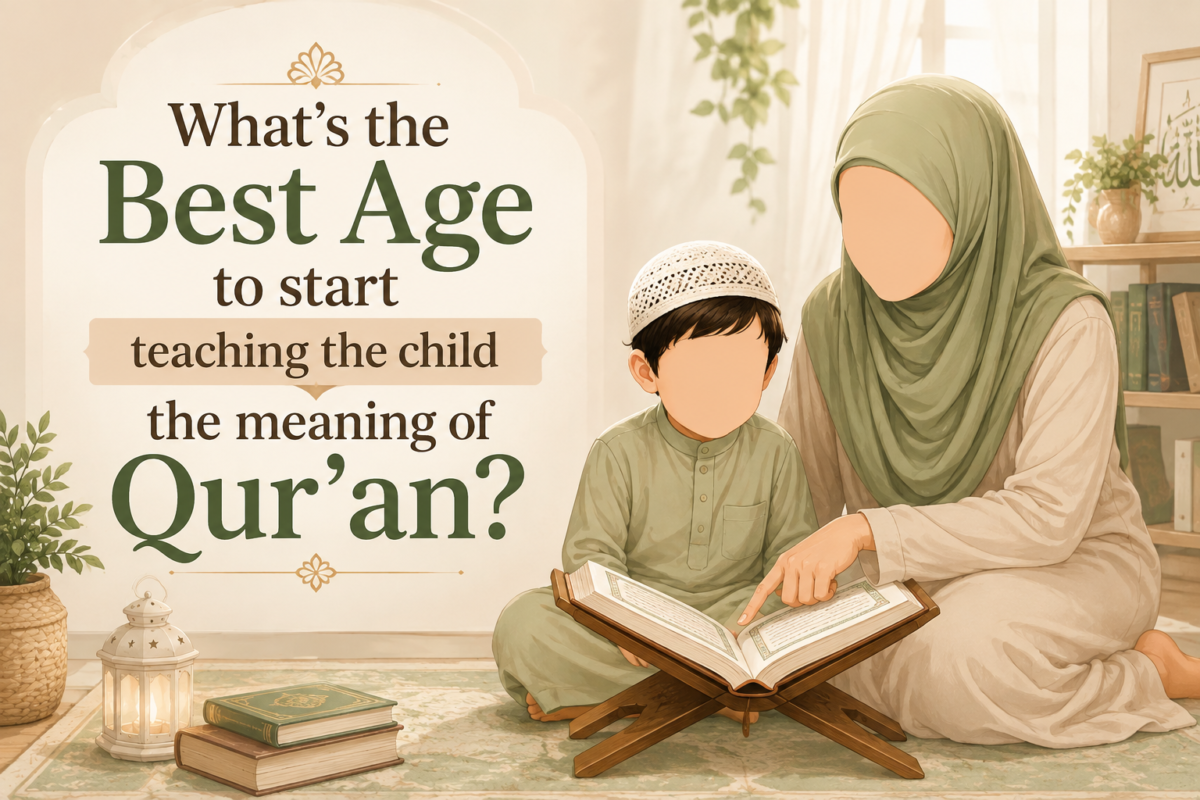
What’s the Best Age to teach the meaning of Quran?
كَذَٰلِكَ يُبَيِّنُ ٱللَّهُ لَكُمْ ءَايَـٰتِهِۦ لَعَلَّكُمْ تَعْقِلُونَ
“Thus does Allah make clear to you His verses that you might use reason.” (Surah al-baqarah, 2:242)
This ayah closes a passage in Surah al-Baqarah dealing with the rulings of maintenance owed to widowed and divorced women — a genuinely technical point of fiqh. And yet Allah ﷻ tells us explicitly why He revealed it in this detail: not for rote transmission, but la’allakum ta’qiloon — so that you might reason, might engage your intellect with it. If that is the stated purpose behind a single fiqh ruling, it should reframe how we think about a much more foundational question parents ask constantly: what’s the best age to start a child in online Quran classes?
Most parents asking this question are really asking a narrower one — how young can a child begin correctly pronouncing Arabic letters and memorizing surahs? That’s a legitimate question, and it has a reasonably well-established answer. But it isn’t the only question that matters, and treating it as the only one is exactly the mistake 2:242 warns against: reducing revelation to something recited rather than something reasoned with. A complete answer has to address both when a child can start reciting, and when a child can start understanding — because the Quran itself tells us the second was always the point.
Two Different Questions Being Conflated
“Best age to start Quran classes” usually collapses two separate developmental questions into one:
- When can a child begin correct recitation and memorization? This is largely a question of speech development, attention span, and auditory-verbal memory — and the honest answer is: earlier than most parents assume, often as young as three or four for informal listening and repetition, and around five to six for structured Noorani Qaida instruction.
- When can a child begin genuinely understanding what they’re reciting — the meaning, the ruling, the reasoning behind it? This is a question of cognitive and religious development, not speech development, and it has a very different timeline — one that classical fiqh actually addresses directly.
Programs and parents that only answer the first question end up with children who can produce beautiful, correct Arabic recitatin with no attachment to meaning for years. That’s not a failure of the child or even necessarily of the teacher — it’s a predictable result of only ever having asked the first question.
The Age of Tamyeez: What Classical Fiqh Already Tells Us
Classical fiqh does not treat childhood as a single undifferentiated stage. It recognizes tamyeez — the age of discernment, when a child develops the capacity to distinguish between right and wrong, benefit and harm, in a basic reasoned way — as a real developmental marker, commonly placed around the age of seven, though it varies by individual child rather than being a fixed cutoff. This is the same age the prophet ﷺ specified for a related and very concrete instruction — to command a child to pray once they reach seven years old (Sunan Abi Dawud 495, graded hasan). The timing is not a coincidence. Seven is roughly when a child becomes capable of grasping why an action is being asked of them, not merely performing it because an adult said so — which is precisely the age at which the Prophet ﷺ instructed parents to begin commanding, rather than simply modeling, the prayer.
This matters directly for Quran instruction. Before tamyeez, a child’s engagement with the Quran is necessarily more sensory and habitual than reasoned — listening, repeating, absorbing sound and rhythm. That is valuable and worth doing early; it is not a wasted stage. But it is not the stage at which 2:242’s ta’qiloon — reasoning — becomes possible. That capacity opens up around and after tamyeez, and a child’s Quran education should shift to meet it, rather than continuing indefinitely as pure repetition simply because repetition was where things successfully started.
Age-by-Age: What’s Realistic and What’s Owed
Ages 3–5: Exposure, not instruction
Informal listening to Quran recitation, repeating short surahs (al-Fatiha, the final short surahs) by sound, and simple, concrete explanations of meaning pitched at a preschooler’s level (“this surah asks Allah to guide us”) are appropriate and beneficial. Structured 1-on-1 Tajweed instruction is generally premature here — not harmful, but not where the real developmental readiness is yet.
Ages 5–7: Structured recitation begins
This is the realistic window for beginning formal instruction — Noorani Qaida, correct Makharij, the mechanics of reading Arabic script. A child at this stage can sit through a structured lesson and retain correction. Meaning can and should still be introduced in simple form, but the primary work at this stage is legitimately mechanical: building the foundation of correct sound before layering deeper reasoning on top of it.
Ages 7–10: Tamyeez, and the shift toward understanding
This is the stage 2:242 becomes directly actionable rather than aspirational. A child now has real capacity to ask “why” and receive an answer that actually lands — why we pray the way we pray, what a specific surah is instructing, what makes an action halal or haram. Fiqh and Aqaaid instruction alongside continued Quran work stop being optional extras and start being the point, not a supplement to recitation.
Ages 10–13: Depth and the first real doubts
Reasoning capacity deepens further, and so does exposure to the world outside the home — school, peers, media. This is commonly when the first real doubts about belief surface, which is exactly why a curriculum’s later levels (see our piece on the Tasheel series) are written to address those doubts directly rather than leaving a child to encounter them for the first time unprepared.
Ages 13 and older: Approaching taklif
As a child nears and reaches puberty, they approach full religious accountability (taklif) in fiqh terms. Instruction at this stage should be treating the child increasingly as a young adult responsible for their own practice and understanding, not a younger child being introduced to basics for the first time.
Why Understanding Can’t Be an Afterthought
Return to where 2:242 sits in the Quran: in the middle of a passage explaining a legal ruling. Allah ﷻ did not reveal that ruling and leave it unexplained, trusting people to simply comply. He explained it, and told us explicitly that the explanation exists so that we would reason with it. If that is true of a single ruling on maintenance payments, it is certainly true of the whole of the Quran a child is being taught to recite. A child who has memorized Surah al-Baqarah in full but cannot explain what a single ruling within it means or why it exists has been given the recitation and denied the stated purpose behind it.
This is not an argument against early memorization — a young child’s retention is genuinely remarkable, and there is real classical precedent for prioritizing hifz while that window is open. It’s an argument against treating memorization as the finish line rather than the first half of the task. The second half — the ta’qiloon — has its own developmental timeline, and a program (or a parent) only ever asking “how young can we start reciting” will keep missing it.
Common Questions Parents Ask
Isn’t it better to memorize as much as possible while a child’s memory is sharpest, even without full understanding yet?
There’s real truth here — childhood memory genuinely is exceptional, and getting Quran into a child while that window is wide open has real, lasting value. The mistake isn’t prioritizing early memorization; it’s treating it as sufficient on its own indefinitely. Memorization now, paired with meaning introduced as soon as the child’s tamyeez allows it, captures the benefit of both.
My child is already 9 or 10 and hasn’t started structured classes yet — have we missed the window?
No single window has closed. What changes at this age is that instruction can move faster and go deeper immediately, since the reasoning capacity 2:242 describes has started. In our tafsir Class for children, we have children from 8 Years of age joyfully understanding Qur’an.
Watch the class revising Surah al Qalam
Tafsir for children
Does this age guidance differ for boys and girls?
The developmental markers of tamyeez and the general age-by-age progression apply to both. What does need individual attention as children approach puberty is ensuring a female teacher for daughters specifically, and structuring instruction around the actual, individual timing of each child’s development rather than a fixed calendar age.
A Concluding Reflection
The question “what’s the best age to start” is worth asking, but it’s only half the question that matters. The Quran itself, in the middle of explaining a point of fiqh, tells us why any of this is being made clear to us in the first place — so that we would reason with it, not simply receive it. A child’s Quran education should be built around that same purpose from the start: early exposure and memorization where the child’s capacity genuinely is, and a real, deliberate shift toward understanding the moment their tamyeez allows it — not indefinitely deferred in favor of more recitation.
اللَّهُمَّ فَهِّمْ أَوْلَادَنَا كِتَابَكَ وَٱجْعَلْهُمْ مِنْ أَهْلِهِ O Allah, grant our children understanding of Your Book, and make them among its people.
Fahmina Jawed (Aafiya) Alimah, MA Arabic
References Cited
- Quran, Surah al-Baqarah 2:242 — “Thus does Allah make clear to you His verses that you might use reason.”
- Sunan Abi Dawud 495 — “Command your children to pray when they become seven years old…” (graded hasan)
📌 You might also like:
- Online Madrasa for Kids: What to Look for Before You Enroll
- The Tasheel Series Explained: What Your Child Actually Learns, Level by Level
- Quran-Only vs Full Madrasa: How to Choose the Right Program for Your Child
Written by

Writes about Parenting, Islamic Homeschooling, Child Development, Gentle Parenting, and Raising Confident, God-Conscious Children.
Discover more from Islam Hashtag
Subscribe to get the latest posts sent to your email.