A New Series Begins This Rabi-ul-Awwal: Walking Through the Seerah of Prophet Muhammad ﷺ
Assalamu Alaikum wa Rahmatullahi wa Barakatuh,
This is Aafiya. I have been quite busy over the last few months conducting courses for children and women, and in that time I kept feeling that there was one thing missing — a proper study of the Seerah that everyone could benefit from, not just the students in my classes. So I have decided to start writing this series, in sha’ Allah, so that the men, the women, the children, the students, and anyone who simply loves the prophet ﷺ can go through it together.
You can read this article in any language by choosing the language you find easy to read. (This is translated via google translate and some translation may not be exact) At the end of the article there is a Quiz so feel free to try the Quiz to check your understanding.
Rabi-ul-Awwal is the month in which the Best of Creation, our beloved Prophet Muhammad ﷺ (ṣallallāhu ʿalayhi wa ālihi wa sallam), was born into a waiting world. There could not be a better time to begin this journey.
This series is based on one of the most trusted and beloved biographies of the Prophet ﷺ ever written — Ar-Raheeq Al-Makhtum (The Sealed Nectar) by Shaykh Safi-ur-Rahman Al-Mubarakpuri, the book that won first prize in a worldwide Seerah-writing competition held by the Muslim World League. Each post will take up a portion of this book, explain it in simple language, highlight the people we meet along the way, and draw out lessons we can carry into our own lives.
I will be publishing on alternate days, in sha’ Allah. Please do check back regularly, and if you find this beneficial, share it with your friends and family so they can benefit too.
I hope you enjoy it. Let us begin where every good biography must begin: before the birth. Who were the Arabs? Where did they come from? And how does a name like Adnan or Qusai bin Kilab connect all the way to the Prophet ﷺ himself?
Seerah Series Part 1: The Arabian Peninsula and the Origins of the Arab Tribes Before Islam
This is the summary
(Seerah of Prophet Muhammad ﷺ | The Sealed Nectar Summary | Rabi-ul-Awwal Special)
Why Start With Geography and Genealogy when studying seerah?
It might seem strange to begin the story of the Prophet ﷺ with maps and family trees. But the Arabian Peninsula — its isolation, its tribes, its bloodlines — was the exact stage Allah chose for the final Messenger ﷺ. Nothing about it was random, and understanding it helps us understand everything that follows.
Where Exactly Is Arabia?
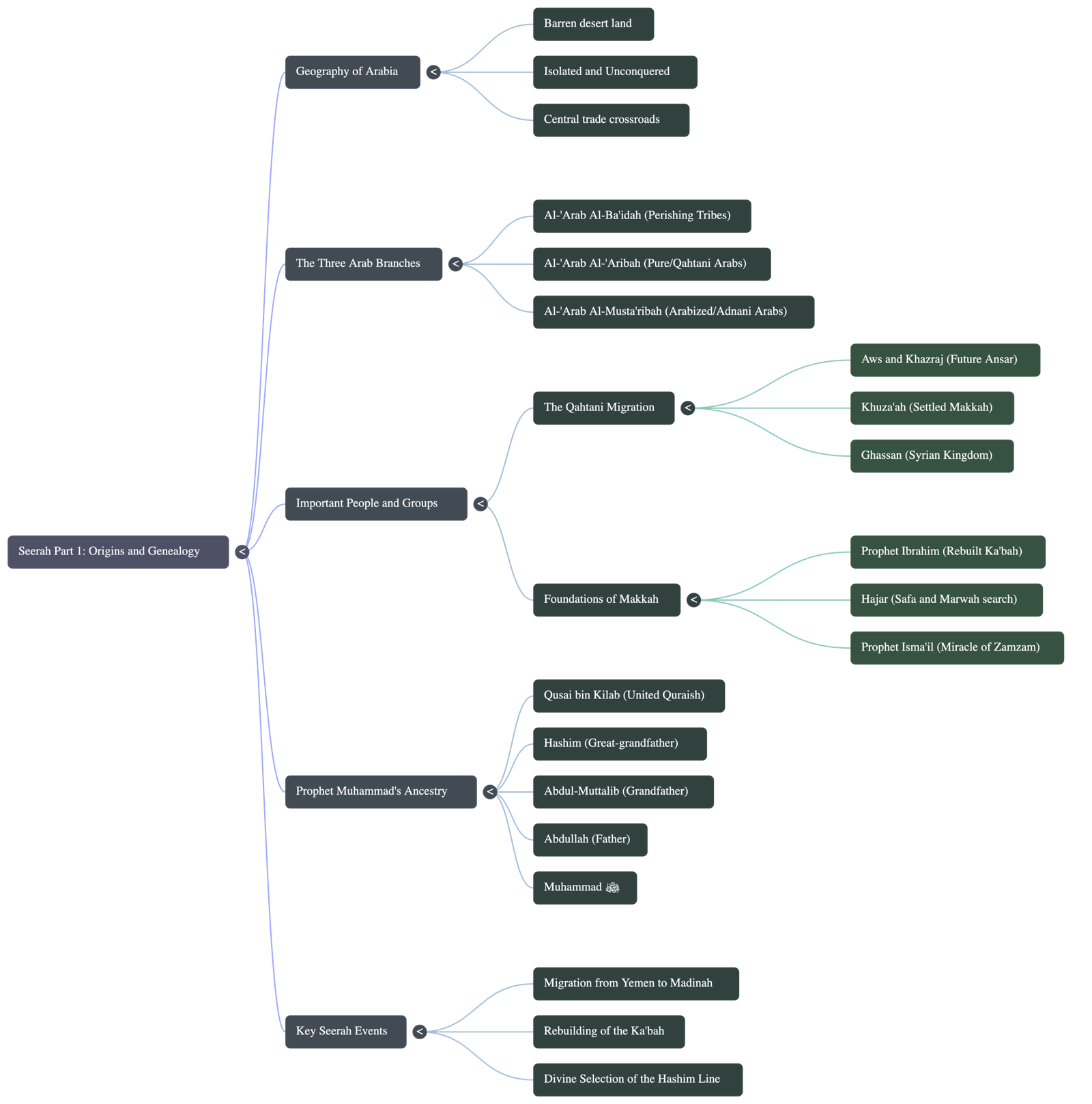
The word “Arab” itself linguistically points to a barren, waterless desert land, and that is precisely what most of the peninsula is. It sits bordered by the Red Sea and Sinai to the west, the Arabian Gulf to the east, the Arabian Sea to the south, and old Syria and Iraq to the north, a massive stretch of over a million square miles.
Here is the fascinating part: this harsh, forbidding desert terrain was actually a gift in disguise. Because it was so difficult to cross, foreign empires never managed to conquer or colonize it the way they did neighboring lands. The Arabs remained free, self-governing, and culturally untouched, even while sitting right between two superpowers of the ancient world. At the same time, its position made it a natural crossroads of trade, culture, and religion between three continents.
Takeaway for students: Allah placed His final Prophet ﷺ in a land that was independent, unconquered, and central — a people with no colonial baggage, ready to carry a message to the entire world.
The Three Branches of the Arab Family Tree
Scholars of lineage (ansaab) divide the Arabs into three broad groups. This is genuinely useful to memorize, because these names will resurface again and again throughout the Seerah:
- Al-‘Arab Al-Ba’idah (The Perishing Arabs) — Ancient tribes like ‘Ad and Thamud, whose stories are mentioned in the Qur’an, but who vanished from history long ago.
- Al-‘Arab Al-‘Aribah (The Pure Arabs) — Also called the Qahtani Arabs, descended from Ya’rub bin Yashjub bin Qahtan, originally based in Yemen.
- Al-‘Arab Al-Musta’ribah (The Arabized Arabs) — Also called the ‘Adnani Arabs, descended from Prophet Ishmael (Isma’il) عليه السلام. This is the branch the Prophet Muhammad ﷺ belongs to.
From Yemen to Everywhere: How the Qahtani Tribes Spread
The Qahtani Arabs were originally concentrated in Yemen, split mainly into two major tribal confederations: Himyar and Kahlan. Trade routes were choked off after Rome took control of Egypt and Syria’s naval trade, and tribal rivalry with Himyar eventually pushed the Kahlan tribes to scatter across Arabia, a migration that reshaped the entire peninsula.
A few names from this migration matter enormously for later Seerah study, so pay close attention:
Who’s Who — Names to Remember
- Aws and Khazraj — descendants of Tha’labah bin ‘Amr, who eventually settled in Madinah. These two tribes would, generations later, become the Ansar (رَضِيَ اللّٰهُ عَنْهُمْ), the Helpers who welcomed the Prophet ﷺ after the Hijrah.
- Khuza’ah — led by Harithah bin ‘Amr, this tribe eventually settled in Makkah itself, displacing the earlier tribe of Jurhum.
- Ghassan — founded by Jafnah bin ‘Amr in Syria, they became a client-kingdom of the Byzantines.
So when you later read about the Ansar of Madinah welcoming the Prophet ﷺ with open arms, remember that their roots trace all the way back to a tribal migration out of Yemen centuries earlier. The events of the Seerah are all connected, even across many generations.
The ‘Adnani Line: Tracing the Prophet’s ﷺ Own Ancestry
This is where the story turns personal, because this is the Prophet’s ﷺ own family line.
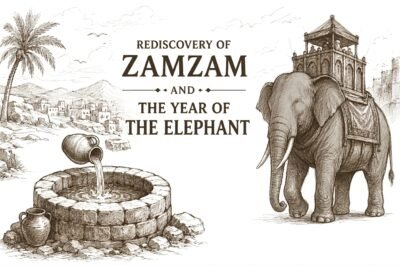
It begins with Prophet Ibrahim (Abraham) عليه السلام. After leaving his hometown near Kufah for Harran and then Palestine, he eventually, by Allah’s decree, brought his wife Hajar (Hagar) عليها السلام and their infant son Isma’il (Ishmael) عليه السلام to a barren valley in Hijaz, beside what would become the Sacred House. It was here that the miracle of Zamzam occurred, sustaining mother and child in the middle of the desert.
Who’s Who
- Ibrahim (Abraham) عليه السلام — the father of prophets, and the direct ancestor of Prophet Muhammad ﷺ through Isma’il.
- Hajar عليها السلام — Isma’il’s عليه السلام mother, whose desperate search for water between the hills of Safa and Marwah is commemorated by every pilgrim performing hajj or Umrah to this day.
- Isma’il (Ishmael) عليه السلام — the son of Ibrahim عليه السلام through whom the Prophet’s ﷺ entire lineage descends. He grew up among the tribe of Jurhum, learned Arabic from them, and later helped his father rebuild the Ka’bah.
Ibrahim عليه السلام visited his son periodically, and it was on one such visit, after Isma’il عليه السلام had grown into a young man, the two prophets عليه السلام together rebuilt the Ka’bah, raising its foundations at Allah’s command and calling humanity to pilgrimage, a call still answered by millions every year.
Isma’il عليه السلام had twelve sons, but only the line of one of them survived in any traceable, significant way: Qidar. From Qidar’s descendants eventually came ‘Adnan, and from ‘Adnan’s line, after many generations, came Quraish, the very tribe of the Prophet ﷺ.
Meet Quraish: The Tribe Chosen to Receive a Prophet
Quraish itself branched into many clans — Jumah, Sahm, ‘Adi, Makhzum, Tayim, Zahrah, and the line of Qusai bin Kilab, who is credited with uniting the previously scattered clans of Quraish into a single, organized, respected leadership around the Ka’bah.
From Qusai’s descendants came the family of ‘Abd Manaf, which split into four branches — ‘Abd Shams, Nawfal, Muttalib, and Hashim. It was from the family of Hashim that Allah chose to send His final Messenger:
Muhammad ﷺ, son of ‘Abdullah, son of ‘Abdul-Muttalib, son of Hashim.
The Prophet ﷺ himself described this chain of selection beautifully, saying that Allah chose Isma’il from the children of Ibrahim, chose Kinanah from the children of Isma’il, chose Quraish from Kinanah, chose Hashim from Quraish, and chose him ﷺ from the family of Hashim. Every single link in that chain was not an accident. It was divine selection, generation after generation, narrowing down to one final, perfect choice.
Key Takeaways
- The geography of Arabia, isolated yet central, was itself part of Allah’s plan for the message to spread from an independent, unconquered people.
- Arabs are traditionally divided into three lineage groups: the Perishing Arabs, the Qahtani (Pure) Arabs, and the ‘Adnani (Arabized) Arabs, the Prophet’s ﷺ own branch.
- The Aws and Khazraj, later known as the Ansar (رضي الله عنهم), trace back to the Qahtani migration out of Yemen.
- The story of Ibrahim, Hajar, and Isma’il (عليهم السلام) in the valley of Makkah is the literal foundation of the Ka’bah and the Prophet’s ﷺ own ancestry.
- The Prophet ﷺ descends through Isma’il → Qidar → ‘Adnan → Kinanah → Quraish → Qusai → Hashim → ‘Abdul-Muttalib → ‘Abdullah → Muhammad ﷺ
Let Us Discuss — Tell Us in the Comments
- Had you heard the connection between the Ansar of Madinah and the earlier Qahtani migration from Yemen before today?
- What is one thing from today’s post you are going to share with your own family or students this Rabi-ul-Awwal?
Please share your answers in the comments below, and please do share this post with your friends and family so more people can benefit from it, in sha’ Allah.
Coming up in Part 2: We move from tribes and genealogy into the religious and political landscape of pre-Islamic Arabia, the idols, the beliefs, and the state of Jahiliyyah (ignorance) the Prophet ﷺ was born to transform. Check back in the coming days, in sha’ Allah.
May Allah send His peace and blessings upon our beloved Prophet Muhammad ﷺ, upon his pure family, and upon all his noble Companions رضي الله عنهم أجمعين. Ameen.
Read a short Biography of Prophet Muhammad صَلَّى ٱللّٰهُ عَلَيْهِ وَآلِهِ وَسَلَّمَ
A small request: Please do not copy and paste this article elsewhere. If you found it beneficial, kindly share the original link instead — this helps us continue our dawah work and reach more people. Jazakumullahu Khairan.
Play Quiz to test your understanding
What does the word 'Arab' linguistically point to?
The word 'Arab' itself linguistically points to a barren, waterless desert land, which describes most of the peninsula.
Which body of water borders the Arabian Peninsula to the west?
The Arabian Peninsula sits bordered by the Red Sea and Sinai to the west.
Into which three broad groups do scholars of lineage (ansaab) divide the Arabs?
Scholars of lineage divide the Arabs into Al-'Arab Al-Ba'idah (The Perishing Arabs), Al-'Arab Al-'Aribah (The Pure Arabs), and Al-'Arab Al-Musta'ribah (The Arabized Arabs).
The ancient tribes of 'Ad and Thamud belong to which division of the Arab family tree?
Al-'Arab Al-Ba'idah (The Perishing Arabs) are ancient tribes like 'Ad and Thamud who vanished from history long ago.
The Aws and Khazraj tribes of Madinah (later known as the Ansar) trace their roots back to which original region?
The Aws and Khazraj were Qahtani Arabs originally based in Yemen who migrated after trade routes choked and settled in Madinah.
Which tribe eventually settled in Makkah, displacing the earlier tribe of Jurhum?
The tribe of Khuza'ah, led by Harithah bin 'Amr, settled in Makkah and displaced the earlier tribe of Jurhum.
Who is the direct ancestor of Prophet Muhammad ﷺ through whom the Musta'ribah (Arabized) lineage descends?
The Arabized Arabs are also called 'Adnani Arabs and descend from Prophet Isma'il (Ishmael) عليه السلام.
Which son of Prophet Isma'il عليه السلام has a traceable, significant line from which 'Adnan descends?
Of Isma'il's twelve sons, only the line of Qidar survived in a traceable, significant way, eventually leading to 'Adnan.
Who is credited with uniting the scattered clans of Quraish into a single, organized leadership around the Ka'bah?
Qusai bin Kilab is credited with uniting the previously scattered clans of Quraish into a single, organized, respected leadership around the Ka'bah.
In the chain of divine selection described by the Prophet ﷺ, which branch of the family of 'Abd Manaf did Allah choose to send His Messenger from?
The family of 'Abd Manaf split into four branches: 'Abd Shams, Nawfal, Muttalib, and Hashim. Allah chose His final Messenger from the family of Hashim.
Share your Results:
Subscribe with your email to get notifications about the new Posts
🔒 No spam, ever. Unsubscribe anytime.
Written by
Ustadha Fahmina holds a Sanad in Alimiyyah (6-year Dars-e-Nizami) from two recognized Islamic institutes and a Master's degree in Arabic . She teaches Qur'an, Tafsir, Hadith, and Fiqh following the Hanafi school within Ahl al-Sunnah wal Jama'ah. She founded Islam Hashtag in 2015 to bring authentic Islamic learning to Muslim families online. She also holds a degree in Optometry and is the founder of Optometryskills.com.
Discover more from Islam Hashtag
Subscribe to get the latest posts sent to your email.