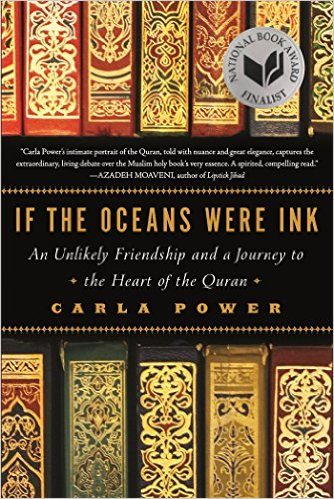
If the Oceans were Ink-Book Review–When A Madrassa Scholar And Jewish Reporter Become Friends
What happens when an American writer and a madrassah-trained scholar debate the Holy Quran in a bid to find interfaith understanding?
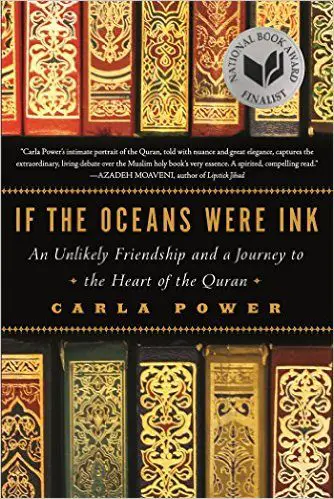
Carla Power writes her experience in her Book “If the Oceans Were Ink” .She gives details of her year with sheikh Akram and how the Quran provided her with many moments of grace. “I found comfort in how small I felt reading the text, as when I considered the images of the ‘lord of the heavens and the earth and everything in between, and Lord of all points of the sunrise.’ She says that even as a nonbeliever, I still find myself taking refuge in the Quran classes as a clam inlet from daily life.”
If the Oceans Were Ink is Carla Power’s eye-opening story of how she and her longtime friend Sheikh Mohammad Akram Nadwi found a way to confront ugly stereotypes and persistent misperceptions that were cleaving their communities. Their friendship-between a secular American and a madrasa-trained sheikh-had always seemed unlikely, but now they were frustrated and bewildered by the battles being fought in their names. Both knew that a close look at the Quran would reveal a faith that preached peace and not mass murder; respect for women and not oppression. And so they embarked on a yearlong journey through the controversial text.
Power notes the greatness of the Quran by highlighting the triviality of worldly matters like the “close on Wall Street, the exam score or dress size, even happiness itself” that seemed nothing next to the fact that from God we come and to God we return. She describes this as “constant reminders of one’s own puniness and powerlessness.”
She also shares a personal experience that made her realise the essence of the word InshAllah. “When my mother died, I remember thinking how sensible it was, the Muslim practice of saying InshAllah after every plan, every promise, no matter how minor, since only God can be sure whether next Wednesday’s lunch date will indeed be kept. It was a comfort, in a season of grief, to hang out with a community that honored this world’s certainties.”
On her understanding of namaz, she writes about it as a symbol of devotion to God. She mentions studies on the postures of Muslim prayers by scientists who have concluded that they encourage calm and flexibility. While standing straight strengthens the arrangement of muscles in the body, bowing helps stretch out the lower back and hamstrings, and sitting after prostration keeps joints mobile. In relation to this, Power notes how “Akram’s prayers have rendered him culturally supple, too, stretching his humanity in surprising ways. The act of return, to his prayer mat, to his Quran and his classical text–has often afforded an expansion of his worldview, not a restriction of it.”
She beautifully describes the sheikh offering his prayers and the meaning attached to his every move. She writes, “In standing, kneeling, bring his forehead to the earth, then standing again, his attention returns to his origins and destination, which are one and the same.” She also shares the words of the sheikh, who connects the experience to a “feeling of returning to the arms of your mother, when you are a child.”
The author explains the meaning of existence for the sheikh revolves around God, in the shape of a circle. The circle has God at its end, beginning, and every point in between. This sheds lights on his belief that “from Allah he has come, and to Allah he will return,” with everyday circling back to God.
On starting her Quran lessons, as she was able to understand its message, she realised that it is more than just a book. Instead, she reflects on its reach to Muslims around the world as a “metaphor of return. It is a place to which the faithful return, again and again.”
She explains, “I’d come a long way from earliest encounter with the Quran, but I still hadn’t understood that it was far more than a much-revered book. Over the course of the year, I began to see that the Quran was not merely a set of pages between two covers. Calling it a book, something one can read from beginning to end, embalms it in expectations. It was just another way of limiting it into something small: an amulet, a manifesto, an instruction guide, a political tool. In the life of a Muslim like Sheikh Akram, its meaning is much more diffuse.”
She devotes a chapter to the sheikh’s research on nine thousand women who were highly respected for their knowledge and wisdom through the ages. Other issues covered include education for women, veiling, separation from men in religious observances and other events, family relationships, and child marriage
On questioning the sheikh about how to better understand the Quran, she shares his response, “Read. Keeping reading the Quran. Read it, and read it again. Return,” echoing the command that prophet Muhammad had heard upon revelation.
About The Book:
It is a 325 Page Book and costs just 19 $. The Book starts with an Introduction of her journey and is spread into 16 chapters .This book is a Finalist for the National Book Award.It is Hailed by The Washington Post as “mandatory reading,” and praised by Fareed Zakaria as “intelligent, compassionate, and revealing,” a powerful journey to help bridge one of the greatest divides shaping our world today.
Praise for If the Oceans Were Ink
- “A vibrant tale of a friendship…. If the Oceans Were Ink is a welcome and nuanced look at Islam [and] goes a long way toward combating the dehumanizing stereotypes of Muslims that are all too common…. If the Oceans Were Ink should be mandatory reading for the 52 percent of Americans who admit to not knowing enough about Muslims.”―The Washington Post
- “For all those who wonder what Islam says about war and peace, men and women, Jews and gentiles, this is the book to read. It is a conversation among well-meaning friends―intelligent, compassionate, and revealing―the kind that needs to be taking place around the world.”―Fareed Zakaria, author ofThe Post-American World
- “Carla Power’s intimate portrait of the Quran, told with nuance and great elegance, captures the extraordinary, living debate over the Muslim holy book’s very essence. A spirited, compelling read.”―Azadeh Moaveni, author of Lipstick Jihad
- “Unique, masterful, and deeply engaging. Carla Power takes the reader on an extraordinary journey in interfaith understanding as she debates and discovers the Quran’s message, meaning, and values on peace and violence, gender and veiling, religious pluralism and tolerance.”―John L. Esposito, University Professor and Professor of Islamic Studies, Georgetown University, and author ofThe Future of Islam
- “A thoughtful, provocative, intelligent book.”―Diana Abu-Jaber, author of Birds Of Paradise andThe Language of Baklava
So What Next ? Definately this National Book award finalist book deserves to be Read.If you want to Read this Book.
You can get it HERE
Want More Recommendations:


Written by
Ustadha Fahmina holds a Sanad in Alimiyyah (6-year Dars-e-Nizami) from two recognized Islamic institutes and a Master's degree in Arabic from Indira Gandhi National University. She teaches Qur'an, Tafsir, Hadith, and Fiqh following the Hanafi school within Ahl al-Sunnah wal Jama'ah. She founded Islam Hashtag in 2015 to bring authentic Islamic learning to Muslim families online. She also holds a degree in Optometry and is the founder of Optometryskills.com.
Discover more from Islam Hashtag
Subscribe to get the latest posts sent to your email.