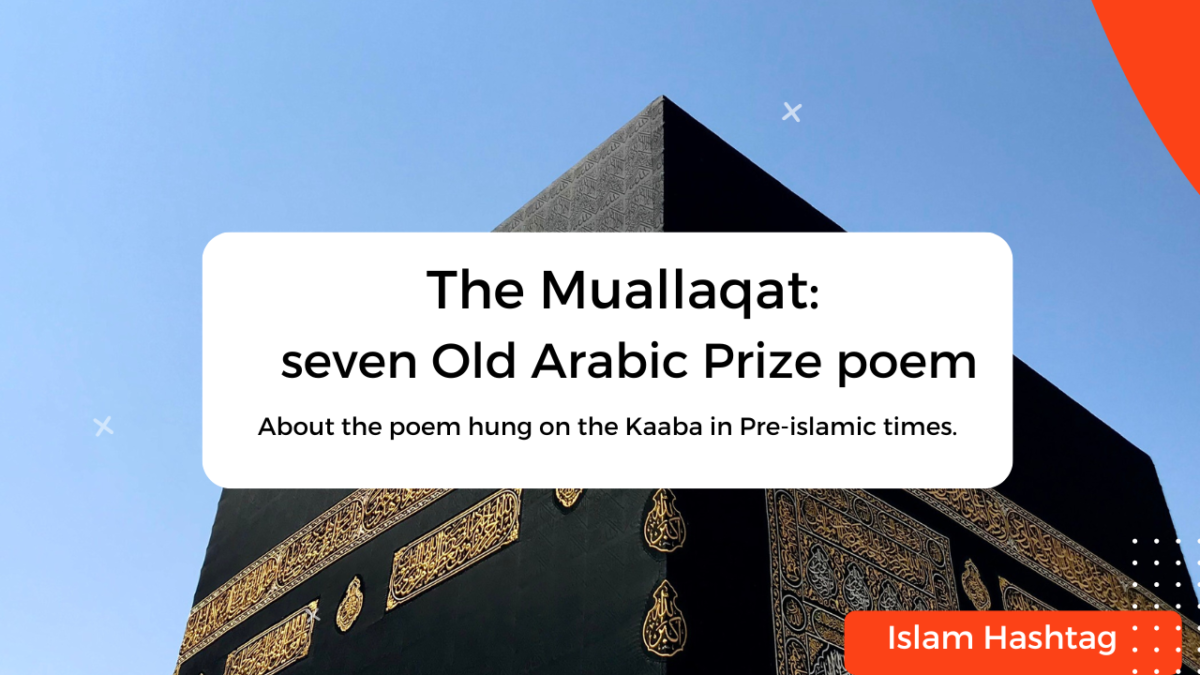
The Mu’allaqat: seven Old Arabic Prize poem
In the last article , I mentioned about my indulgence in books of Arabic read at Masters level. Here is a pearl of knowledge about Arabic Poetry which I want to share.
Have you ever wondered what poetry was like in ancient times? Imagine words so powerful that they were inscribed and hung on the walls of the Kaaba, the most sacred site in mecca. These weren’t just any words; they were the Mu’allaqat, a collection of seven (sometimes ten) pre-Islamic Arabic poems that have captivated hearts for centuries.
Picture yourself in the vast deserts of pre-Islamic Arabia, where life was harsh, yet poetry flourished. Poetry wasn’t just an art form; it was the very heartbeat of Arab society, preserving history and culture. kaaba which is a sacred place of worship also served as a gallery in those time where the finest poems were displayed. The Mu’allaqat were among these prized poems, symbolizing not only the artistic brilliance of their creators but also the honor and prestige they brought to their tribes.
See- New and exclusive picture of Kaaba
In pre-Islamic Arabia, poetry was the lifeblood of society, and nowhere was this more evident than in the bustling markets of Ukaz. Here, during the sacred month of Dhul-Hijjah, tribes from across the Arabian Peninsula would gather, not just to trade goods, but to engage in a battle of words that would determine their standing in the eyes of their peers.
The Poetic Contests of Ukaz
Every year, during Dhul-Hijjah, Ukaz became the stage for a grand poetic contest. Tribes would send their most skilled poets to represent them in this prestigious assembly. The stakes were high—this wasn’t just a contest of creativity, but a competition for honor and respect. The poets would present their verses before an assembly of critics and listeners, each hoping that their words would be the ones to resonate the most.
These contests were fierce, with each tribe vying to outdo the other. The themes of the poetry varied, but they often revolved around the core aspects of Arab life—love, valor, tribal honor, and the harsh realities of desert existence. The poems were rich in imagery and emotion, reflecting the collective experiences of the tribes. Winning a contest at Ukaz was more than just personal glory; it was a victory for the entire tribe, cementing their reputation in the annals of Arab history.
Judgment and the Legacy of the Mu’allaqat
When the judges, who were often revered poets themselves, made their decision, the winning poems were celebrated in a manner befitting their greatness. The highest honor was to have one’s poem transcribed in gold ink on Egyptian silk and then hung on the walls of the Kaaba in Mecca. This act symbolized the poem’s elevation to the status of a cultural treasure, revered by all who visited the sacred site.
The Mu’allaqat—literally “The Suspended Odes”—were the poems that achieved this distinction. These were not just poems; they were immortalized works that captured the essence of pre-Islamic Arab society. To have a poem hung on the Kaaba was to have it preserved for future generations, ensuring that the words and the messages they carried would never be forgotten.
Themes and Cultural Significance
The themes of the Mu’allaqat were a reflection of the world in which they were created. They spoke of love—both romantic and familial—honor, and the harsh realities of life in the Arabian desert. They celebrated the valor of warriors, the beauty of nature, and the wisdom of elders. Through these poems, we get a glimpse into the values and beliefs that shaped pre-Islamic Arab society.
Share this Image
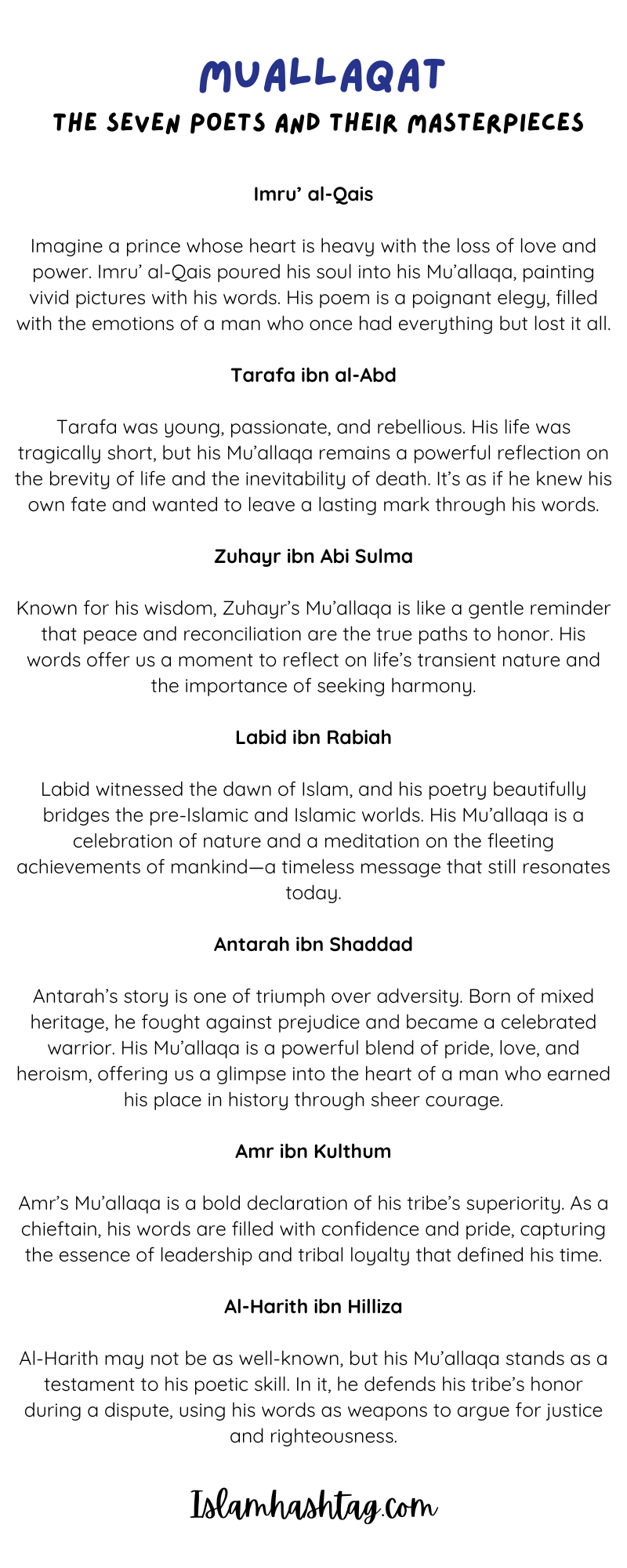
The Seven Poets of Muallaqat and Their Masterpieces
Let me introduce you to the poets behind these legendary works of Muallaqat. Each one had a unique voice, yet they all shared a deep connection to the land and life around them.
- Imru’ al-Qais
Imagine a prince whose heart is heavy with the loss of love and power. Imru’ al-Qais poured his soul into his Mu’allaqa, painting vivid pictures with his words. His poem is a poignant elegy, filled with the emotions of a man who once had everything but lost it all. - Tarafa ibn al-Abd
Tarafa was young, passionate, and rebellious. His life was tragically short, but his Mu’allaqa remains a powerful reflection on the brevity of life and the inevitability of death. It’s as if he knew his own fate and wanted to leave a lasting mark through his words. - Zuhayr ibn Abi Sulma
Known for his wisdom, Zuhayr’s Mu’allaqa is like a gentle reminder that peace and reconciliation are the true paths to honor. His words offer us a moment to reflect on life’s transient nature and the importance of seeking harmony. - Labid ibn Rabiah
Labid witnessed the dawn of Islam, and his poetry beautifully bridges the pre-Islamic and Islamic worlds. His Mu’allaqa is a celebration of nature and a meditation on the fleeting achievements of mankind—a timeless message that still resonates today. - Antarah ibn Shaddad
Antarah’s story is one of triumph over adversity. Born of mixed heritage, he fought against prejudice and became a celebrated warrior. His Mu’allaqa is a powerful blend of pride, love, and heroism, offering us a glimpse into the heart of a man who earned his place in history through sheer courage. - Amr ibn Kulthum
Amr’s Mu’allaqa is a bold declaration of his tribe’s superiority. As a chieftain, his words are filled with confidence and pride, capturing the essence of leadership and tribal loyalty that defined his time. - Al-Harith ibn Hilliza
Al-Harith may not be as well-known, but his Mu’allaqa stands as a testament to his poetic skill. In it, he defends his tribe’s honor during a dispute, using his words as weapons to argue for justice and righteousness.
Themes and Styles
What makes the Mu’allaqat so special? It’s the way these poets could weave common themes like love, war, and the harshness of desert life into their verses, making us feel the weight of their words even today. They used rich imagery, metaphors, and a formal structure that begins with a nostalgic reflection on past glories
The original metres of Arabic Poetry- Muallaqat
The RajaZ: The Earliest Metre
The original metre employed in early Arabic poetry was the Rajaz, a short iambic verse that became synonymous with the songs of camel drivers. This metre was simple, rhythmic, and always ended with the same rhyme, making it perfect for extemporaneous verse. It was often used to express defiance, contempt, or praise in a straightforward and powerful manner. The Rajaz’s rhythm was ideally suited for the repetitive, almost hypnotic chants that would accompany long journeys across the desert.
Evolution to the Qasida
As Arabic poetry evolved, so did its structures. The Mu’allaqat, among the most esteemed examples of early Arabic poetry, were composed in a more complex form known as the Qasida. This form is characterized by verses, or couplets, called bayts. Each bayt consists of two halves, or hemistichs, where the two hemistichs of the first bayt rhyme with each other and with the second hemistich of each succeeding couplet throughout the poem.
The Qasida was a more elaborate form of poetry than the Rajaz, allowing poets to explore deeper themes and express their thoughts with greater nuance and complexity. The Mu’allaqat, composed in the Qasida form, are prime examples of this evolution. They are marked by their long, flowing lines and intricate rhyme schemes, which reflect the poets’ mastery of rhythm and their ability to convey powerful emotions.
The Meaning Behind Qasida
The term Qasida is often thought to be derived from the Arabic word “Qasd,” which means “an object or aim.” This is fitting, as the Qasida was typically composed with the specific aim of achieving preeminence in the highly competitive poetical contests held in places like Ukaz. However, another interpretation, suggested by Professor Ahlwardt, ties the term Qasida to the idea of “breaking things into halves.” This interpretation aligns with the structure of the Qasida, where each bayt is divided into two hemistichs, giving the poem a balanced, yet dynamic form.
The Mu’allaqat and Their Metres
Within the sixteen known measures of Arabian prosody, four were predominantly used in the Mu’allaqat. Despite the variety of metres, the movement of the rhyme in these poems, known as Qasida, remains consistent. This uniformity in rhyme and metre across the Mu’allaqat highlights the poets’ skill in maintaining rhythm while exploring a range of themes—from the intense emotions of love and hatred to the harsh realities of life in the desert.
The poets behind the Mu’allaqat were not learned scholars; rather, they were natural poets, driven by the raw passion of the desert life. Most of them likely could neither read nor write, but this did not diminish their ability to create verses that were both rhythmically precise and emotionally powerful. Their poetry was a reflection of their environment—rugged, intense, and unrestrained. These were men whose passions found their fullest expression in the flowing verse, capturing the essence of their world in a form that continues to resonate today.
Where are the Muallaqat Preserved?
The seven “Prize Poems” known as the Mu’allaqat are preserved in many European libraries. These ancient Arabic poems, celebrated for their literary excellence, were transcribed and collected over the centuries, eventually making their way into European collections. Scholars and collectors recognized the importance of these works, ensuring that they were preserved in some of the most prestigious libraries across Europe.
Today, these libraries hold manuscripts and printed editions of the Mu’allaqat, allowing researchers and enthusiasts to study them in their original Arabic as well as in various translations. The preservation of these poems in European libraries has played a crucial role in the global appreciation and understanding of Arabic literary heritage.
If you want more information on this subject, you can consider reading this Book: Arabian poetry for English readers(Amazon)
Did you enjoy reading this article? Do let me know in the comment box below. Consider Sharing this article with proper attribution.
Written by

Ustadha Fahmina holds a Sanad in Alimiyyah (6-year Dars-e-Nizami) from two recognized Islamic institutes and a Master's degree in Arabic . She teaches Qur'an, Tafsir, Hadith, and Fiqh following the Hanafi school within Ahl al-Sunnah wal Jama'ah. She founded Islam Hashtag in 2015 to bring authentic Islamic learning to Muslim families online. She also holds a degree in Optometry and is the founder of Optometryskills.com.
Discover more from Islam Hashtag
Subscribe to get the latest posts sent to your email.