

Zakat third pillar of Islam : Benefits of Zakat: Have you ever wondered Why do Muslim Pay Zakat?
In our journey toward spiritual excellence, we often focus on our prayers (Salah) and our fasting (Sawm). Yet, there is a pillar that acts as the very heartbeat of social justice in Islam—one that purifies not only our wealth but our very souls. I am speaking, of course, of Zakat, the third pillar of Islam.
Too often, students view Zakat as a “religious tax.” This is a narrow perspective. Zakat is an act of worship (Ibadah). It is a divine mechanism designed to balance the scales of humanity. Today, I want to share with you five profound reasons why a Muslim pays Zakat and why this pillar is essential for your spiritual growth.
1. The Literal and Spiritual Purification (Tazkiyah)
The word “Zakat” itself comes from the Arabic root meaning “to purify” and “to grow.” When you calculate your 2.5% of surplus wealth, you are not losing money; you are pruning a tree.
Just as a gardener prunes a plant so it may grow stronger and more fruitful, Zakat, the third pillar of Islam, removes the spiritual “impurities” of greed and stinginess from your heart. It cleanses the remainder of your wealth, making it Barakah(blessed) and permissible for your use.
2. Establishing Social Equity and Justice
Islam does not look down upon the accumulation of wealth, provided it is earned halal. However, Allah (SWT) reminds us that within the wealth of the rich, there is a “recognized right” for the needy.
By paying Zakat, we ensure that wealth does not merely circulate among the affluent. It creates a safety net for the Fuqara (poor) and the Masakin (needy). This circulation is the “semantic” core of an Islamic economy—it turns a collection of individuals into a cohesive Ummah where no one is left to suffer in silence.
3. A Shield Against the Evils of Materialism
We live in an age of “more”—more followers, more gadgets, more luxury. This constant pursuit can lead to a sickness of the heart called Wahn (love of the world and fear of death).
Paying Zakat serves as a yearly reminder that we are merely trustees, not owners. Everything we hold—our bank accounts, our gold, our investments—belongs to Allah. When you fulfill this third pillar, you are declaring that your heart is not enslaved by the Dirham or the Dollar, but is anchored in the Divine.
4. Attaining the Pleasure and Mercy of Allah
In the Quran, Allah frequently pairs the command to “establish prayer” with “give Zakat.” This pairing is not accidental. If Salah is the vertical connection between you and your Creator, Zakat is the horizontal connection between you and His creation.
To truly seek Allah’s mercy, one must show mercy to others. By fulfilling the obligatory charity in Islam, you unlock doors of sustenance and protection that no amount of personal saving could ever achieve. Remember the promise: “Allah will deprive usury of all blessing, but will give increase for deeds of charity” (Quran 2:276).
5. An Investment in the Eternal Hereafter
My dear students, our time on this earth is fleeting. Every penny spent on our own comforts stays here, but every penny given as Zakat travels ahead of us to our graves and beyond.
Zakat is a “loan” to Allah, and He is the most generous of paymasters. It will be a shade for the believer on the Day of Judgment. By understanding the reasons why a Muslim pays Zakah, you transition from a consumer to a visionary—someone who invests in an eternal home.
Summary Table: The Essence of Zakat
| Feature | Description |
|---|---|
| Obligation | 2.5% of qualifying wealth (Nisab) |
| Spiritual Goal | Purification of the soul from greed |
| Social Goal | Poverty alleviation and wealth distribution |
| Condition | Must be held for one lunar year (Hawl) |
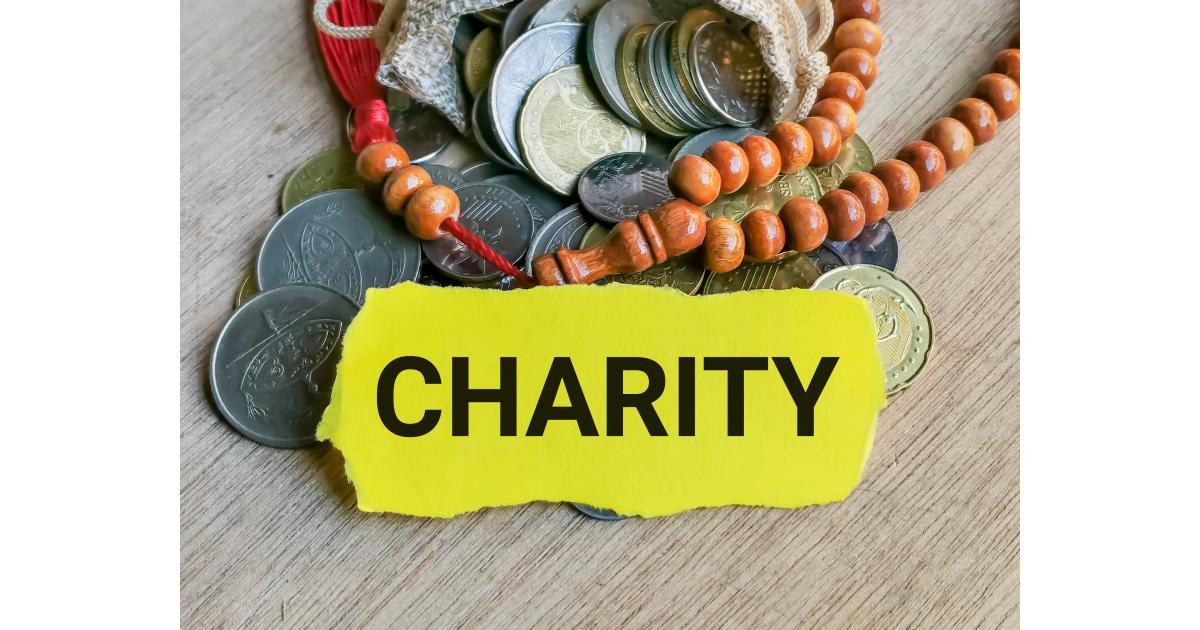
How is zakat a Blessing ?Benefits of Zakat:
Mention of Zakat in Quran
1) ZAKAH PURIFY THE HEART FROM SELFISHNESS AND GREED
Love of Wealth is an innate human tendency.Paying Zakat purify the wealth and increase the halal earning.

:
Take, [O, Muhammad], from their wealth a charity by which you purify them and cause them increase, and invoke [ Allah ‘s blessings] upon them. Indeed, your invocations are reassurance for them. And Allah is Hearing and Knowing.(9:103 -surah Al tawbah)
2) ZAKAH IS AN EXPRESSION OF WORSHIP AND TOTAL SUBMISSION OF ALLAH

And they were not commanded except to worship Allah , [being] sincere to Him in religion, inclining to truth, and to establish prayer and to give zakat. And that is the correct religion.(98:5 )
3) ZAKAH ENCORPORATES THE CONCEPT OF SOCIAL SECURITY AND RELATIVE EQUALITY AMONG MEMBERS OF SOCIETY:
When the wealthy distribute the annual amount of Zakat amount the rightful beneficiaries,wealth ceases to build up in a few hands and instead kept in constant circulation.
Reference:
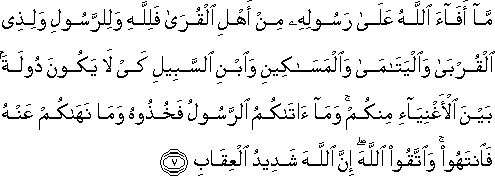
Sahih international: SURAH aL HASHR -59:7
And what Allah restored to His Messenger from the people of the towns – it is for Allah and for the Messenger and for [his] near relatives and orphans and the [stranded] traveler – so that it will not be a perpetual distribution among the rich from among you. And whatever the Messenger has given you – take; and what he has forbidden you – refrain from. And fear Allah ; indeed, Allah is severe in penalty.
4) ZAKAH HAS LOTS OF REWARD.
Reference:

surah Al-baqarah(2:277)
Indeed, those who believe and do righteous deeds and establish prayer and give zakah will have their reward with their Lord, and there will be no fear concerning them, nor will they grieve.
5) ZAKAH IS A MULTIPLIER OF WEALTH
Reference:
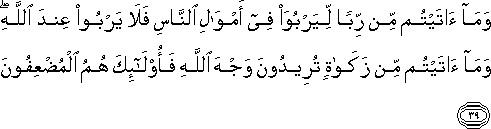
And whatever you give for interest to increase within the wealth of people will not increase with Allah . But what you give in zakah, desiring the countenance of Allah – those are the multipliers.
Zakat ~ A respite to Poor and Destitute
ZAKAT= BARAKAH
Want to learn more about Zakah like who is eligible for Zakat and how to calculate Zakat ? There are a number of videos in You tube about Zakah and there are good books in this topic available too . If you think you still won’t be able to calculate zakah by yourself ,then you can consult any scholar and ask them to help you.
Giving Zakat to relatives
What should Zakaat and Fidya be used for?
In principle, Fidya and Zakat must be given to poor Muslims who are eligible recipients of Zakat. Accordingly, Zakat and Fidya money cannot be used to pay for Madrassah expenses(ref)
The Recipient of zakat
The recipient of Zakat is every needy Muslim who does not have enough wealth that meets the Nisab level and does not have enough to meet his real needs. The recipient can not be a Hashmi, nor one’s husband or wife, nor offspring, including a person’s son, daughter, grandson, and granddaughter. The recipient can not be his parents mother or father, grandfather and grandmother. Apart from these, all other people can receive Zakat. A Hashmi is a person who is a descendant of the blessed Prophet’s ﷺ family, the children of Sayyida Fatimah, the Prophet’s ﷺ daughter.”
Not having enough to meet the Nisab means:
1) He has no wealth whatsoever in which case he would be called miskeen.
2) He does have some wealth but it is less than the Nisab, in this case he is classified as Faqir.
3) He does have the Nisab amount, but his real needs are so great that he is in debt.
4) He has the Nisab amount and has no debt. However, he is a traveller and does not have enough to meet his needs during his journey.
Zakat can be paid to needy relatives who do not have the Nisab. For example, one’s brother, sister, maternal and paternal uncles, and one’s son-in-law if they are needy. In fact, paying Zakat to them earns double the reward.
Another recipient of Zakat mentioned in Surah Al-Tauba, verse 60, is ‘in Allah’s cause.’ This means those warriors, soldiers, and pilgrims who do not possess means of livelihood. According to some, it refers to the student of Islam. In the commentary of Bada’i it means “all works deserving divine merits.”
Another condition when giving Zakat is that the recipient should be made the full owner, someone who has control over the money, this is known as Tamleek. This is in contrast to providing a shroud and a coffin for a funeral, digging a well, building a school, a bridge, or a hostel. Zakat cannot be spent on such projects. If one wants to spend on any of these projects.
Read More articles on What you need to know more as a Muslim .
Read more at https://askimam.org/public/question_detail/46482#_edn1
Written by

Ustadha Fahmina holds a Sanad in Alimiyyah (6-year Dars-e-Nizami) from two recognized Islamic institutes and a Master's degree in Arabic from Indira Gandhi National University. She teaches Qur'an, Tafsir, Hadith, and Fiqh following the Hanafi school within Ahl al-Sunnah wal Jama'ah. She founded Islam Hashtag in 2015 to bring authentic Islamic learning to Muslim families online. She also holds a degree in Optometry and is the founder of Optometryskills.com.
Discover more from Islam Hashtag
Subscribe to get the latest posts sent to your email.

Great! Thank you for the post!