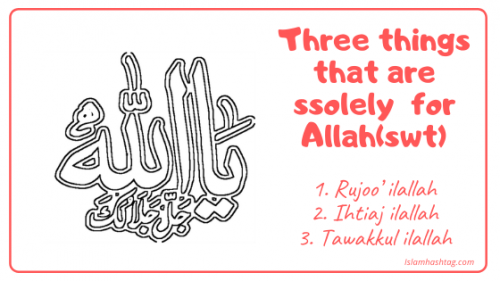
Three Things That Belong Solely to Allah: Rujoo’, Ihtiaj, and Tawakkul — A Complete Guide to the Heart’s Return
By Alimah Fahmina Jawed | IslamHashtag
There is a kind of spiritual poverty that is not about money, not about circumstance, and not about health. It is the poverty of a heart that has forgotten where to turn.
We live in a world of a thousand destinations for our need. We turn to our jobs for security. We turn to relationships for comfort. We turn to our own intelligence and planning for certainty. And none of these things are wrong in themselves — Islam does not ask us to abandon the asbab (means). But when the heart begins to rely on these things the way it should rely only on Allah — when it returns to them instead of to Him — something fundamental has shifted in the soul.
The scholars of tazkiyah (spiritual purification) identified three states of the heart that must be reserved exclusively for Allah ﷻ. They named them:
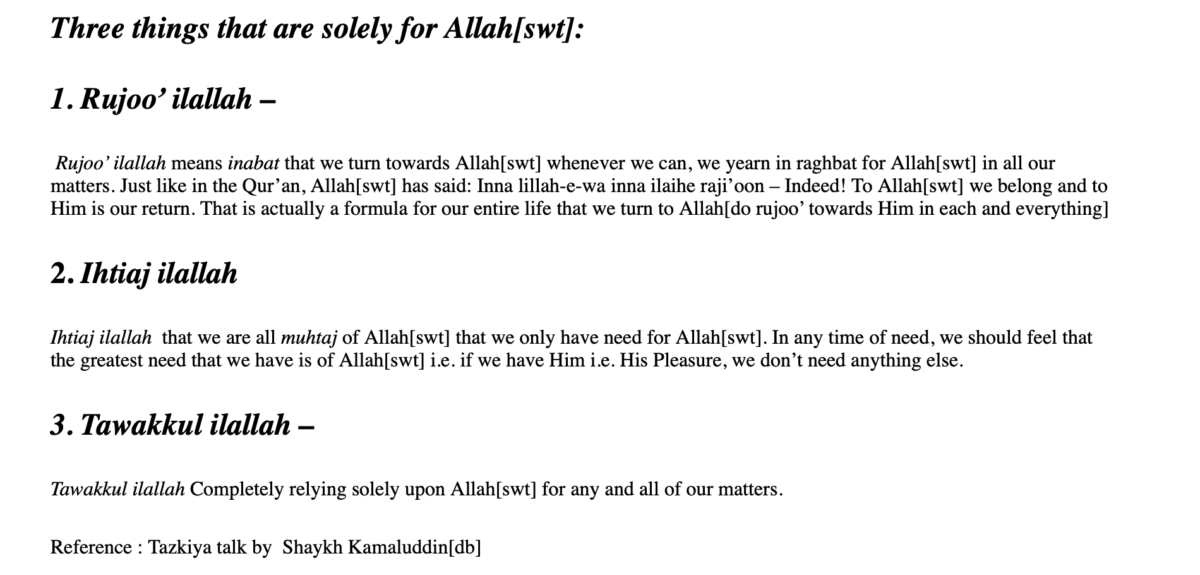
Rujoo’ ilallah — Return to Allah Ihtiaj ilallah — Need for Allah Tawakkul ‘alallah — Reliance upon Allah
These are not three separate practices. They are one continuous movement of the soul — a turn, a need, a surrender — that together describe what it means to have a living relationship with the Divine. Understanding them deeply, in their Quranic and scholarly dimensions, can transform how you experience every moment of your life.
The Framework: Why These Three? Why Solely for Allah?
The Quran describes the complete believer as one whose heart, in every state, has a single direction. Allah ﷻ says:
وَمَن يُسْلِمْ وَجْهَهُ إِلَى اللَّهِ وَهُوَ مُحْسِنٌ فَقَدِ اسْتَمْسَكَ بِالْعُرْوَةِ الْوُثْقَىٰ
“And whoever submits his face (himself) to Allah while he is a doer of good — he has grasped the most trustworthy handhold.” — Surah Luqman (31:22)
The phrase “submits his face to Allah” — yuslim wajhahu — is the Quranic image of Rujoo’, Ihtiaj, and Tawakkul combined. The “face” in Arabic rhetoric is the whole self. To submit it entirely means there is no direction the heart turns toward that is not oriented to Allah.
Ibn al-Qayyim al-Jawziyyah, in his incomparable Madarij as-Salikin (Stations of the Wayfarers), describes these three as foundational maqamat (stations) of the heart’s relationship with Allah — each one a prerequisite for the one that follows. You cannot have true tawakkul without genuine ihtiaj. You cannot experience genuine ihtiaj without the habit of rujoo’.
They form a chain. Together they constitute what the scholars call ‘uboodiyyah — the complete servitude of the heart to Allah ﷻ alone.
1. Rujoo’ Ilallah — Returning to Allah
The Meaning
Rujoo’ (رجوع) comes from the Arabic root r-j-‘, meaning to turn back, to return, to revert. Rujoo’ ilallah — return to Allah — means that the heart’s instinct in every situation, every emotion, and every moment of change is to turn toward Allah first.
Not after trying everything else. Not as a last resort. As the first reflex.
The scholars distinguish between two types of rujoo’:
Al-Inabah — the voluntary, longing return of the heart that loves Allah and turns to Him even before a difficulty arrives. This is the rujoo’ of the muqarrabeen (those drawn close), the highest station.
Al-Awbah — the return of the repentant servant who has strayed and comes back. This is also beloved to Allah — perhaps the most beloved act a servant can perform.
Both are captured in the famous formula of the Quran:
إِنَّا لِلَّهِ وَإِنَّا إِلَيْهِ رَاجِعُونَ
“Indeed, to Allah we belong, and indeed to Him we are returning.” — Surah Al-baqarah (2:156)
Most of us know this as the verse of calamity — said when we hear of a death or a loss. But the scholars of tafsir make a profound observation: the verb is present tense — raji’oon — we are returning, right now, continuously. It is not only a statement for death. It is a statement for every moment. We are always in a state of return to Allah, whether we recognise it or not.
The believer who understands rujoo’ recognises this — and makes it conscious.
Rujoo’ in the Quran
Allah ﷻ praises the people of rujoo’ repeatedly:
وَالَّذِينَ إِذَا فَعَلُوا فَاحِشَةً أَوْ ظَلَمُوا أَنفُسَهُمْ ذَكَرُوا اللَّهَ فَاسْتَغْفَرُوا لِذُنُوبِهِمْ
“And those who, when they commit an immorality or wrong themselves, remember Allah and seek forgiveness for their sins.” — Surah Ali ‘Imran (3:135)
The sequence here is the definition of rujoo’: wrong is committed → the heart immediately turns toward Allah (dhakaru Allah) → istighfar follows. The return happens before the punishment, before the consequence — as the first movement of a heart trained in rujoo’.
Contrast this with a heart that has lost rujoo’: wrong is committed → it turns to distraction, to justification, to other people, to self-blame that spirals inward rather than upward. The pain is the same. The direction is entirely different.
Rujoo’ in the Sunnah
The prophet ﷺ modelled rujoo’ in one of the most moving narrations in the entire hadith literature. After the unspeakable ordeal of Ta’if — rejected, mocked, bleeding from wounds made by stones thrown by children — alone on the outskirts of a hostile city, the Prophet ﷺ made a dua that stands as the greatest example of rujoo’:
“O Allah, to You I complain of my weakness, my scarcity of resources and the humiliation I have been subjected to by people. O Most Merciful of those who are merciful. O Lord of the weak and my Lord too. To whom have you entrusted me? To a distant person who receives me with hostility? Or to an enemy to whom you have granted authority over my affair? So long as You are not angry with me, I do not care…”
Every line of this dua is pure rujoo’. Not a turning to anyone else. Not calculation of next steps. Just — ilallah. To Allah.
Practical Rujoo’: What Does It Look Like Daily?
- When you receive bad news, before you call anyone, before you check your phone — say Inna lillahi wa inna ilayhi raji’oon with its meaning fully present.
- When you sin — and every person sins — do not let shame drive you away from Allah. Let it drive you towardHim in tawbah. The door is always open. “Say: O My servants who have transgressed against themselves — do not despair of the mercy of Allah. Indeed, Allah forgives all sins.” (Az-Zumar 39:53)
- Begin each day by consciously turning your first waking moments toward Allah — before the phone, before the news, before the to-do list.
- Make istighfar a continuous background of your life, not a response to specific sins. The Prophet ﷺ made istighfar seventy times a day — not because he sinned seventy times, but because rujoo’ was the permanent orientation of his heart.
2. Ihtiaj Ilallah — Need for Allah
The Meaning
Ihtiaj (احتياج) is derived from haja — need, want, poverty of self. Ihtiaj ilallah means to have one’s need directed entirely toward Allah — to feel, deeply and practically, that He is the one you cannot do without.
This is more radical than it sounds. Most of us would say we need Allah — in theory, in times of crisis, in abstract aqeedah. What the scholars of tazkiyah are describing is something more specific: the felt, lived, heart-level recognition that without Allah, you have nothing. That your degrees, your health, your relationships, your intelligence — all of it is borrowed light that returns to Him the moment He withdraws His hand.
The Quran names this state with a word that should stop every reader cold:
يَا أَيُّهَا النَّاسُ أَنتُمُ الْفُقَرَاءُ إِلَى اللَّهِ ۖ وَاللَّهُ هُوَ الْغَنِيُّ الْحَمِيدُ
“O people! You are the ones in need of Allah, while Allah is the Self-Sufficient, the Praiseworthy.” — Surah Fatir (35:15)
Al-fuqara’ — the poor, the needy. Allah is addressing all of humanity with this declaration. Not just the materially poor. Not just those in crisis. All people — the richest, the most powerful, the most accomplished — are, in reality, fuqara’ ilallah, utterly needy before Allah.
Ibn al-Qayyim comments on this verse with extraordinary depth. He says that faqr ilallah (poverty to Allah, need for Allah) is not a deficiency to be ashamed of — it is the highest station a human being can occupy. Because the inverse — to feel self-sufficient, independent, not needing Allah — is the station of Fir’awn and Qarun. It is kibr (arrogance), the root of every spiritual disease.
True ihtiaj ilallah is, paradoxically, the most dignifying state a human can be in. To know you need the Lord of All Worlds is to be in the company of every Prophet, every Siddiq, every righteous soul.
The Four Dimensions of Ihtiaj Ilallah
The scholars identify that our need for Allah operates on four levels simultaneously:
1. The need of existence — we did not create ourselves and we cannot sustain our own existence for a single breath without His permission. “And if Allah were to punish people for what they have earned, He would not leave upon the earth any creature.” (Fatir 35:45)
2. The need of guidance — without the Quran and Sunnah, without hidayah (guidance), the human intellect alone cannot find its way. This is why we say ihdinas-siratal mustaqeem — guide us to the straight path — in every single rak’ah of every salah. We need His guidance seventeen times a day at minimum.
3. The need of forgiveness — “If you were not to sin, Allah would replace you with a people who would sin and then seek forgiveness from Allah, and He would forgive them.” (Muslim) Our very capacity for tawbah is a form of our need for Allah. We need His mercy the way lungs need air.
4. The need of the heart — the deepest ihtiaj is this: the human heart finds no rest, no true peace, no actual contentment except in Allah. “Verily, in the remembrance of Allah do hearts find rest.” (Ra’d 13:28) Every other object the heart attaches to — wealth, status, people, pleasure — eventually disappoints. Allah alone is the wafi (the one who truly fulfils).
When Ihtiaj Is Directed Elsewhere
The spiritual disease that ihtiaj is the cure for is called istikhfaf — self-sufficiency, the illusion that one does not truly need Allah. This manifests in subtle ways:
- Turning to people in times of need before turning to Allah, with a heavier heart-weight on what they can do than on what Allah can do.
- Letting your confidence in your own plans and abilities crowd out actual dua and tawakkul.
- Feeling that your current blessing is the result of your own merit, rather than pure grace from Allah.
- Not making dua with urgency because “things are fine right now.”
The test of ihtiaj is in abundance, not scarcity. It is easy to feel one needs Allah when in crisis. The harder, more mature spiritual work is to feel it equally when everything is going well.
Sulayman ﷺ — the prophet who was given a kingdom unlike anything before or after him — is described in the Quran saying, upon seeing a miracle:
“This is from the favor of my Lord to test me whether I will be grateful or ungrateful.” (An-Naml 27:40)
At the height of his power, he recognised: this is from Him. Not mine. Not earned. A gift to be grateful for. That is ihtiaj ilallah in times of ease.
3. Tawakkul ‘Alallah — Complete Reliance Upon Allah
The Meaning
Tawakkul (توكل) comes from the root w-k-l — to entrust, to make a wakeel (agent, representative). Tawakkul ‘alallahmeans to make Allah your complete agent and trustee — to do your part, take your means, and then leave the outcome entirely in His hands with full confidence in His wisdom.
This is among the most misunderstood concepts in Islam, in both directions. Some reduce it to fatalism — “I’ll just pray and not act.” Others, in overcorrecting, reduce it to mere planning — “I’ll take all my means and dua is just a supplement.” Both are wrong.
The Prophet ﷺ defined it precisely. When a Bedouin left his camel untied and said “I rely on Allah”, the Prophet ﷺ replied:
“Tie your camel, then put your trust in Allah.” — Tirmidhi — Hasan
The camel must be tied. The application must be submitted. The medication must be taken. The business plan must be made. Then — after the means are taken to the full extent of one’s capacity — the heart releases the outcome to Allah with complete tranquillity. That release, that inner peace in the face of uncertainty, is tawakkul.
Tawakkul in the Quran
Allah makes a direct promise — among the most extraordinary guarantees in the entire Quran — to those who have tawakkul:
وَمَن يَتَوَكَّلْ عَلَى اللَّهِ فَهُوَ حَسْبُهُ ۚ إِنَّ اللَّهَ بَالِغُ أَمْرِهِ
“And whoever relies upon Allah — then He is sufficient for him. Indeed, Allah will accomplish His purpose.”— Surah At-Talaq (65:3)
Huwa hasbuhu — He is sufficient for him. The scholars say the hā (him) in this sentence refers to the person — not to any specific need or any one situation. Allah becomes sufficient for the person — comprehensively, in all their affairs — when they have tawakkul.
Allah also commands it directly in the context of taking decisions:
فَإِذَا عَزَمْتَ فَتَوَكَّلْ عَلَى اللَّهِ ۚ إِنَّ اللَّهَ يُحِبُّ الْمُتَوَكِّلِينَ
“Then when you have decided, put your trust in Allah. Certainly, Allah loves those who rely on Him.” — Surah Ali ‘Imran (3:159)
Note the sequence: decide (‘azamta), then put your trust. Decision and effort come first. Tawakkul is not the replacement of effort — it is the spiritual state that accompanies effort and determines how the heart experiences the outcome.
What Tawakkul Gives the Heart
The scholars describe three gifts tawakkul gives to the believer:
Peace before the outcome — because the heart is not anxious about what it cannot control. Ibn al-Qayyim writes: “The servant of Allah who has tawakkul is the most relaxed of people regarding the means, because he knows they are in Allah’s hand — and the most diligent of people in taking them, because he knows they are the doors Allah has set for His decree to pass through.”
Contentment with the outcome — because whatever arrives has come from the One who was trusted. If it is what was hoped for, it is a blessing. If it is not, it is wisdom from the One whose knowledge encompasses everything the servant cannot see.
Freedom from the servitude of people — this is one of the most liberating fruits of tawakkul. When your heart has handed its concerns to Allah, you are no longer enslaved by what others can do for you or against you. The Prophet ﷺ told Ibn Abbas رضي الله عنه:
“Know that if the whole nation were to gather together to benefit you with something, they would not benefit you with anything except what Allah has already written for you. And if they gather to harm you with something, they would not be able to harm you with anything except what Allah has already written against you.” — Tirmidhi — Sahih
When this enters the heart, the tyranny of human opinion loses its grip entirely.
Tawakkul and the Birds: The Prophetic Image
The most vivid image of tawakkul in the hadith literature is the one about birds:
“If you were to rely upon Allah with the reliance He is due, He would provide for you just as He provides for the birds: they go out hungry in the morning and return full in the evening.” — Tirmidhi — Hasan
Notice: the birds go out. They fly. They search. They exert every capacity they have. But they do not worry about whether they will find food. They go out, and they trust. They return full.
This is the life of the believer with tawakkul: active, engaged, taking all means — but internally free, unclenched, at peace with whatever Allah’s provision looks like today.
The Three Together: A Single Spiritual Movement
Rujoo’, Ihtiaj, and Tawakkul are not three separate chapters of the believer’s life. They are one continuous experience, always present, always simultaneous.
Rujoo’ is the direction — the heart always faces Allah, always returns to Him. Ihtiaj is the fuel — the felt, real, constant awareness that I cannot live without Him. Tawakkul is the surrender — after doing everything I can, the outcome is Yours.
A person with strong rujoo’ will naturally develop ihtiaj — because turning to Allah again and again deepens the awareness of how much you need Him. And deep ihtiaj naturally produces tawakkul — because when you truly feel that only Allah can help, you stop placing the burden on your own hands.
Ibn al-Qayyim describes this triad as the backbone of what he calls al-‘ubudiyyah al-kamilah — complete servitude — the spiritual station that distinguishes the true believer from one who merely performs the outward rituals of Islam without their inward substance.
Why These Three Must Be Solely for Allah
The question bears asking: why solely? Why can we not have rujoo’, ihtiaj, and tawakkul distributed across multiple sources — some for Allah, some for our human supports?
The answer is both theological and psychological.
Theologically: because these three states, when directed at anything other than Allah, are forms of hidden shirk — the shirk of the heart, not the act of prostrating to an idol, but the act of giving something else the function of Allah in one’s inner life. The Prophet ﷺ said: “The thing I fear most for you is minor shirk.” When asked what that was, he replied: “Showing off.” — Ahmad. Many scholars extend this to the tawakkul placed in people — leaning on them as we should lean only on Allah.
Psychologically: because nothing other than Allah is capable of bearing these states. Every created thing — every person, every institution, every plan — will eventually fail you in some way, not out of malice, but out of limitation. They are created, finite, impermanent. Only the One who is Al-Qayyum (the Ever-Self-Sustaining) can carry the full weight of a heart’s rujoo’, ihtiaj, and tawakkul without ever buckling.
The mother whose rujoo’ is in her child will be shattered when the child fails her. The believer whose rujoo’ is in Allah will never be shattered — because He never fails, and He never leaves.
A Practical Checklist: Where Is Your Heart Directed?
These questions, drawn from the spirit of the scholars’ teachings on tazkiyah, are worth sitting with honestly:
For Rujoo’:
- When something goes wrong, what is the first place my heart goes?
- When I’ve done something I’m ashamed of, do I move toward Allah or away from Him?
- Is istighfar a daily habit, or only an emergency response?
For Ihtiaj:
- Do I make dua with genuine urgency, or does some part of me feel “I’ve got this”?
- When I’m blessed, do I feel dependent on Allah, or do I feel I deserved it?
- Can I sit in salah and feel the actual, present need I have for Allah — or is salah mostly habit?
For Tawakkul:
- After I have done everything I can, does my heart release the outcome — or does it keep gripping?
- Am I afraid of what people can do to me, or is that fear proportionate, manageable, secondary to my trust in Allah?
- When a door closes, can I say — and mean — “Allah is sufficient for me”?
These are not rhetorical questions. They are the questions the masters of tazkiyah gave their students to work on over years of spiritual development. Be patient with yourself. These are stations, not switches.
Duas for Rujoo’, Ihtiaj, and Tawakkul
Dua of Rujoo’ — the dua of Yunus ﷺ, for when the heart needs to return:
لَّا إِلَٰهَ إِلَّا أَنتَ سُبْحَانَكَ إِنِّي كُنتُ مِنَ الظَّالِمِينَ La ilaha illa Anta, Subhanaka, inni kuntu mina z-zalimeen “There is no deity except You; exalted are You. Indeed, I have been of the wrongdoers.” — Surah Al-Anbiya (21:87)
Dua of Ihtiaj — the dua of Musa ﷺ at his lowest:
رَبِّ إِنِّي لِمَا أَنزَلْتَ إِلَيَّ مِنْ خَيْرٍ فَقِيرٌ Rabbi inni lima anzalta ilayya min khayrin faqir “My Lord, indeed I am, for whatever good You would send down to me, in [dire] need.” — Surah Al-Qasas (28:24)
Dua of Tawakkul — the dua the Prophet ﷺ taught for every morning:
اللَّهُمَّ بِكَ أَصْبَحْنَا وَبِكَ أَمْسَيْنَا وَبِكَ نَحْيَا وَبِكَ نَمُوتُ وَإِلَيْكَ النُّشُورُ allahumma bika asbahna wa bika amsayna wa bika nahya wa bika namutu wa ilayka an-nushur “O Allah, by You we enter the morning and by You we enter the evening, by You we live and by You we die, and to You is the resurrection.” — Abu Dawud, Tirmidhi
Closing Reflection
There is a beautiful passage in Surah Az-Zumar where Allah describes the state of the believer at the moment of their soul’s departure:
“And those who feared their Lord will be driven to Paradise in groups until, when they reach it while its gates have been opened and its keepers say: Peace be upon you; you have done well, so enter it to abide eternally therein.” — Surah Az-Zumar (39:73)
The scholars note that these are people who, throughout their lives, kept turning back — rujoo’ — who kept acknowledging their need — ihtiaj — and who kept placing their trust — tawakkul — in the One who deserved it.
Not perfect people. Not people who never struggled, never doubted, never fell. But people whose direction was right. Whose heart was facing the right way.
That is all that is being asked of us. Not arrival. Just the right direction — held consistently, returned to honestly, maintained with dua and patience and the knowledge that the One you are facing never tires of your return.
Related Reading on IslamHashtag
- Understanding the Hadith: Nothing Changes Destiny Except Dua
- Dua for Various Trials of Life
- Inna Lillahi wa Inna Ilayhi Raji’un — The Four Sunnah of Istirja’
- La Hawla Wala Quwwata Illa Billah — The Treasure of Paradise
- 20 Tips to Increase Barakah from Quran and Sunnah
- Ya Hayyu Ya Qayyum — Meaning and Benefits
This article is an expanded reflection on a tazkiyah talk by Shaykh Kamaluddin (db). The Quranic and hadith references, scholarly commentary, and practical applications have been developed by Alimah Fahmina Jawed.
Alimah Fahmina Jawed is the founder of IslamHashtag.com, a graduate of two prestigious Islamic institutions with an MA in Arabic, and a teacher of Tafsir, Hadith, Fiqh, and Seerah. IslamHashtag has been serving the Ummah for over 11 years from mecca.
Written by

Ustadha Fahmina holds the Alimah sanad from two prestigious institutes and is a certified Optometrist Doctor. She teaches Tafsir, Hadith, Fiqh, Seerah to Women and Kids and is passionate about spreading authentic information about the religion of Islam. Connect with her to keep updated about her recent ebooks and projects.
Discover more from Islam Hashtag
Subscribe to get the latest posts sent to your email.