
Hajj & Umrah Guide: The Complete Step-by-Step Resource for Every Pilgrim
Last updated: August 2026
In this guide: Everything you need for hajj and Umrah in one place — what each pilgrimage means, the step-by-step rituals from Ihram to Tawaf al-Wada, the exact duas to recite at each stage, a printable packing checklist, Nusuk visa help, where to stay in Makkah and Madinah, and free downloadable PDFs. Bookmark this page — you’ll want to come back to it before, during, and after your journey.
Hajj being the fifth pillar of Islam holds immense importance for every Muslim who is physically and financially able to perform it. Umrah, though not obligatory, is a Sunnah so beloved that many Muslims perform it several times in their lives. Whether you are preparing for your first Hajj, planning an Umrah trip next month, or simply want to understand what these two journeys involve, this guide walks you through everything — in the order you’ll actually need it.
May Allah accept your Hajj and Umrah and make it a Hajj Mabroor. Ameen.
Table of Contents
- What Are Hajj and Umrah?
- Hajj vs Umrah: Key Differences
- The Three Types of Hajj (Tamattu, Qiran, Ifrad)
- How to Prepare Before You Travel
- Step-by-Step Guide to Performing Umrah
- Step-by-Step Guide to Performing Hajj (Day by Day)
- Essential Duas for Hajj and Umrah
- Hajj & Umrah Packing Checklist
- Visas, Nusuk, and Travel Logistics
- Where to Stay: Makkah and Madinah Ziyarah Guide
- Free Downloads: PDFs, Talbiya Audio & Handouts
- Frequently Asked Questions
- Explore Our Full Hajj & Umrah Library
What Are Hajj and Umrah? {#what-are-hajj-and-umrah}
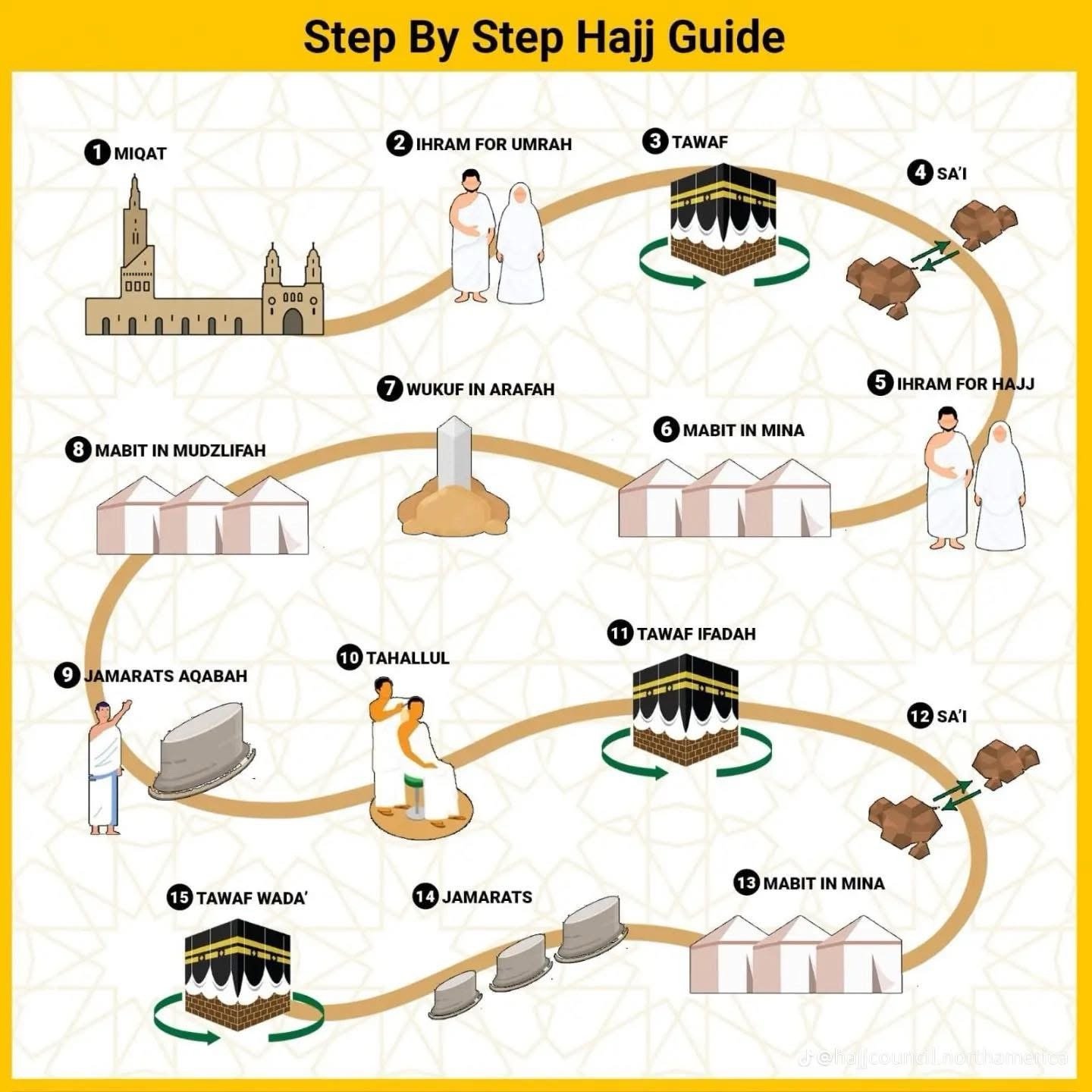
Hajj is the annual pilgrimage to the House of Allah in Makkah, performed only during specific days of the Islamic month of Dhul Hijjah. It is the fifth pillar of Islam and is fard (obligatory) once in a lifetime for every adult Muslim who has the physical ability and financial means to undertake it.
Umrah is often called the “minor pilgrimage.” It follows a shorter set of rituals — Ihram, Tawaf, Sa’i, and Halq or Taqsir — and can be performed at any time of the year. It is not obligatory, but it is a confirmed Sunnah, and the prophet ﷺ encouraged Muslims to perform it whenever they are able.
Both pilgrimages centre on the same sacred sites: the kaaba in Masjid al-Haram, the hills of Safa and Marwah, and — for Hajj — the plains of Arafat, Muzdalifah, and Mina.
For the full breakdown with rulings and evidences, read our detailed article: What is the Difference Between Hajj and Umrah
Hajj vs Umrah: Key Differences {#hajj-vs-umrah}
| Hajj | Umrah | |
|---|---|---|
| Ruling | Obligatory (once in a lifetime, if able) | Sunnah Mu’akkadah (highly recommended) |
| Timing | Only 8th–13th Dhul Hijjah | Any time of the year |
| Core Rituals | Ihram, Tawaf, Sa’i, Arafat, Muzdalifah, Mina, Jamarat, Halq/Taqsir | Ihram, Tawaf, Sa’i, Halq/Taqsir |
| Duration | Around 5–6 days minimum | Can be completed in a few hours |
| Missing a pillar | Invalidates the Hajj | Invalidates the Umrah |
The Three Types of Hajj {#types-of-hajj}
When you make your intention (niyyah) for Ihram, you must choose one of three forms of Hajj:
- Tamattu’ — You perform Umrah first during the Hajj months, exit Ihram, then re-enter Ihram for Hajj alone on the 8th of Dhul Hijjah. This is the form the Prophet ﷺ most encouraged and the one most pilgrims choose today.
- Qiran — You combine the intentions of Umrah and Hajj together and remain in Ihram until the Hajj is complete.
- Ifrad — You perform Hajj only, with no Umrah combined, typically done by residents of Makkah or those already in Ihram boundaries.
Both Tamattu’ and Qiran require a Hady (sacrificial animal); Ifrad does not. If you are unsure which to choose, Tamattu’ is generally the easiest and most recommended for first-time pilgrims — ask your group scholar or travel agent to confirm what’s included in your package.
How to Prepare Before You Travel {#how-to-prepare}
Preparation for Hajj and Umrah isn’t just logistical — it’s spiritual, physical, and financial.
Spiritually:
- Repay debts and settle disputes with people before you leave.
- Make sincere tawbah (repentance) and set clear intentions.
- Learn the rulings of Ihram and the rituals before you travel, not on the plane.
- Set specific personal duas you want to make — many pilgrims regret forgetting to ask for something they’d been planning for years.
Here is a sample Personal Dua Diary — 100 Things to Ask Allah to help you build your own list in advance.
Physically:
- Hajj involves a lot of walking, standing, and being on your feet in heat — start walking daily a few months in advance if you can.
- Get your vaccinations sorted early (meningitis is typically required for the Saudi visa).
- Pack any personal medication with prescriptions.
Financially:
- Budget beyond the package price for the Hady (sacrifice), Zamzam water for family, gifts, and local transport.
- Exchange some Saudi Riyal before you travel or on arrival.
👉 Read: 10 Reminders If You Are Planning for Umrah and 8 Powerful Intentions for Umrah
Step-by-Step Guide to Performing Umrah {#umrah-steps}
Umrah has four essential steps. Missing any one of them invalidates the Umrah.
1. Enter the State of Ihram (at or before the Miqat)
- Perform ghusl (or wudu if ghusl isn’t possible), trim nails, and remove excess hair.
- Men wear two unstitched white sheets; women wear normal modest clothing that covers everything except the face and hands.
- Pray two rak’ahs of nafl if possible.
- Make your niyyah (intention) for Umrah: “allahumma inni ureedul ‘umrata fa yassirha li wa taqabbalha minni” — “O Allah, I intend to perform Umrah, so make it easy for me and accept it from me.”
- Begin reciting the Talbiyah continuously: “Labbayk Allahumma labbayk…”
2. Perform Tawaf (circle the Kaaba seven times)
- Start and end at the Black Stone (Hajr al-Aswad) corner.
- Men perform Ramal (brisk walking) for the first three circuits only, in Umrah/Hajj Tawaf.
- After Tawaf, pray two rak’ahs, preferably near Maqam Ibrahim, then drink Zamzam.
3. Perform Sa’i (walk between Safa and Marwah, seven times)
- Begin at Safa, facing the Kaaba, and recite the prescribed dua.
- Walk briskly between the green markers (men only).
- A “round” is one direction — Safa to Marwah counts as one, Marwah back to Safa is the second, and so on until seven.
4. Halq or Taqsir (shave or trim the hair)
- Men either shave the head completely (Halq — more rewarding) or trim it evenly (Taqsir).
- Women trim a fingertip’s length from the ends of their hair.
- This exits you from the state of Ihram — your Umrah is now complete.
Step-by-Step Guide to Performing Hajj (Day by Day) {#hajj-steps}
8th Dhul Hijjah — Yaumul Tarwiyah
Enter Ihram (if performing Tamattu’, re-enter at your accommodation) and travel to Mina. Pray Dhuhr, Asr, Maghrib, Isha, and Fajr there, shortened but not combined.
👉 Read: Yaumul Tarwiya — What the 8th of Dhul Hijja Is Really Asking of You
9th Dhul Hijjah — Day of Arafah
This is the single most important day of Hajj. “Hajj is Arafah,” the Prophet ﷺ said. Pilgrims move to the plains of Arafat after sunrise, spend the day in intense dua, dhikr, and repentance until sunset, then head to Muzdalifah, praying Maghrib and Isha combined there and collecting pebbles for the Jamarat.
9 Spiritually Rewarding Ways to Make the Most of the Day of Arafah
10th Dhul Hijjah — Eid al-Adha / Yaum an-Nahr
- Stone the largest Jamarat (Jamarat al-Aqabah) with seven pebbles.
- Perform the Hady (sacrifice).
- Do Halq or Taqsir — most of the restrictions of Ihram are now lifted.
- Perform Tawaf al-Ifadah (an obligatory pillar of Hajj) and Sa’i (if not already done under Tamattu’).
11th–12th (and sometimes 13th) Dhul Hijjah — Days of Tashreeq
Stay in Mina and stone all three Jamarat (Sughra, Wusta, Aqabah) with seven pebbles each, after Dhuhr, on each day.
Before Leaving Makkah — Tawaf al-Wada (Farewell Tawaf)
The final act before departure — a last seven circuits around the Kaaba to bid farewell to the House of Allah.
Essential Duas for Hajj and Umrah {#duas}
Carrying a printed or memorised dua list is one of the most practical things you can do — during Tawaf and Sa’i in particular, it’s easy to lose focus without one.
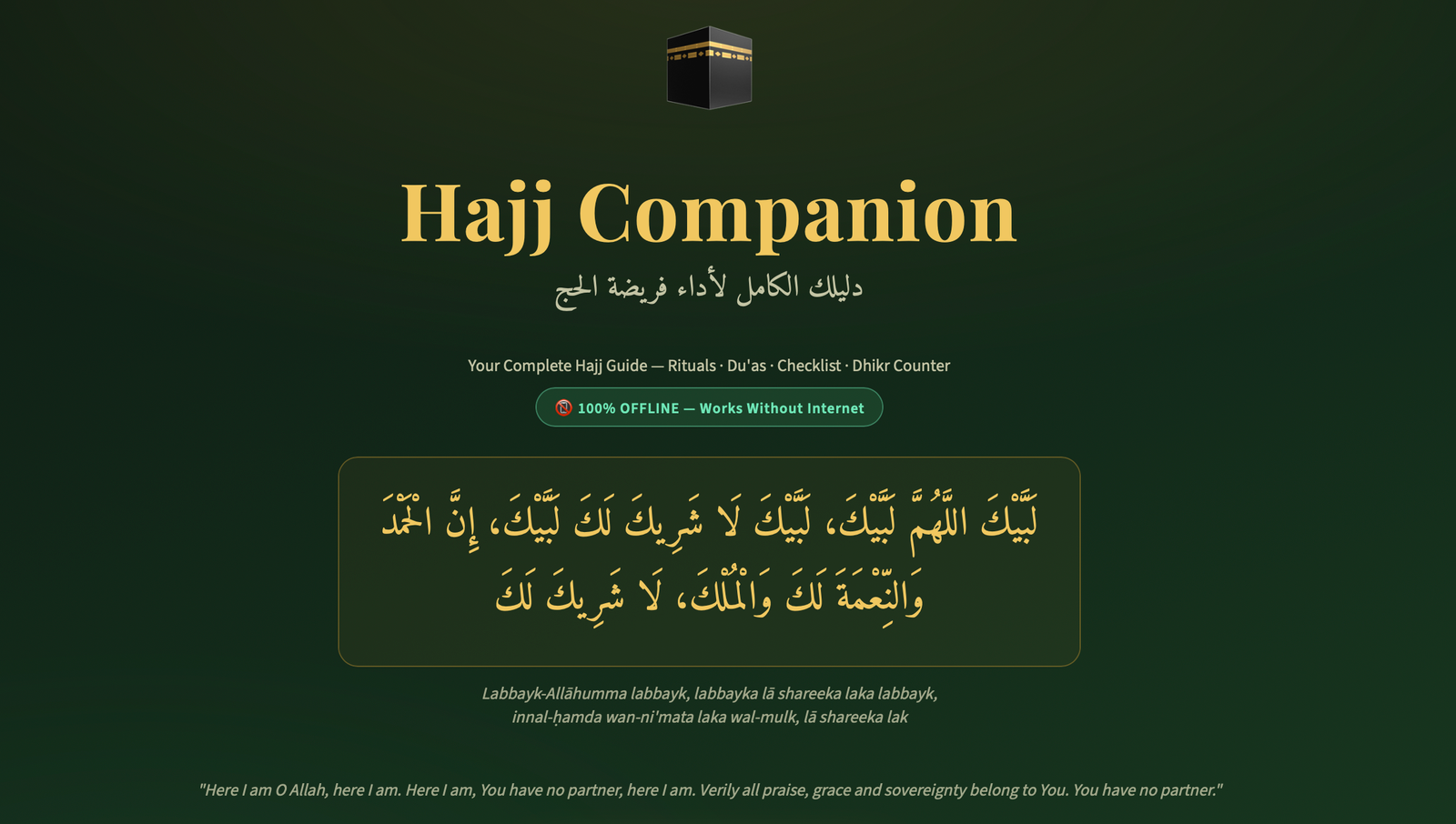
- The Talbiyah (recite frequently while in Ihram): Labbayk Allahumma labbayk, labbayka la shareeka laka labbayk, innal hamda wan-ni’mata laka wal mulk, la shareeka lak. “Here I am, O Allah, here I am. Here I am, You have no partner, here I am. Indeed all praise, grace, and sovereignty belong to You. You have no partner.”
- Between Safa and Marwah, and at Arafat: La ilaha illallahu wahdahu la shareeka lah, lahul mulku wa lahul hamd, wa huwa ‘ala kulli shay’in qadeer.
- The Rabbana dua after Tawaf: Rabbana atina fid-dunya hasanatan wa fil-akhirati hasanatan wa qina ‘adhaban-nar.
Download the full set: One-Minute Supplication Handout and 40 Rabbana Duas from the Quran, with meanings
Travelling means someone is being sent off, too: Duas for Bidding Farewell — What to Say When Someone Leaves for Hajj or a Journey
Hajj & Umrah Packing Checklist {#packing-checklist}
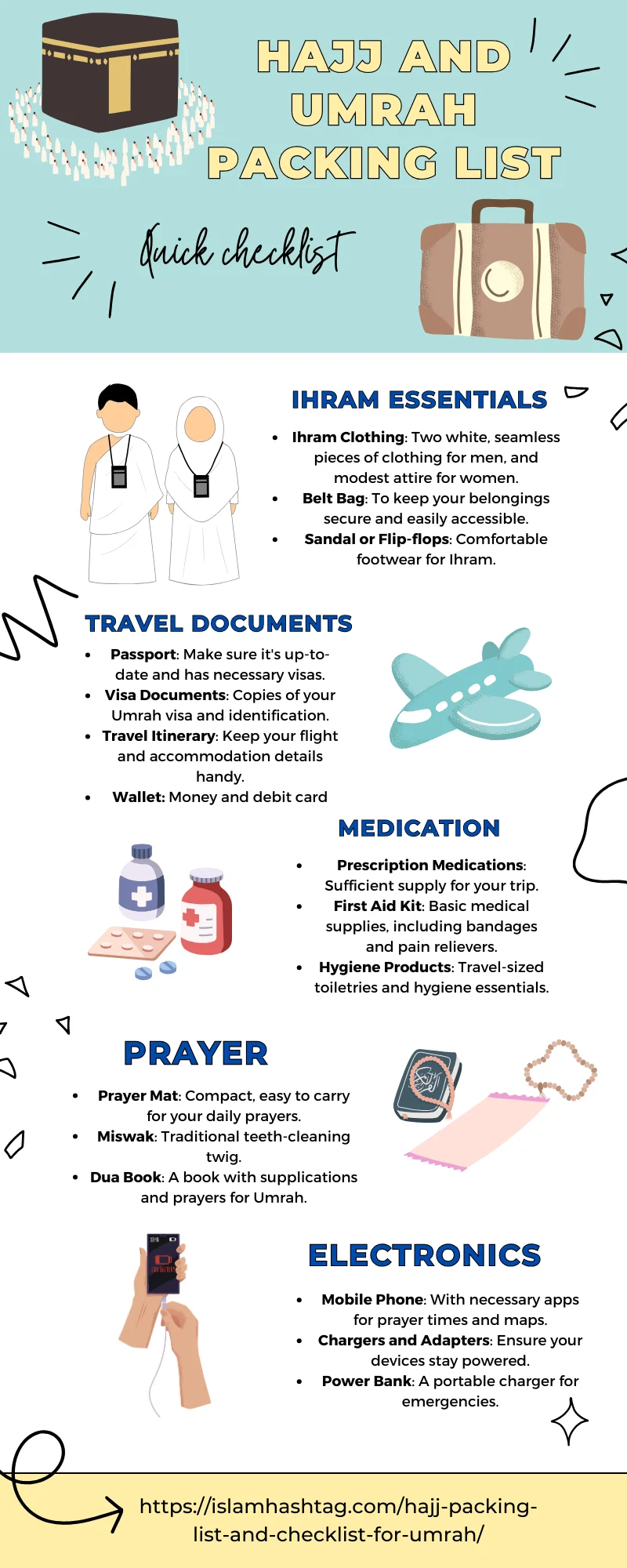
A quick-reference version — the full illustrated checklist with product links is here: Complete Umrah and Hajj Packing List
- Passport, visa printout, and hotel/Kafila contact details (carry a physical copy, not just digital)
- Money in Saudi Riyal and your local currency
- Two sets of Ihram for men; comfortable, modest clothing for women
- A stitched (non-leather) Ihram belt for men
- Rubber slippers + a labelled polythene bag to carry them during Tawaf
- Small crossbody/zip bag for essentials — preferable for women to hang around the neck
- Small torch, nail cutter, scissors (for hair trimming), and an alarm clock
- A small cloth pouch for collecting the 100 pebbles for the Jamarat
- Sleeping mat/bag for nights in Mina and Muzdalifah
- A 3-to-2 pin travel adapter for charging
- Any prescription medicine plus general medicines (painkillers, stomach relief, cold/flu tablets)
- Printed duas and this guide’s free downloads
Quick tips once you’re there:
- Zamzam containers with green lids are not chilled — look for other colours if you want cold water.
- Note the gate number and name you entered the Haram through — it’s very easy to lose your group otherwise.
- Go to the toilets at least an hour before salah times; queues get long fast.
- Many pilgrims don’t know the Haram has free safety wristbands for children and the elderly — find out where to get them here.
Visas, Nusuk, and Travel Logistics {#visas-logistics}
Saudi Arabia now processes the vast majority of Hajj and Umrah visas through the official Nusuk platform, which also handles Rawdah access bookings in Madinah.
Are You Performing Hajj via Nusuk? Here’s What You Need to Know
Keep in mind Saudi visa rules change from year to year — recent updates pilgrims should be aware of:
- Umrah visa validity was cut to one month — confirm your travel dates fall within the validity window before booking flights.
- Children have, in recent years, been restricted from accompanying pilgrims during Hajj — check the current-year rule before including children in your Hajj group (Umrah is generally unaffected).
- The Saudi transit visa now allows some travellers to perform Umrah and visit the Rawdah even on a layover.
Because these rules are updated by the Saudi authorities, always cross-check the current requirements on the official Nusuk portal before you finalise travel.
Where to Stay & What to Visit: Makkah and Madinah Ziyarah Guide {#ziyarah}
Your pilgrimage doesn’t end at the rituals — the blessed cities themselves hold sites worth knowing about, especially in Madinah where you’ll likely have more free time.
In Madinah:
- The Raudhah of Masjid Nabawi — the blessed spot between the Prophet’s ﷺ house and his minbar, described as a garden from the gardens of Paradise. Book your Rawdah slot via Nusuk in advance if you can.
- 7 Secrets Hidden in the City of Madina
- The Secret Basement Library of Masjid Nabawi
In Makkah:
- Ziyarah Places in Mecca — A Full List
- Zamzam Well Stairs Before 2000 — A Memory Many Pilgrims Still Cherish — a look at how the Zamzam well has changed over the decades.
- Download the Al-Maqsad Grand Mosque navigation app — it works offline and helps you locate gates, the Rawdah, and prayer areas inside Masjid al-Haram.
Free Downloads: PDFs, Talbiya Audio & Handouts {#free-downloads}
Everything below is free to download and print before you travel:
- 📄 Printable Hajj Pamphlet — a 2-page pocket guide you can carry with you
- 🎧 Talbiya of Hajj — Free MP3 Download — listen to it on the flight or whenever your heart needs stillness
- 📄 Useful Arabic Words and Phrases (PDF) — a simple English-to-Arabic mini guide
- 📄 One-Minute Supplication Handout
- 📄 Personal Dua Diary — 100 Things to Ask Allah
Frequently Asked Questions {#faqs}
Is Umrah compulsory? No. Umrah is a confirmed Sunnah, not an obligation, though many scholars consider it highly recommended to perform at least once in a lifetime.
Can I combine Hajj and Umrah in one trip? Yes — this is the Tamattu’ or Qiran form of Hajj, and it is the most common approach for pilgrims travelling from outside Saudi Arabia.
What invalidates Ihram? Cutting hair or nails, using scented products, hunting, marital relations, and (for men) wearing stitched clothing or covering the head are all prohibited while in Ihram. Unintentional violations may require a fidyah (expiation) — consult a scholar if unsure.
How much walking is involved in Hajj? A significant amount — Tawaf alone is roughly 7 laps of the Kaaba (around 1.5 km), and pilgrims often walk many kilometres a day between Mina, Arafat, and Muzdalifah. Physical preparation in the months before travel is strongly recommended.
What is Hajj Mabroor? A “Hajj Mabroor” is an accepted pilgrimage — one performed with sincerity, funded by halal means, free of sin and dispute, and which leaves the pilgrim spiritually transformed afterward. Read more: The Quest for Hajj Mabrur: A Journey of the Heart
Do I need to trim my nails and hair before Dhul Hijjah if I’m not going for Hajj? If you intend to sacrifice an animal (Udhiyah) for Eid al-Adha, it’s recommended to avoid cutting your hair and nails from the 1st of Dhul Hijjah until after the sacrifice. Full details: Cutting Nails and Trimming Hair Before Dhul Hijjah
Explore Our Full Hajj & Umrah Library {#explore-more}
This guide covers the essentials, but our Hajj and Umrah Magazine section has over 110 articles — pilgrim stories, ruling updates, Haramain news, and reflections — updated regularly as Hajj season approaches. A few reader favourites:
- Arafat Sermon (English and Urdu)
- Ask Your Religious Questions Inside Bab Umar of Masjid an-Nabawi
- Abdul Wahab Al Shaibi Becomes the New Key-Bearer of the Holy Kaaba
Test your knowledge: Take our Hajj and Umrah Quiz
Have a question this guide didn’t answer? Leave a comment below and we’ll do our best to help — or write to us via our Hajj section for a free resource. Hajj Mabroor to everyone preparing for this journey. Jazakumullahu Khairan for reading.