
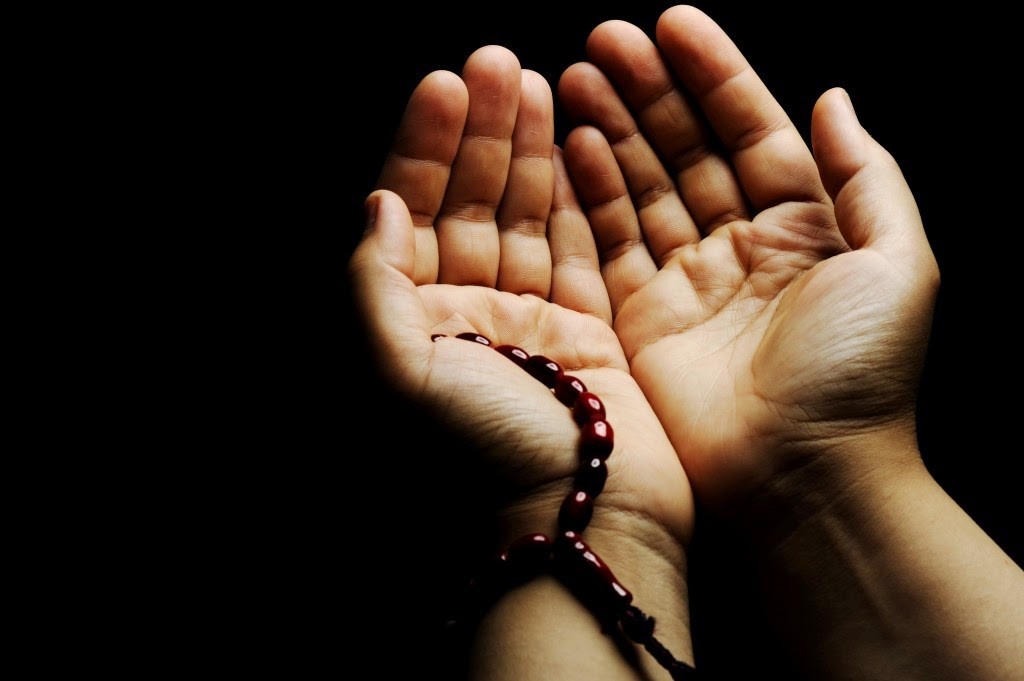
Dua for Various Trials of Life — Authentic Supplications from the Quran and Sunnah
By Aafiya | IslamHashtag
There is a moment most of us know — when the difficulty is too heavy to explain to anyone, when words run out, when even the people who love you cannot reach the place inside you that is hurting. It is exactly in that moment that Allah ﷻ says:
“Call upon Me; I will respond to you.” — Surah Ghafir (40:60)
Dua is not a last resort. It is the first response of a believer. It is the weapon the Prophet ﷺ described as more powerful than any circumstance, and it is the thread that connects us to the One who holds every trial in His hands.
In this article, I have compiled authentic duas for the various trials of life — drawn from the Quran, from Sahih Bukhari and Muslim, and from the supplications the Prophet ﷺ taught specifically for moments of hardship — with Arabic text, transliteration, translation, and scholarly context. This is not a list to scroll past. This is a guide to sit with, to memorise from, and to return to.
First: Understanding the Nature of Trials in Islam
Before we turn to the duas themselves, we must understand why trials come — because the dua of someone who understands their trial is fundamentally different from the dua of someone who is simply desperate.
Allah ﷻ says in Surah Al-baqarah:
وَلَنَبْلُوَنَّكُم بِشَيْءٍ مِّنَ الْخَوْفِ وَالْجُوعِ وَنَقْصٍ مِّنَ الْأَمْوَالِ وَالْأَنفُسِ وَالثَّمَرَاتِ ۗ وَبَشِّرِ الصَّابِرِينَ
“And We will surely test you with something of fear and hunger and a loss of wealth and lives and fruits, but give good tidings to the patient.” — Surah Al-Baqarah (2:155)
The scholars of tafsir note that Allah says “We will surely test” — it is not conditional. Every soul will be tested. The question is not whether the trial will come, but how we meet it.
Umar ibn al-Khattab رضي الله عنه said something that Imam Ibn al-Qayyim preserved in his works: “I was never afflicted with a trial except that with it Allah gave me four blessings: it was not in my religion; I was not prevented from being content; it was not worse than it was; and I hoped for reward through it.”
This is the lens through which we make dua in times of trial — not bargaining, not despair, but informed trust in the One who sent the difficulty and the One who holds its removal.
The Dua of Ayyub ﷺ — For Pain, Illness, and Prolonged Hardship
Perhaps the most profound dua in the entire Quran for someone suffering is the dua of Prophet Ayyub ﷺ. He had lost his health, his wealth, and his children. His trial lasted years. And his dua was not a demand — it was a whisper of acknowledgement:
أَنِّي مَسَّنِيَ الضُّرُّ وَأَنتَ أَرْحَمُ الرَّاحِمِينَ
“Anni massaniya ad-durru wa anta arhamur-rahimeen”
“Indeed, adversity has touched me, and You are the Most Merciful of the merciful.” — Surah Al-Anbiya (21:83)
He did not say: “Remove this from me.” He simply turned to Allah and described his state, trusting that the Most Merciful does not need to be convinced — He only needs to be called upon.
Allah ﷻ responded: “So We responded to him and removed what afflicted him of adversity.” (21:84)
Recite this dua when you are in pain — physical, emotional, or spiritual — and when you have been suffering so long that you have run out of words.
The Dua of Yunus ﷺ — For When You Feel Trapped and Alone
لَّا إِلَٰهَ إِلَّا أَنتَ سُبْحَانَكَ إِنِّي كُنتُ مِنَ الظَّالِمِينَ
“La ilaha illa Anta, Subhanaka, inni kuntu mina z-zalimeen”
“There is no deity except You; exalted are You. Indeed, I have been of the wrongdoers.” — Surah Al-Anbiya (21:87)
This dua was made in the darkness of the whale’s stomach — the most enclosed, hopeless circumstance imaginable. And it begins not with a request, but with tawhid and istighfar.
The Prophet ﷺ said about this dua: “No Muslim ever calls upon Allah with it in any matter, except that Allah will respond to him.” (Tirmidhi — Hasan Sahih)
Scholars note its three-part structure: affirming tawhid (La ilaha illa Anta), glorifying Allah (Subhanaka), and acknowledging one’s own shortcoming (inni kuntu mina z-zalimeen). This combination — sincerity + humility + recognition of need — is the spiritual architecture of a dua that is answered.
Recite this when you feel trapped, when every door seems closed, when you feel you have caused your own difficulty.
The Dua of the Prophet ﷺ for Distress and Anxiety (Dua Karb)
The Prophet ﷺ specifically taught this dua for moments of overwhelming distress — what the scholars call karb(crushing worry):
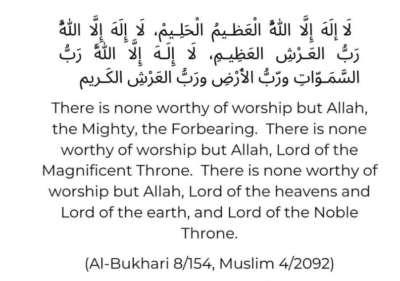
لَا إِلَهَ إِلَّا اللَّهُ الْعَظِيمُ الْحَلِيمُ، لَا إِلَهَ إِلَّا اللَّهُ رَبُّ الْعَرْشِ الْعَظِيمِ، لَا إِلَهَ إِلَّا اللَّهُ رَبُّ السَّمَاوَاتِ وَرَبُّ الْأَرْضِ وَرَبُّ الْعَرْشِ الْكَرِيمِ
“La ilaha illallahul-‘Azimul-Halim, la ilaha illallahu Rabbul-‘arshil-‘azim, la ilaha illallahu Rabbus-samawati wa Rabbul-ardi wa Rabbul-‘arshil-karim”
“There is no deity except Allah, the Magnificent, the Forbearing. There is no deity except Allah, Lord of the Magnificent Throne. There is no deity except Allah, Lord of the heavens and Lord of the earth and Lord of the Noble Throne.” — Bukhari & Muslim
When Ibn Abbas رضي الله عنه reported this hadith, he noted that the Prophet ﷺ would recite this when he was distressed. Notice: it contains no specific request. It is pure tawhid — the repetition of la ilaha illallah with different descriptions of Allah’s greatness. The scholars explain that when the heart is overwhelmed, the most powerful remedy is to expand its awareness of who Allah is.
Recite this dua in moments of acute distress, panic, or when the anxiety feels too large to contain.
Dua for Sadness, Depression, and Helplessness
اللَّهُمَّ إِنِّي عَبْدُكَ ابْنُ عَبْدِكَ ابْنُ أَمَتِكَ نَاصِيَتِي بِيَدِكَ مَاضٍ فِيَّ حُكْمُكَ عَدْلٌ فِيَّ قَضَاؤُكَ أَسْأَلُكَ بِكُلِّ اسْمٍ هُوَ لَكَ سَمَّيْتَ بِهِ نَفْسَكَ أَوْ أَنْزَلْتَهُ فِي كِتَابِكَ أَوْ عَلَّمْتَهُ أَحَدًا مِنْ خَلْقِكَ أَوِ اسْتَأْثَرْتَ بِهِ فِي عِلْمِ الْغَيْبِ عِنْدَكَ أَنْ تَجْعَلَ الْقُرْآنَ رَبِيعَ قَلْبِي وَنُورَ صَدْرِي وَجَلَاءَ حُزْنِي وَذَهَابَ هَمِّي
“Allahumma inni ‘abduka, ibnu ‘abdika, ibnu amatika, nasiyati biyadika, madin fiyya hukmuka, ‘adlun fiyya qada’uka, as’aluka bikulli ismin huwa laka, sammayta bihi nafsaka, aw anzaltahu fi kitabika, aw ‘allamtahu ahadan min khalqika, aw ista’tharta bihi fi ‘ilmil-ghaybi ‘indaka, an taj’alal-Qur’ana rabi’a qalbi, wa nura sadri, wa jala’a huzni, wa dhahaba hammi.”
“O Allah, I am Your servant, son of Your servant, son of Your maidservant. My forelock is in Your hand. Your judgment upon me is assured, Your decree concerning me is just. I ask You by every name You have named Yourself with, or revealed in Your Book, or taught to any of Your creation, or kept to Yourself in the knowledge of the unseen — make the Quran the spring of my heart, the light of my chest, the removal of my sadness, and the relief of my anxiety.” — Ahmad — Sahih by Ibn Hibban
The Prophet ﷺ said about this dua: “There is no person who is afflicted with distress and grief, and says this supplication, except that Allah will remove his distress and grief, and replace it with joy.” A companion asked: “Should we learn it?” He ﷺ replied: “Yes — whoever hears it should learn it.”
This is one of the most complete duas in the Sunnah. It addresses sadness (huzn) — the grief of the past — and anxiety (hamm) — the worry about the future — simultaneously, and anchors both in the Quran.
For a deeper exploration of the duas for depression and anxiety, see our dedicated article: 10 Dua for Sadness, Depression, and Anxiety.
Dua at the Time of Calamity — Inna Lillahi
When sudden loss strikes — a death, an accident, a diagnosis — the Sunnah gives us the Dua of Istirja’:
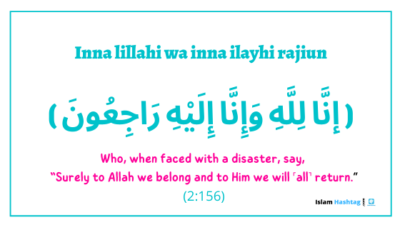
إِنَّا لِلَّهِ وَإِنَّا إِلَيْهِ رَاجِعُونَ، اللَّهُمَّ أْجُرْنِي فِي مُصِيبَتِي وَأَخْلِفْ لِي خَيْرًا مِنْهَا
“Inna lillahi wa inna ilayhi raji’un. Allahumma’jurni fi musibati, wa akhlif li khayran minha.”
“Indeed to Allah we belong and to Him we shall return. O Allah, reward me in my calamity and replace it with something better.” — Muslim
Umm Salamah رضي الله عنها reported that the Prophet ﷺ taught her this dua when her husband Abu Salamah died. She said she could not imagine anything better than Abu Salamah — yet she made the dua. And Allah replaced him with the Prophet of Allah ﷺ himself in marriage.
The scholars note that the second part of this dua — asking for something better — takes courage to say sincerely when you are in grief. But it is the acknowledgement embedded in it — You know what is better than I do — that makes it such a profound act of tawakkul.
Read our full article on Inna Lillahi wa Inna Ilayhi Raji’un for the complete Sunnah of reciting Istirja’ and its four blessings.
Hasbunallahu wa Ni’mal Wakeel — For When You Feel Powerless
حَسْبُنَا اللَّهُ وَنِعْمَ الْوَكِيلُ
“Hasbunallahu wa ni’mal-wakeel”
“Allah is sufficient for us, and He is the best Disposer of affairs.” — Surah Al-Imran (3:173)
This is the dua that Ibrahim ﷺ recited as he was thrown into the fire. This is the dua the Sahabah recited when they were told that enemy armies had gathered against them. The Quran records their response: “It only increased them in faith.”
Ibn Abbas رضي الله عنه narrated: “Ibrahim ﷺ said it when he was thrown into the fire. And Muhammad ﷺ said it when people told him: ‘The people have gathered against you, so fear them.’ So it increased them only in faith, and they said: ‘Allah is sufficient for us, and He is the best disposer of affairs.'” — Bukhari
Recite this when you have done everything in your power — made the plan, taken the means — and the outcome is entirely beyond you. This is the dua of tawakkul: the active trust of someone who has surrendered the result to Allah.
Ya Hayyu Ya Qayyum — The Dua of Life and Sustenance
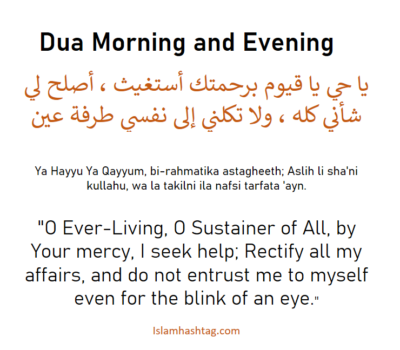
يَا حَيُّ يَا قَيُّومُ بِرَحْمَتِكَ أَسْتَغِيثُ
“Ya Hayyu Ya Qayyumu birahmatika astaghith”
“O Ever-Living, O Self-Sustaining Sustainer — in Your mercy I seek relief.” — Tirmidhi — Hasan
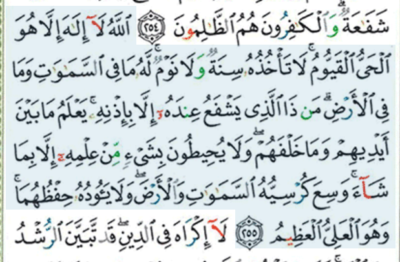
The Prophet ﷺ said: “Cling to: Ya Hayyu Ya Qayyum.” Imam Ibn al-Qayyim wrote at length about this dua in Al-Wabil as-Sayyib, noting that Al-Hayy (The Ever-Living) and Al-Qayyum (The Self-Sustaining) are among the greatest of Allah’s names — the ones upon which all of His other names rest.
Al-Qayyum means the One who sustains everything in existence. When you recite this, you are calling on the One whose sustaining power never sleeps, never tires, and cannot be overwhelmed by your need.
Read a fuller breakdown of this dua at Ya Hayyu Ya Qayyum bi rahmatika astaghith — meaning and benefits.
La Hawla wa La Quwwata Illa Billah — For Helplessness and Burden
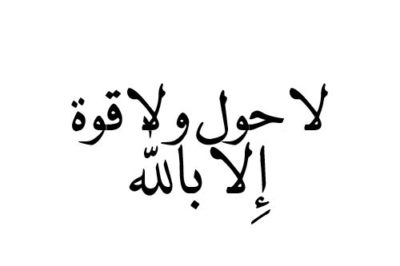
لَا حَوْلَ وَلَا قُوَّةَ إِلَّا بِاللَّهِ
“La hawla wa la quwwata illa billah”
“There is no power and no strength except with Allah.”
The Prophet ﷺ called this al-Kanz — a treasure from the treasures of Paradise. It is the acknowledgement that you cannot move, change, or endure anything except by His permission and power.
Ibn al-Qayyim explains that hawl refers to the ability to move from one state to another, and quwwah is the strength to carry that movement through. Saying la hawla wa la quwwata illa billah is surrendering both — the desire to change and the ability to change — to Allah alone.
Recite this when you feel exhausted by carrying a burden, when you don’t know how to move forward, and especially between other duas, as a constant background supplication.
See the full spiritual explanation: La Hawla Wala Quwwata Illa Billah — the treasure of Paradise.
Dua for Specific Types of Trial
For Financial Hardship
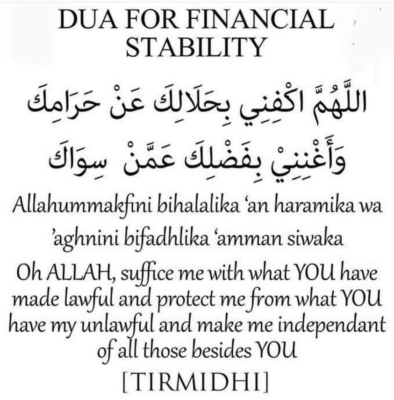
The Prophet ﷺ taught a specific dua that Anas ibn Malik رضي الله عنه reported for barakah in provision. See our full article: Dua for Financial Stability and 10 Ways and Dua for Rizq and Wealth.
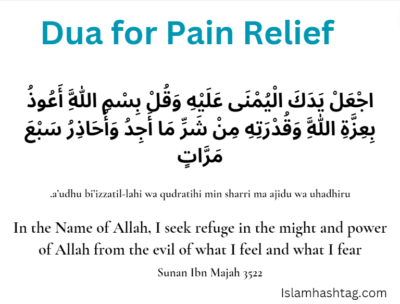
For Illness and Pain
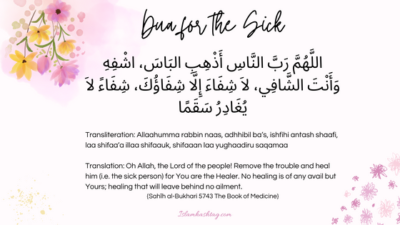
The Prophet ﷺ said: “Whoever visits a sick person who has not yet reached their time of death and says seven times: ‘As’alullaha al-‘Azim Rabbal ‘arshil ‘azim an yashfiyaka — I ask Allah the Mighty, Lord of the Mighty Throne, to cure you’ — Allah will cure them of that illness.” — Abu Dawud, Tirmidhi — Hasan
See also: Dua for the Sick and Shifa and A Powerful Dua for Pain Relief.
For Grief and Loss
اللَّهُمَّ إِنِّي أَعُوذُ بِكَ مِنَ الْهَمِّ وَالْحَزَنِ
“Allahumma inni a’udhu bika minal-hammi wal-huzn…”
This is the famous dua that the Prophet ﷺ taught for worry (hamm) and grief (huzn), along with six other things he sought refuge from. Read the complete dua with full analysis: Dua for Sadness, Depression, and All Worries.
For Times of Fear and Oppression
The dua of the oppressed — Hasbunallahu wa ni’mal wakeel — has already been mentioned. Additionally, see the duas compiled in: Duas for Protection from Evil.
When Someone Has Passed Away
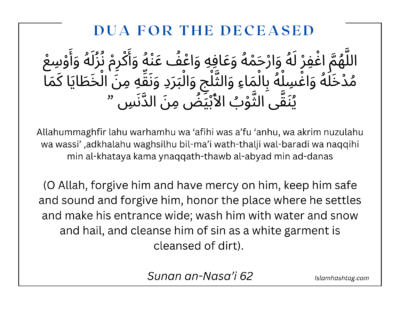
See: Dua at Funeral and Dua for the Deceased and Powerful Dua for Those Who Passed Away.
During Calamity and Disaster
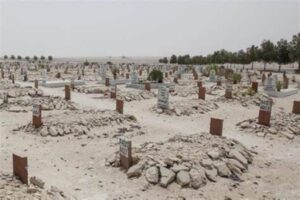
See the Sunnah acts at the time of any sudden calamity: Dua at the Time of Calamity.
The Conditions of an Accepted Dua
The scholars — drawing from the Qur’an, hadith, and the works of Imam Ibn al-Qayyim in Al-Wabil as-Sayyib — describe several conditions that elevate a dua from mere words to a supplication that is truly accepted:
1. Presence of heart (hudur al-qalb). The Prophet ﷺ said: “Know that Allah does not answer a dua from a heedless, inattentive heart.” — Tirmidhi. Make your dua with your full attention.
2. Avoiding prohibited earnings. The famous hadith of the man who raises his hands to the sky, yet his food is haram and his drink is haram — “How then will he be answered?” — Muslim. Guard your halal.
3. Certainty of response. Make dua with the conviction that Allah will answer — not as a wish, but as a certainty grounded in His promise.
4. Choose the blessed times. The last third of the night, between adhan and iqamah, during sujood, on Fridays between Asr and Maghrib, and the day of Arafah.
5. Face the qiblah and raise your hands. The Prophet ﷺ raised his hands when making du’a in moments of need, and the scholars consider this among the strongest etiquettes of supplication.
6. Begin with praise and salawat. Open with Alhamdulillah, send salawat upon the Prophet ﷺ, then ask.
Dua Is Always Answered — Just Not Always as We Expect
One of the most comforting hadiths on dua is this:
“There is no Muslim who calls upon Allah with a supplication that does not contain sin or a cutting of family ties, except that Allah will give him one of three things: He will answer his supplication immediately, or He will store it up for him in the Hereafter, or He will avert from him a harm similar to it.” — Ahmad — Sahih
When your dua feels unanswered, it is not being ignored. It is being received. Allah chooses the form of the answer — immediate relief, stored reward, or a harm averted that you may never even know about. Every sincere du’a reaches Allah. None is lost.
Complete Index of Dua Articles on IslamHashtag
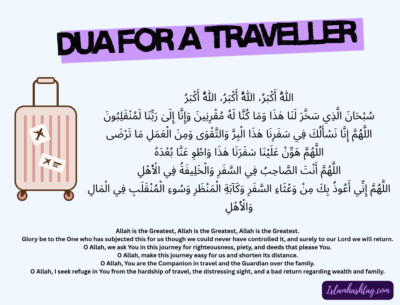
Below is our full library of dua resources — each article contains authentic Arabic text, transliteration, translation, source, and scholarly context:
(The existing article thumbnails and links from the original page can be embedded here as a styled grid — each one now follows genuine content the reader has engaged with)
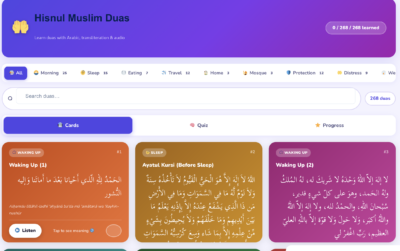
Read the complete Hisnul Muslim (Fortress of the Muslim) — all 268 authentic duas organised by occasion — at islamhashtag.com/learn-hisnul-muslim-dua/.
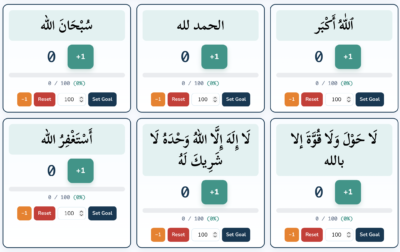
Track your daily adhkar and dua with our Digital Tasbih Counter.



























A Final Word
When Imam Ahmad ibn Hanbal was tested with imprisonment, beatings, and years of persecution over a theological question he would not abandon, he was asked: “What sustained you?”
He mentioned the dua. Not a specific dua — but the act of turning to Allah, again and again, in the darkness of that experience.
Trials do not last forever. Dua does not go unanswered. And the believer who emerges from difficulty with their imanintact — perhaps deepened, perhaps changed in ways they could not have asked for — is the one who made du’a not only to be freed from the trial, but to be guided through it.
May Allah ﷻ relieve every difficulty you are carrying right now. May He replace every loss with something better, every fear with tranquillity, and every closed door with an opening you did not expect.
Ameen, ya Rabb al-‘Alameen.